

Every year, companies spend millions on vulnerability scanners and still get breached. Not because the scanners are broken — because they're solving the wrong problem. Scanners find known vulnerabilities in known software. They match fingerprints against databases. They're very good at it. But the vulnerabilities that actually lead to breaches in 2026 — the ones in the OWASP Top 10 that cause real damage — are logic vulnerabilities: IDOR, privilege escalation, race conditions, authentication bypass, business logic flaws. No scanner finds those. Only a thinking attacker does.
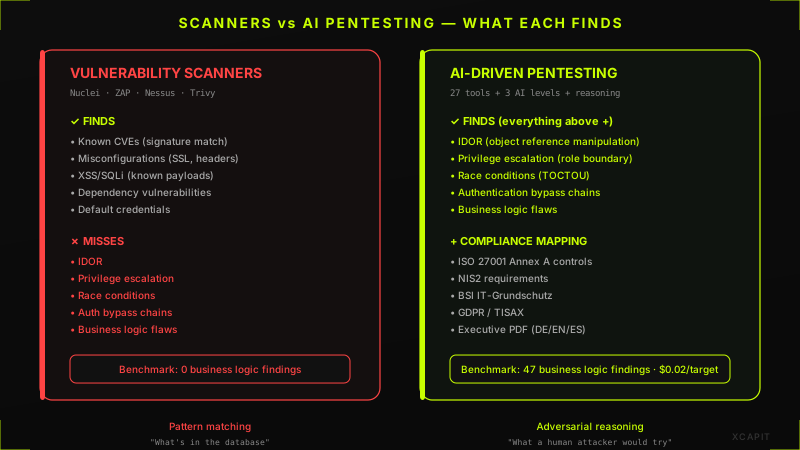
What scanners actually do (and do well)
Let's be precise about what vulnerability scanners are. Tools like Nuclei, OWASP ZAP, and Nessus work by sending known payloads to known endpoints and checking responses against known patterns. They maintain databases of thousands of CVEs, misconfigurations, and signature-based detections. They're fast, automated, and essential for any security program.
- Port scanning and service fingerprinting (nmap, masscan)
- Known CVE detection against version databases (Nuclei, Nessus)
- Common misconfigurations (SSL/TLS issues, open admin panels, default credentials)
- XSS and SQL injection via known payload databases (ZAP, sqlmap)
- Dependency vulnerability scanning (Trivy, Snyk)
This is genuinely valuable. If you're running a WordPress site with an unpatched plugin, a scanner will find it in seconds. If your TLS configuration is weak, it'll flag it. If there's a known RCE in your version of Apache, it's caught. Every company should run scanners regularly — they're table stakes.
What scanners fundamentally cannot do
Here's where the gap becomes dangerous. Scanners cannot reason about application logic. They don't understand what your application is supposed to do, so they can't determine when it does something it shouldn't. The vulnerabilities that actually get companies breached — the ones that appear in breach reports, incident post-mortems, and regulatory enforcement actions — are overwhelmingly logic flaws.
- IDOR (Insecure Direct Object Reference): User A can access User B's data by changing an ID in the URL. The scanner sees a valid HTTP 200 response and moves on — it doesn't know User A shouldn't see that data.
- Privilege escalation: A regular user can perform admin actions by manipulating request parameters. The scanner doesn't understand role boundaries.
- Race conditions: Two simultaneous requests exploit a time-of-check-to-time-of-use (TOCTOU) gap — doubling a withdrawal, applying a discount twice, bypassing a rate limit. Scanners don't send concurrent requests with adversarial timing.
- Authentication bypass: A password reset flow can be exploited by manipulating the token validation sequence. The scanner tests each endpoint in isolation — it doesn't chain them like an attacker would.
- Business logic flaws: An e-commerce checkout allows negative quantities, a loan application accepts contradictory inputs, a tariff calculator can be manipulated via API parameter injection. These are domain-specific — no signature database covers them.
The fundamental limitation is architectural: scanners are pattern matchers. They compare what they see against what they've seen before. Logic vulnerabilities are, by definition, novel — they depend on the specific business logic of the specific application. Finding them requires understanding intent, not matching patterns.
The manual pentest: effective but economically broken
Human pentesters find logic flaws. That's what they're trained to do. A senior pentester reads your application, understands its workflows, hypothesizes attack paths, and tests them. They find IDOR because they understand that User A's session shouldn't return User B's invoice. They find privilege escalation because they understand role boundaries. They find race conditions because they think adversarially about timing.
The problem is economics, not capability. A manual penetration test costs €15,000-50,000 per engagement. It takes 2-4 weeks to execute and another 1-2 weeks for the report. Most SMEs can afford one per year — if that. The result: your application is tested on day 1 and unmonitored for the remaining 364 days. Every code change, every new feature, every configuration update introduces potential vulnerabilities that won't be found until next year's engagement.
And there aren't enough pentesters. The global cybersecurity workforce gap is 3.5 million professionals. Even if every company wanted monthly pentests, there aren't enough humans to do them. The manual model doesn't scale.
The third option: AI that reasons like an attacker
What if you could combine the reasoning capability of a human pentester with the speed, cost, and frequency of a scanner? That's the question we set out to answer when we built xNinja — and the benchmark results surprised even us.
AI-driven pentesting works fundamentally differently from scanning. Instead of matching patterns, it reasons about application behavior. The AI agent receives the same information a human pentester would — endpoints, responses, authentication flows, API schemas — and plans attack strategies. It hypothesizes that if endpoint /api/users/123 returns data for user 123, changing it to /api/users/124 might return someone else's data. It tests it. If the response is 200 with different user data, it has found an IDOR — something no scanner would flag.
The approach uses three levels of intelligence, each building on the previous:
- Level 1 — Tool orchestration: 27 security tools (nmap, nuclei, ZAP, sqlmap, testssl, and 22 more) coordinated in an intelligent pipeline. The AI decides which tools to run based on what it discovers, not a fixed sequence.
- Level 2 — Adaptive testing: The AI analyzes tool outputs, identifies patterns, and generates hypotheses about business logic vulnerabilities. It tests for IDOR by manipulating object references, for privilege escalation by replaying requests with different session tokens, for race conditions by sending concurrent requests.
- Level 3 — Autonomous pentester: The AI plans multi-step attack chains, chains individual findings into exploitation paths, and generates executive narratives explaining the business impact of each vulnerability. It thinks like a senior pentester — not like a scanner with a bigger database.
The benchmark: 47 vs 0
We ran a controlled benchmark against four well-known targets including OWASP Juice Shop — a deliberately vulnerable application designed to test exactly these capabilities. The results:
- Nuclei: 0 business logic findings. Detected known CVEs and misconfigurations only.
- OWASP ZAP: 0 business logic findings. Detected XSS and injection via known payloads only.
- PentestGPT: 0 business logic findings. Single-LLM approach without integrated tool execution.
- xNinja (AI-driven): 47 business logic findings — including IDOR, privilege escalation, authentication bypass, and race conditions.
- Cost per target: xNinja $0.02 vs PentestGPT $21.90 — a 1,095x cost reduction.
The 47 findings weren't false positives. Each was verified against the known vulnerability catalog of the target applications. The AI found real vulnerabilities that real attackers would exploit — and that three other tools missed entirely.
The compliance multiplier: NIS2 changes the math
NIS2 (Directive (EU) 2022/2555) entered into force in October 2024 and requires regular security assessments — including penetration testing — for over 100,000 companies across the EU. The sectors are broad: energy, transport, health, digital infrastructure, manufacturing, food, waste management, and more. Companies in scope face fines of up to €10 million or 2% of global turnover.
For an SME with 200 employees in a regulated sector, the math before AI pentesting was brutal: €25,000 per annual pentest × compliance with NIS2 + ISO 27001 + possibly TISAX = multiple engagements per year = €50,000-100,000+ in security assessment costs alone. With AI-driven continuous pentesting: €588/year (PRO tier) with 50 audits per month, automatic compliance mapping to five EU frameworks, and PDF reports ready for the auditor. That's a 97.6% cost reduction — and it runs continuously instead of once a year.
What this means for your security program
AI pentesting doesn't replace your scanner or your annual pentest engagement. It fills the gap between them. Run your scanners for known CVEs — they're fast and essential. Bring in human pentesters for your most critical applications once a year. And run AI-driven pentesting continuously for everything else: every sprint, every deployment, every configuration change.
- Scanners: Run daily. Catch known CVEs, misconfigurations, and dependency vulnerabilities. Cost: free to low.
- AI pentesting: Run weekly or after every deployment. Catch business logic flaws, IDOR, privilege escalation, race conditions. Generate compliance reports automatically. Cost: €49-199/month.
- Human pentesting: Run annually on critical systems. Deep-dive into the most complex attack surfaces with human creativity and domain expertise. Cost: €15,000-50,000/engagement.
- The three layers complement each other. Each catches what the others miss. None alone is sufficient.
If your company needs to comply with NIS2, ISO 27001, BSI IT-Grundschutz, GDPR, or TISAX — or if you simply want to find the vulnerabilities that scanners miss before an attacker does — try xNinja. The first audit takes 10 minutes and costs less than a coffee.

Fernando Boiero
CTO & Co-Founder
Over 20 years in the tech industry. Founder and director of Blockchain Lab, university professor, and certified PMP. Expert and thought leader in cybersecurity, blockchain, and artificial intelligence.
Need a security partner you can trust?
Pentesting, ISO 27001, SOC 2 — we secure your systems.
You Might Also Like
Digital transformation for utilities: modernizing energy without replacing the core
A practical guide for utilities and energy companies: how to integrate SCADA, IoT, AI, tokenization, and cybersecurity to modernize operations without replacing critical systems.
Shadow AI, ISO 42001, and the New Boardroom Risk in Oil & Gas
Why directors of oil & gas operators are starting to treat unmanaged AI use as a duty-of-care issue — and what to do in the next 90 days.
ISO 42001: The New Question Regulators and Auditors Will Ask Your Utility
Why the first internationally certifiable AI governance standard matters more than it seems for the Latin American energy sector.