
Here is a fact that every CIO already knows but few will say out loud in a board meeting: your employees are already using AI. They're pasting customer data into ChatGPT from their personal phones. They're feeding contract clauses into Claude to summarize them. They're asking Gemini to draft responses to regulators. They're doing it without policy, without logging, without any governance whatsoever. And they're doing it because it makes them dramatically more productive — and because nobody gave them a sanctioned alternative.
The elephant in the room: your people already use AI without permission
In every enterprise we've worked with — utilities, financial services, government agencies — the pattern is identical. By the time the CIO decides to 'evaluate AI strategy,' between 15% and 40% of knowledge workers are already using consumer AI tools daily. Not for personal tasks — for work. Summarizing internal documents. Drafting customer responses. Analyzing data that includes PII, financial figures, or regulated information.
They're not doing it to be reckless. They're doing it because it saves them hours per week, and nobody offered them a governed alternative. The shadow AI problem is not a technology problem — it's a policy vacuum that employees fill with consumer tools because the enterprise failed to provide an answer fast enough.
The uncomfortable truth: banning AI doesn't work. Companies that try to block ChatGPT via firewall rules find that employees switch to mobile data. Policies that say 'don't use AI for work' are ignored at the same rate as policies that said 'don't use personal email for work' in 2010. The only viable strategy is to provide a governed alternative that is at least as good as the ungoverned one.
Three tensions pulling in opposite directions
Every enterprise we talk to is experiencing three simultaneous forces that seem contradictory — until you find the architecture that resolves all three at once.
Tension 1: "We can't NOT use AI"
The competitive pressure is real. Competitors are shipping AI-assisted products. Clients expect AI-powered support. Internal operations are measurably slower without AI augmentation. The board asks 'what is our AI strategy?' every quarter. Saying 'we're evaluating' stopped being acceptable twelve months ago.
Tension 2: "We can't use AI without governance"
An AI agent that miscalculates a utility tariff and sends it to 50,000 customers is a legal liability. An agent that cites a regulation that doesn't exist in a response to a regulator is a compliance failure. An agent that leaks PII because the prompt wasn't sanitized is a data breach under GDPR, LGPD, or local data protection law. The enterprise — not the model provider — carries the liability. And 'we have a log file, probably' is not an audit trail.
Tension 3: "We can't depend on a single vendor"
Locking into OpenAI alone means exposure to pricing changes (which have already happened), availability outages (which happen monthly), model deprecations (which happen quarterly), and geopolitical risk for companies operating under data sovereignty requirements. Meanwhile, local models (Llama, Mistral, Qwen via Ollama or vLLM) are now good enough for 60-70% of enterprise queries — but they require orchestration infrastructure to use effectively alongside cloud models.
Why current solutions don't resolve the triangle
Every existing category solves one edge of this triangle while leaving the other two exposed.
- ChatGPT Enterprise / Claude for Business: Secure chat for individual employees. Single-vendor lock-in. No custom agents, no on-prem option, no multi-LLM routing. Solves 'use AI' but fails on governance depth and vendor independence.
- Agent frameworks (LangChain, CrewAI, AutoGen): Developer tools for building agents in code. No product UI, no multi-tenant governance, no audit chain, no promotion gates. Requires a full engineering team to operate — not a product your IT team deploys.
- LLM gateways (LiteLLM, Portkey): Proxy layers that route requests across providers. Solve the multi-LLM routing piece. But they don't manage agents, don't provide RAG, don't offer audit chains, and don't deploy on-premise as a complete platform.
- Workflow platforms (n8n, Zapier AI): Orchestrate flows with AI steps. Not LLM-native. Multi-model support via custom nodes only. No audit chain, no agent versioning, no governance model.
- No single category covers: multi-LLM + custom agents + audit chain + on-prem + governance. That's the gap.
The architecture that resolves all three
After two years of building AI systems for regulated enterprises, we converged on an architecture that satisfies all three tensions simultaneously. It has five layers, and every layer is load-bearing — remove one and the system fails a real-world requirement.
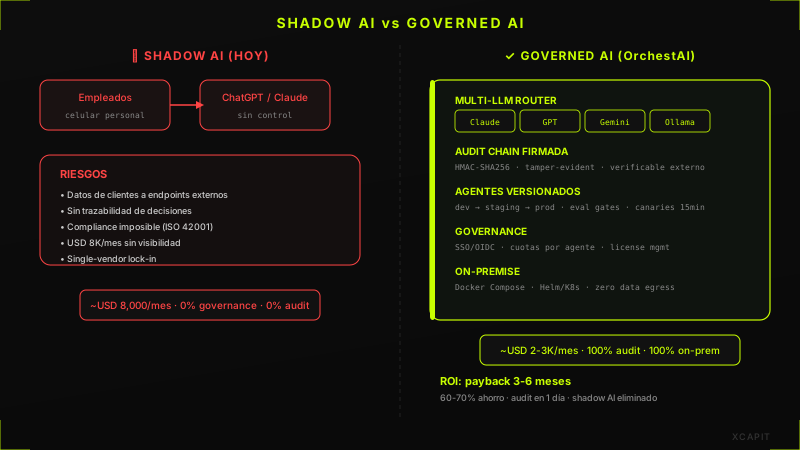
- Multi-LLM router with strategies: The platform connects to every major provider (Claude, GPT, Gemini) AND local models (Ollama, vLLM) simultaneously. IT defines routing strategies per agent: 'cheapest' sends to the lowest-cost model that meets quality thresholds; 'local-first' keeps data on-prem and only escalates to cloud for complex queries; 'preferred' pins to a specific model with automatic fallback if it's down. This eliminates single-vendor risk and cuts cost 60-70% by routing routine queries to free local models.
- Signed audit chain (HMAC tamper-evident): Every agent action — every prompt, every response, every tool call, every model selection decision — is hashed and chained. The chain is verifiable by any authorized third party without system access. An external auditor can confirm that no record has been altered, inserted, or deleted since creation. This satisfies ISO 42001 traceability requirements and the EU AI Act's mandate for high-risk system logging.
- Versioned agent catalog with promotion gates: Agents are created, tested, and promoted through environments (dev → staging → production) with evaluation gates. An agent only reaches production users if it passes regression tests and quality benchmarks. Continuous canaries run every 15 minutes to catch drift. If an agent degrades, it's automatically demoted. This is CI/CD for AI — not 'deploy and pray.'
- Per-agent cost quotas and observability: Every agent has monthly token budgets, cost alerts, and usage dashboards. The CFO can see exactly how much each use case costs. No more 'we spent $47,000 on OpenAI last month and we don't know why.' Granular attribution, not organizational lump sums.
- Full on-premise deployment: Docker Compose for simple setups, Helm chart for Kubernetes in enterprise environments. The platform runs entirely in the client's datacenter or private cloud. No data egress. No API calls to external services unless the routing strategy explicitly permits it. For regulated industries with data sovereignty requirements, this is non-negotiable.
The business case: a regional electric utility
To make this concrete, consider the economics for a regional electric utility — a profile representative of our first deployment environment.
- 1,500 employees, ~200 actively using AI for work (knowingly or via shadow AI)
- ~3,000 daily customer service interactions (tariff questions, outage reports, billing disputes)
- Use cases: automated response to technical queries, report generation, tariff analysis, internal support
Without a governed platform: estimated cloud AI spend of ~USD 8,000/month with zero visibility into what's being sent to which model. Compliance risk: impossible to pass ISO 42001 or equivalent local audits. Data risk: customer PII flowing to consumer AI endpoints without consent or logging.
With multi-LLM orchestration and local-first routing: 60-70% of queries route to on-premise models (free, no data egress). Only complex queries escalate to cloud providers. Cloud spend drops to ~USD 2,000-3,000/month. Audit chain passes external review in one day instead of weeks of manual log reconstruction. Per-agent quotas prevent cost surprises. Shadow AI becomes irrelevant because the governed alternative is faster and better.
Payback: 3-6 months against uncontrolled cloud spend — without counting the avoided cost of a compliance incident, a data breach, or a public misinformation event.
What a CIO should demand before adopting any AI platform
If you're evaluating platforms for enterprise AI adoption — whether ours or anyone else's — here are the six questions that separate production-grade governance from marketing slides.
- Can I deploy fully on-premise with zero data egress to external services? If the answer is 'cloud only' or 'hybrid with some egress,' that's a data sovereignty risk for any regulated industry.
- Is the audit trail independently verifiable? Not 'we have logs' — can an external auditor, without system access, cryptographically verify that no record was tampered with? HMAC chain or equivalent, not just a database table.
- Can I route the same query to different models based on cost, privacy, or availability policies? Single-model platforms are concentration risk. Multi-model without routing intelligence is just a proxy.
- Do agents go through promotion gates before reaching production users? If there's no eval pipeline, you're deploying untested AI to your operations. That's not 'agile' — it's reckless.
- Can I set per-agent cost ceilings and get alerts before budget overruns? Organizational-level spend tracking is too late. You need agent-level attribution to understand and control costs.
- Who carries the liability when an agent produces an incorrect output? If the platform vendor disclaims all responsibility and your enterprise has no audit trail, you're uninsured against AI-induced errors.
At Xcapit, we built OrchestAI to answer all six with 'yes' by architecture, not by roadmap promise. It's the platform we wished existed when our enterprise clients started asking for governed AI adoption — and it's now in active pilot with a regional utility.
If your enterprise is navigating the shadow-AI-to-governed-AI transition and you want to see the platform in action, let's schedule a 30-minute demo.

Fernando Boiero
CTO & Co-Founder
Over 20 years in the tech industry. Founder and director of Blockchain Lab, university professor, and certified PMP. Expert and thought leader in cybersecurity, blockchain, and artificial intelligence.
Ready to leverage AI & Machine Learning?
From predictive models to MLOps — we make AI work for you.
You Might Also Like
If everyone has Artificial Intelligence, where will the competitive advantage be?
AI is no longer a barrier to entry: today it is within reach of companies of every size. Why the difference is no longer about using AI, but about how it is used and the quality of the architecture that integrates it.
Will Artificial Intelligence replace developers? Why software engineering matters more than ever
AI automates code generation, testing and documentation, but it does not replace engineering. Why, as writing code becomes easier, the value of those who design architectures and understand the business goes up.
Innovating also means exploring: why companies need to build a culture of experimentation
When new AI tools appear practically every day, innovating no longer depends on adopting technology but on exploring, learning and experimenting continuously. How Xcapit Labs turns that exploration into business capability.