

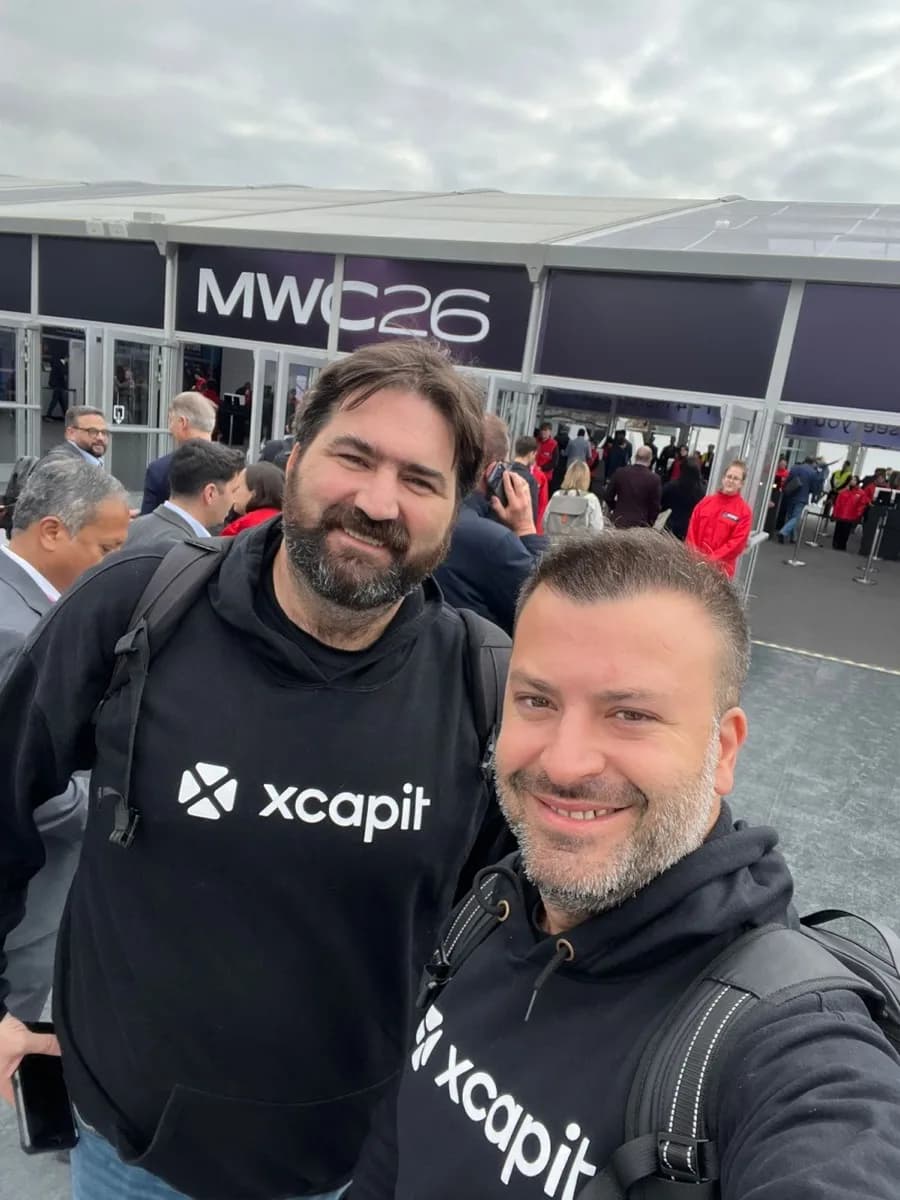
Barcelona, March 2026. Every year, the Mobile World Congress brings together the world's largest technology companies, the consultancies that define global strategic agendas, and the decision-makers who move entire industries. This year, the Xcapit team was there — and what we found wasn't more AI hype, but something far more important: a shift in mindset.
The leading consultancies — McKinsey, Accenture, Deloitte, BCG — converged on a message that is no longer speculative but operational: agentic AI has stopped being a technology promise and has become a business strategy. And companies that don't adopt it as such will fall behind.
In this article, we share the three lessons we consider most relevant for any company — regardless of size — evaluating how to integrate AI into their operations for real.
1. From Promise to Value Delivery
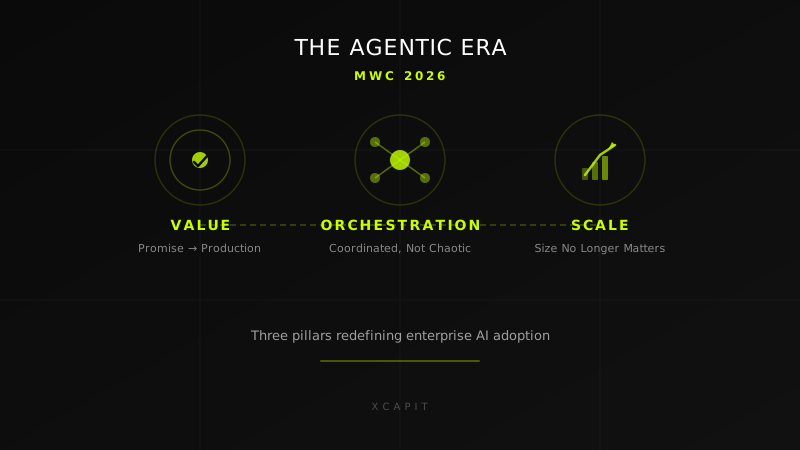
For the past three years, the AI conversation was dominated by awe: models that generate text, images, code. The demos were impressive. But at MWC 2026, the tone shifted dramatically. The question is no longer 'what can AI do?' but 'how much measurable value is it generating?'.
The companies leading AI adoption aren't the ones running the most models — they're the ones that can demonstrate clear ROI: reduced operational costs, accelerated processes, improved decision quality. The pilot that never reaches production doesn't count. The demo that doesn't become a metric is worthless.
At Xcapit, we live this firsthand. Our spec-driven development methodology was born from exactly this conviction: every AI agent we build has measurable success criteria defined before writing the first line of code. We don't build agents to impress — we build them to deliver value.
- 73% of AI pilot projects never reach production (source: consultancies at MWC 2026)
- Successful companies define value metrics before choosing the technology
- The difference between a demo and a product is production engineering — not the model
2. The Agentic Vision: Orchestration, Not Chaos
The second major consensus at MWC 2026 was that companies need to move from 'having agents' to 'having an agentic strategy'. The difference is enormous.
Many organizations today have multiple AI agents running across different departments: one for customer service, another for data analysis, another for content generation. The problem is these agents don't know each other. They duplicate work. They contradict each other. They compete for resources. They generate inconsistent information.
The agentic vision proposed by leading consultancies is that of a company where agents are orchestrated: they share context, follow a unified strategy, have clear roles, and amplify each other. It's not about adding agents — it's about designing a system.
This is exactly what we solve with ArgenTor, our multi-agent framework built in Rust. ArgenTor isn't just another orchestration framework — it's a platform where agents operate in isolated WASM sandboxes, share context through the MCP protocol, and have integrated human-in-the-loop approval workflows. Security and coordination aren't optional features — they're the architecture.
- An orchestrated enterprise has agents that collaborate, not compete
- The MCP protocol allows agents from different providers to share tools without friction
- Orchestration requires governance: who can do what, when, and with what approval
3. Size No Longer Matters: Agents as a Force Multiplier
This was perhaps the most powerful lesson from MWC 2026, and the one that should matter most to mid-sized and small companies.
Historically, competing with a large company required having large teams: more people, more infrastructure, more budget. Agentic AI changed that. A 50-person company with the right agents can operate with the speed, reach, and sophistication of a 5,000-person one.
Agents don't replace people — they magnify them. A 5-person sales team with agents that qualify leads, personalize proposals, and automate follow-up can compete with a 50-person team doing everything manually. A 10-person engineering team with agents that write tests, review code, and monitor production can maintain a platform that previously required 40.
This isn't theory. At Xcapit, we use our own agents for security analysis with 35 specialized agents that match the output of a full security team. And we do it at a fraction of the cost and time.
- AI agents are capacity multipliers, not people replacements
- Mid-sized companies can compete with corporations if they design their agentic strategy correctly
- The cost of not adopting agents is no longer 'falling behind' — it's losing the ability to compete
What This Means for Your Business
If you're reading this and your company is still evaluating 'whether' to adopt agentic AI, the window is closing. The conversation at MWC 2026 was no longer about whether agents work — it was about how to orchestrate them, how to measure their impact, and how to scale.
Our recommendations:
- Don't start with technology — start with the business problem you want to solve and the metrics you'll use to measure success
- Don't build isolated agents — design an agentic strategy where each agent has a clear role in a coordinated system
- Don't wait to be big — agents are your competitive advantage precisely because they amplify small teams
- Choose a partner that understands production, not just demos — the difference between a POC and a production system is engineering, not magic
At Xcapit, we build AI agents that go from concept to production. If you want to explore how an agentic strategy can transform your business, let's talk.

José Trajtenberg
CEO & Co-Founder
Lawyer and international business entrepreneur with over 15 years of experience. Distinguished speaker and strategic leader driving technology companies to global impact.
Ready to leverage AI & Machine Learning?
From predictive models to MLOps — we make AI work for you.
You Might Also Like
If everyone has Artificial Intelligence, where will the competitive advantage be?
AI is no longer a barrier to entry: today it is within reach of companies of every size. Why the difference is no longer about using AI, but about how it is used and the quality of the architecture that integrates it.
Innovating also means exploring: why companies need to build a culture of experimentation
When new AI tools appear practically every day, innovating no longer depends on adopting technology but on exploring, learning and experimenting continuously. How Xcapit Labs turns that exploration into business capability.
From requirements to discovery: why companies need to rethink the way they build technology
The model of handing a requirements document to a technical team is starting to show its limits. Why the real challenge is no longer executing a list of features, but understanding precisely the problem you are trying to solve.