Xcapit

Agriculture

Tokenized warrants and AgriFinance — built on rails the regulators are already comfortable with

We help depositories, cooperatives, fintechs, and trade finance companies in Latin America build the next generation of agricultural credit infrastructure: tokenized commodity warrants, on-chain attestations, and traditional finance integration.
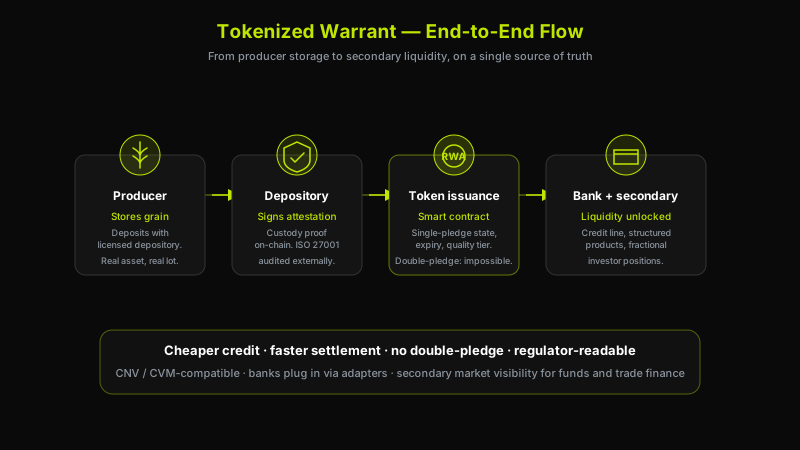
Reference diagram showing tokenized agricultural warrants flowing between farmer, depository, secondary market investors, and credit institutions on a blockchain infrastructure

What we hear from the sector

Three structural problems agricultural finance still hasn't solved

No secondary liquidity for warrants

Traditional warrants are hard to transfer. Without a liquid secondary market, the warrant trades at a discount to fair value — and that discount is the producer's cost.

Double-pledge risk priced into every loan

Without a single source of truth between depositories, banks, and regulators, the same lot of grain can be pledged twice. Every lender prices that risk in. The producer pays the premium.

Reconciliation cost embedded silently

Three independent ledgers reconciled by hand or batch. Every step introduces lag and error. The cost of running that reconciliation is paid by the producer through higher financing rates.

What we bring

An applied AI and blockchain partner that ships to production

Tokenized warrant infrastructure

Production-ready stack: custody attestation, smart-contract issuance, permissioned or hybrid settlement, regulator-grade integration. Built for CNV / CVM-style engagement.

AgriFinance smart contracts

Credit lines, structured products, and bundled exposures built on tokenized warrants. Composable with existing core banking. Designed for institutional adoption, not retail speculation.

Supply chain traceability

Verifiable credentials and IoT attestations for crops, livestock, and processed commodities. Ready for the regulatory layer (EUDR, certifications, ESG reporting) without rebuilding the chain.

Regulator and depository integration

Adapters, read-only nodes, and dashboards for CNV (Argentina), CVM (Brazil), and analogous bodies. Built with the regulator in the room — not after the fact.

Four pressures agricultural finance can no longer outrun

We map these in every discovery session with depositories, cooperatives, fintechs, and trade finance companies across the Southern Cone. None of them require a sophisticated attacker — they only require legacy operational infrastructure and a workforce that hasn't been given better tools.

Cost

Credit campaigns are slow and expensive

Mid-sized producers have real assets and can't turn them into working capital fast enough. Banks lend at rates that assume opacity. Cooperatives lend with concentration risk. The cost premium is paid by the producer who has the worst negotiating position.

Risk

Double-pledge risk priced into every loan

Without a single source of truth between depositories, banks, and regulators, the same lot of grain can be pledged twice. Every lender prices the risk in. The producer pays the premium silently for an operational problem that has a technical solution.

Reconciliation

Three ledgers reconciled by hand

Depository, bank, clearing house, regulator — each runs an independent ledger. Reconciliation is manual or batched, every entry introduces lag and error. The cost of running it is silently embedded in financing rates that producers and cooperatives never see broken out.

Window

The regulatory window is closing

Argentina's CNV and Brazil's CVM are clarifying tokenized financial instrument rules right now. The window between current ambiguity and final rules is the window in which early movers set the standards. Late entrants will integrate into someone else's stack.

Sources: CNV regulatory framework updates 2024–2026, CVM sandbox program reports, World Bank Latin America agricultural finance briefings, Xcapit field interviews with depositories and cooperatives in Argentina, Brazil, and Paraguay.

Tokenization + traceability as the cross-cutting layer

What changes when warrants and traceability are built on cryptographic infrastructure: every party reads from the same truth, transfers settle in minutes, double-pledge becomes mathematically impossible, and the regulator gets a real-time read-only view instead of waiting for batch reconciliation.

Digital trust pillars

Custody attestation · single-pledge enforcement · regulator-grade integration · verifiable credentials · ISO 27001 controls audited externally.

Applied AI for AgriFinance

  • Credit scoring with non-traditional data (yield, satellite, weather, soil)
  • Predictive yield modeling for collateral valuation
  • Fraud detection on warrant issuance and transfers
  • Customer service copilots for cooperatives and producer associations
  • Financial modeling assistants for structured products
  • Risk assessment for trade finance and structured exposures

Blockchain and RWA primitives

  • Tokenized warrants with single-pledge state at the protocol level
  • Custody attestations signed by licensed depositories
  • Secondary market settlement with sub-second finality
  • Smart-contract credit lines collateralized by warrant tokens
  • Regulator dashboards with real-time portfolio visibility
  • Verifiable credentials for producers, depositories, banks, and investors

Compliance posture: ISO 27001 + the AI governance layer

Tokenization without auditable controls is a liability, not an asset. Every smart contract we ship is reviewed externally; every custody attestation flow is documented under ISO 27001-aligned controls; every AI-assisted decisioning system is governed under ISO 42001 principles even when full certification is not yet required.

We work with your existing legal and compliance teams from the design phase, not after a regulator asks. The result is a program that the audit committee, the regulator, and the partner banks can all understand and validate.

Standards are not a checkbox — they are the discipline that lets you scale without rewriting the foundation.

Built in LATAM. Validated globally.

Argentina and Brazil are where the legal frameworks for warrants are oldest and where tokenization frameworks are crystallizing fastest. Building in this geography means engaging with the regulators that other regions will eventually mirror — and shipping production systems where the cost of error is measured in producer livelihoods, not slide decks.

Applied, not theoretical

We are not a research lab and we are not a consultancy that hands over PDFs. Our team ships production systems for regulated environments — RWA tokenization in production for energy, blockchain identity for international development, AI-assisted credit decisioning for fintech — and the same primitives apply here. Engagements end with software running, not a deliverable signed off.

Multinational consultancy
Xcapit
Posture
Generic playbook, retrofit per geography
Native LATAM regulatory engagement, designed for CNV / CVM
Time to first pilot
9–12 months scoping + delivery
4–6 months from kickoff to pilot live
Smart contract development
Outsourced to global blockchain partners
In-house, externally audited, production-grade
Regulator engagement
Through international compliance partners
Direct, in Spanish or Portuguese, with our own legal team
Skin in the game
Bills hourly regardless of outcome
Outcome-aligned engagements with milestone validation

Operational LATAM fit

Depository and bank integration

Adapters that map on-chain events to existing core banking and depository systems — no rip-and-replace required.

Native Spanish and Portuguese team

Discovery, design, delivery, and regulator engagement in the language your stakeholders work in every day.

ISO 27001 certified

Audited externally. Information security controls that match the expectations of regulated counterparties from day one.

Tokenization track record

RWA tokenization shipped in production for the energy sector with provincial government. The patterns translate directly.

We build for the regulator in the room — because by the time the regulator asks, the right answer is already running in production.

Discovery-first — we earn the architecture before we write code

Engagement starts with understanding what you actually need, not selling what we already built. Four steps from first conversation to production system, designed so the program is defensible to your audit committee, your regulator, and your partner banks at every step.

1

Discovery

Understand the business, the regulator, the existing infrastructure. Define the smallest pilot that proves the architecture without committing to scale prematurely.

2

Architecture

Design the technical stack, governance, integration points, and regulator engagement plan. Externally reviewable from day one.

3

Pilot

Build the pilot end-to-end with one product line and one customer relationship. Validate the integration, the audit posture, and the user experience.

4

Scale

Extend to multiple counterparties, integrate with additional banks, and onboard secondary market participants. Production from day one of pilot.

We share rough budgets and timelines transparently at the discovery phase. No surprise change requests.

Why work with Xcapit on AgriFinance and tokenized warrants

  • RWA tokenization patterns running in production for energy infrastructure
  • Native CNV and CVM regulatory engagement — Spanish, Portuguese, in person
  • ISO 27001 certified, ISO 42001 aligned for AI-assisted decisioning
  • Smart contract development in-house with external audit pipeline
  • Applied AI for credit scoring with non-traditional data, proven in fintech
  • Outcome-aligned engagement model with milestone validation, not hourly billing

Questions agribusiness leaders ask us

Is the regulatory framework actually ready for tokenized warrants in Argentina and Brazil?
The legal frameworks for warrants are decades old (Argentina Law 9.643, Brazil Law 11.076). The crypto-asset regulatory frameworks (CNV in Argentina, CVM in Brazil) are still evolving but are explicitly open to tokenized financial instruments under sandbox and pilot programs. The window between current ambiguity and final rules is exactly when early movers set the standards. We work with you and your legal team to engage regulators from the design phase, not after.
Will banks and traditional depositories actually integrate with this?
Yes, and they're the ones asking for it most. The tokenization stack solves real cost problems for depositories (reconciliation), for banks (collateral verification), and for trade finance (liquidity). We design integration adapters that map on-chain events to existing core banking and depository systems, so the institutional plumbing doesn't need to be rebuilt.
Do you deploy this in production or just advise?
We deploy. Our engagement combines a build layer (production smart contracts, custody attestation services, regulator-grade integration) with an advisory layer (regulatory engagement, governance framework, audit support). We're an applied partner, not a consulting firm — and we've built RWA tokenization patterns in production for the energy sector already.
How does this compare to traditional warrants? Do we have to replace what works?
No replacement. Tokenized warrants are a parallel infrastructure that plugs into the existing legal framework. The same warrant law applies, the same depositories operate, the same banks lend. What changes is the speed of settlement, the prevention of double-pledge at the protocol level, and the cost of reconciliation. The traditional infrastructure can continue operating in parallel for as long as makes sense.
What's the realistic timeline and cost to launch a tokenized warrant program?
A focused pilot — one depository, one product line, one quarter of trades — can be live in 4 to 6 months from kickoff. Scaling to production and integrating multiple counterparties takes another 6 to 12 months. The cost is dominated by integration and regulatory engagement, not by smart contract development. We share rough budgets transparently at the discovery phase.

Let's design the program before someone else sets the standard

If you're a depository, cooperative, fintech, or trade finance company looking at tokenized agricultural credit, the first conversation costs you nothing and gets you a clear next step.

Or use the contact form