Xcapit

Mining

Verifiable traceability is the access requirement for the markets that pay the premium

We help mining operators in Argentina, Chile, Peru, and Brazil build the traceability and ESG infrastructure that EU and US buyers — and the regulators behind them — increasingly require. Verifiable credentials, on-chain attestations, IoT integration, and ISO-aligned governance.
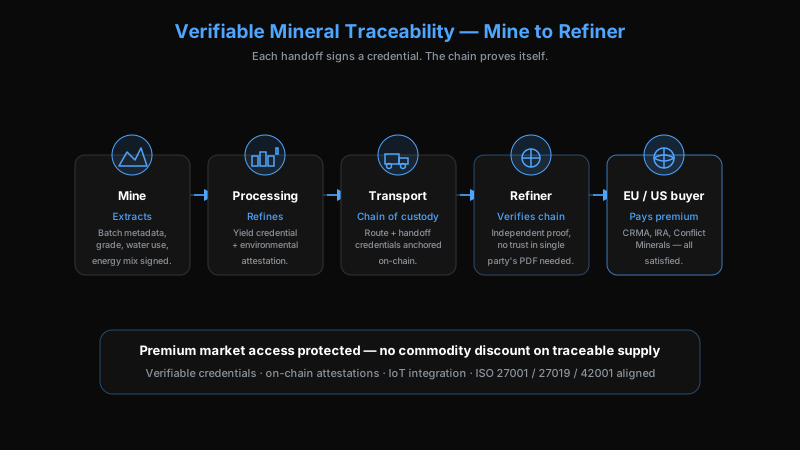
Reference diagram showing the lithium supply chain from mine to refiner, with verifiable credentials and on-chain attestations at each step

What we see in the sector

Three pressures the next 18 months will not forgive

PDF-based ESG documentation no longer survives due diligence

EU battery manufacturers and US automotive OEMs do not accept signed PDFs anymore. The chain has to be independently verifiable. Operators with paper-based documentation lose the premium segment without realizing it.

OT-IT convergence created a new attack surface

Mining control rooms, SCADA, and instrumented sensors are increasingly connected. ISO 27019 was written for OT security but didn't anticipate today's shadow AI and integration patterns. Most operators have the gap and don't know it.

Premium market access is closing for non-traceable supply

EU CRMA, EU Conflict Minerals Regulation, and US IRA battery sourcing rules each take a different angle but converge on the same requirement. Operators without verifiable traceability sell at commodity discount — or sell to intermediaries who do the traceability for them.

What we bring

An applied AI partner with skin in the operational game

Verifiable credentials at every handoff

Mine, processing plant, transport, port, refiner — each party signs a cryptographic credential for what they can prove. The chain verifies itself without faith in any single party's statement.

On-chain attestations for high-stakes events

Production batches, environmental readings, third-party audit results, ESG events — anchored to a public or permissioned blockchain as a tamper-evident timestamp service. The chain answers the regulator's questions without ambiguity.

IoT attestations from the field

Water, energy, air, dust, brine pumping — measured by instrumented sensors with cryptographic attestations of device identity and reading integrity. Audit without needing access to the raw sensor stream.

ISO 27001 + 27019 + 42001 alignment

The three-standard stack that sets the governance floor for any operator running AI in or adjacent to OT. We share the path because we are walking it ourselves — ISO 27001 certified, aligned with 27019 and 42001.

Three pressures the next 18 months will not forgive

We map these in every discovery session with operators in Argentina, Chile, Peru, and Brazil. The window for verifiable traceability infrastructure is open right now and closing fast — buyers, regulators, and insurers are all converging on the same operational requirement.

Market access

PDF documentation no longer survives due diligence

EU battery manufacturers and US automotive OEMs do not accept signed PDFs anymore. The chain has to be independently verifiable. Operators with paper-based documentation lose the premium segment without realizing it — buyers route around them silently.

Security

OT-IT convergence created a new attack surface

Control rooms, SCADA, and instrumented sensors are increasingly connected. ISO 27019 was written for OT security but didn't anticipate today's shadow AI patterns. Most operators have the gap and don't know it — until an audit or an incident makes it visible.

Regulation

Premium markets close for non-traceable supply

EU CRMA, EU Conflict Minerals Regulation, and US IRA battery sourcing rules each take a different angle but converge on the same requirement. Operators without verifiable traceability sell at commodity discount — or sell to intermediaries who do the traceability for them and keep the margin.

Window

Competitors are already 18 months in

Australian lithium projects already have traceability infrastructure. Chinese refiners are integrating. North American projects are funded specifically on IRA compliance. LATAM operators that wait will arrive to a market where traceability is the table stakes and they have nothing to show.

Sources: EU CRMA implementation timelines, US IRA Section 30D guidance, OECD Due Diligence Guidance reviews, Xcapit field interviews with lithium and copper operators in the Southern Cone.

Verifiable traceability as the cross-cutting layer

The traceability stack and the OT-AI governance stack share infrastructure. Verifiable credentials prove provenance of minerals — and the same credentials prove provenance of model outputs influencing operational decisions. ESG, OT security, and AI governance become one connected system rather than three separate budgets.

Digital trust pillars

Verifiable credentials at every handoff · on-chain attestations for high-stakes events · IoT integrity at the field · regulator-grade audit posture · ISO 27001 / 27019 / 42001 aligned.

Applied AI for mining operations

  • Ore grade estimation with reduced sampling cycle time
  • Predictive maintenance for crushers, conveyors, and pumps
  • Safety analytics for high-risk operations and tailings
  • ESG anomaly detection across environmental sensor streams
  • Operational copilots for shift supervisors and control room operators
  • Dust, water, and air quality monitoring with attested readings

Blockchain and traceability primitives

  • Verifiable credentials signed at mine, processing, transport, port, refiner
  • On-chain attestations for production batches and ESG events
  • IoT data digests anchored as tamper-evident timestamps
  • Royalty and revenue distribution with auditable disbursement
  • Certificates of origin compliant with CRMA, IRA, Conflict Minerals
  • Conflict-free declarations verifiable independently by buyers

Compliance posture: ISO 27001 + 27019 + 42001

Three standards converge on the operational profile a modern mining operator needs. ISO 27001 protects information assets. ISO 27019 extends control to the OT environment — control rooms, SCADA, instrumented sensors. ISO 42001 governs the AI Management System that increasingly participates in operational decisions.

We are ISO 27001 certified and operate aligned with ISO 27019 and ISO 42001. We share the path because we are walking it ourselves, not selling a certification we don't have.

An operator with 27001 and 27019 but no 42001 has secured the data and the OT — and left the AI-assisted decisions ungoverned. The three together is the modern bar.

Built in LATAM. Validated globally.

The lithium triangle, the Andean copper belt, and Brazil's critical materials portfolio sit in our home geography. Building here means engaging with the operators, regulators, and academic partners that will set the regional standards — and shipping production systems with operational discipline rather than slideware.

Applied, not theoretical

We are not a research lab and we are not a consultancy that hands over PDFs. Our team ships production systems for regulated environments — verifiable credentials at scale for international development, RWA tokenization for energy, AI for safety-critical fintech — and the same primitives apply directly to mineral provenance. Engagements end with software running, not a deliverable signed off.

Multinational consultancy
Xcapit
Posture
Generic ESG playbook, retrofit per geography
Native LATAM engagement, designed with operators and academic partners
Time to first pilot
9–12 months scoping + delivery
4–6 months from kickoff to pilot live with one customer relationship
Verifiable credentials development
Outsourced to global blockchain partners
In-house, externally audited, production-grade
OT-adjacent integration
Treated as IT project, OT teams brought in late
OT-aware from day one, ISO 27019 informs the design
Skin in the game
Bills hourly regardless of outcome
Outcome-aligned engagements with milestone validation

Operational LATAM fit

Site visits and field engagement

Argentina, Chile, Peru, Brazil — we travel to your operations. ESG, IT, OT, legal, and commercial in the same room from discovery onwards.

Native Spanish and Portuguese team

Discovery, design, delivery, and regulator engagement in the language your stakeholders work in every day.

ISO 27001 certified, 27019 and 42001 aligned

The three-standard stack that matches what EU and US buyers expect from a serious supplier — and we operate it ourselves.

Verifiable credentials track record

Production deployments of cryptographic identity and traceability infrastructure for international development. The primitives translate directly to mineral provenance.

We design with the buyer in the room — because the EU battery manufacturer and the US OEM are the ones writing the procurement contract, and their requirements should drive the architecture, not your assumptions.

Discovery-first — we earn the architecture before we write code

Engagement starts with understanding what your buyers actually require, what your existing systems already produce, and what gap you actually need to close. Four steps from first conversation to production traceability — built so the program defends itself to buyers, regulators, and JV partners at every step.

1

Discovery

Understand the existing ESG documentation, the buyer requirements, the OT integration constraints. Define the smallest pilot that proves the architecture.

2

Architecture

Design the credentialing model, the on-chain anchoring strategy, the IoT integration, and the customer-facing verification UX. Externally reviewable from day one.

3

Pilot

Build the pilot end-to-end with one product line and one customer relationship. Validate buyer acceptance, regulator readability, and operational integration.

4

Scale

Extend to additional product lines, integrate JV partners, onboard buyers as verifiers. Production from day one of pilot.

We share rough budgets and timelines transparently at the discovery phase. No surprise change requests.

Why work with Xcapit on mineral traceability and ESG infrastructure

  • Verifiable credentials and cryptographic identity at production scale (UNICEF, energy)
  • ISO 27001 certified, ISO 27019 and 42001 aligned
  • OT-aware engineering — we don't put models inside OT unsupervised
  • Buyer-side engagement in Europe and North America for procurement alignment
  • Spanish and Portuguese native team for in-region operational delivery
  • Outcome-aligned engagement model with milestone validation, not hourly billing

Questions mining executives ask us

Is mineral traceability really a requirement today, or a 2030 conversation?
Today. The EU Critical Raw Materials Act, Conflict Minerals Regulation, and US Inflation Reduction Act battery sourcing rules are already in effect or in their final compliance windows. EU battery manufacturers and US automotive OEMs are setting traceability requirements in their procurement contracts now. Operators without verifiable traceability are already losing premium market access — they may not realize it because buyers route around them silently.
Can blockchain-based traceability integrate with our existing ESG reporting and ERP systems?
Yes. The blockchain layer is not a system of record — it's a tamper-evident timestamp service. The data lives in your existing systems (ESG reporting, ERP, environmental monitoring), and a cryptographic digest goes on-chain. Adapters map between your existing infrastructure and the on-chain layer. We design the integration so your ESG and IT teams aren't doing double work.
How does this address shadow AI and OT-IT security at the same time?
The traceability stack and the AI governance stack share infrastructure. Verifiable credentials prove provenance of data; the same credentials prove provenance of model outputs that influence operational decisions. ISO 27019 and ISO 42001 stack together with the traceability program, so you address ESG, OT security, and AI governance as one connected system rather than three separate budgets.
We work with multiple JV partners — does this require all of them to adopt the same stack?
Not at the outset. Verifiable credentials are interoperable by design — each party signs only for what they control. JV partners that adopt the stack later can issue credentials retroactively. The operator that builds first sets the technical lingua franca that the partners eventually adopt.
What's a realistic timeline to pilot and scale this?
A focused pilot — one product line, one customer relationship, one quarter of shipments — can be live in 4 to 6 months from kickoff. Scaling to a full production line and multiple customers takes another 6 to 12 months. The technical work is mature; the timeline is dominated by integration with internal systems and customer-side acceptance testing.

Let's build the traceability program before buyers start routing around you

If you're a lithium, copper, or critical-minerals operator looking at EU or US premium market access, the first conversation costs you nothing and gets you a clear next step.

Or use the contact form