

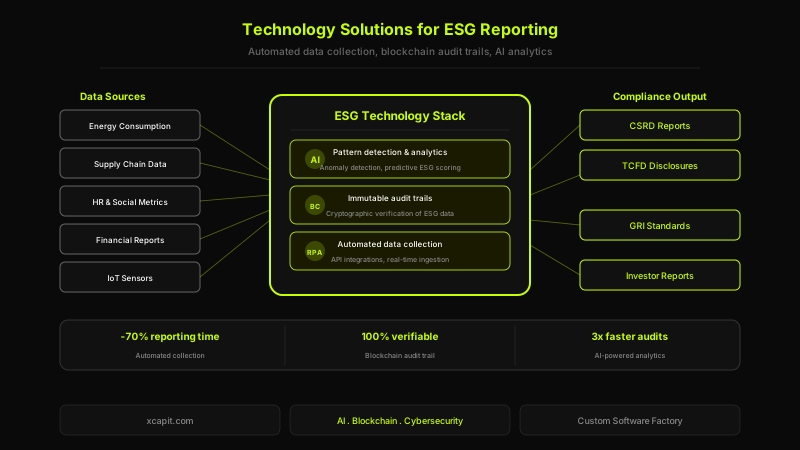
When I speak with enterprise leaders about ESG reporting, the conversation usually starts with frustration. They are drowning in spreadsheets, chasing data across departments, manually aggregating metrics that should flow automatically, and producing reports that satisfy auditors but provide little strategic value. The compliance deadline arrives, the team scrambles for six weeks, the report is filed, and everyone goes back to operating without the insights that the ESG data should be providing year-round.
This is not a people problem — it is a technology problem. Most companies are attempting to meet 2026 reporting requirements with 2015 processes: email-based data collection, spreadsheet-based aggregation, and manual verification that is expensive, slow, and error-prone. The regulatory environment has evolved dramatically — the EU's CSRD, the TCFD recommendations, the GRI Universal Standards, the ISSB frameworks — but the technology infrastructure at most companies has not kept pace. The gap between reporting requirements and reporting capabilities is where technology solutions create the most value.
The ESG Reporting Challenge
The core challenge of ESG reporting is that the data comes from everywhere. Environmental metrics require data from energy management systems, fleet tracking, supply chain partners, waste management providers, and facility operations. Social metrics require data from HR systems, employee surveys, community engagement records, and supply chain labor audits. Governance metrics require data from board management systems, compliance platforms, risk management tools, and regulatory filings. No single system contains all of this data, and in most organizations, these systems were not designed to share information with each other.
The result is that ESG teams spend 60-70% of their time on data collection and aggregation — the least valuable activities in the reporting process — and 30-40% on analysis, verification, and strategic interpretation — the activities that actually produce value. Technology solutions should invert this ratio: automate collection and aggregation so that human expertise is focused on interpretation, strategy, and action.
Adding to the complexity, the regulatory landscape itself is converging but not yet unified. The CSRD requires European Sustainability Reporting Standards (ESRS). The TCFD focuses on climate-related financial disclosures. The GRI provides the broadest stakeholder-oriented framework. The ISSB aims to create a global baseline. Companies operating across multiple jurisdictions may need to satisfy several of these frameworks simultaneously — which means their data infrastructure must be flexible enough to produce reports in multiple formats from the same underlying data.
Automating ESG Data Collection
The foundation of any ESG technology solution is automated data collection. This means building integrations that pull data directly from operational systems — energy management platforms, HR information systems, supply chain management tools, financial systems — rather than relying on manual extraction and re-entry. The technology for this is well established: API integrations, ETL pipelines, and IoT sensor networks can capture the vast majority of ESG-relevant data automatically and in near-real-time.
- Energy and emissions data: Direct integration with utility billing systems, smart meters, and building management systems provides continuous, granular energy consumption data. For Scope 2 emissions, real-time grid carbon intensity data enables location-based and market-based calculations without manual intervention.
- Supply chain data: API integrations with procurement systems, logistics platforms, and supplier management tools capture Scope 3 data at the transaction level. Supplier sustainability questionnaires can be digitized and automated, with responses feeding directly into the reporting database.
- Social and workforce data: HR system integrations capture diversity, equity, and inclusion metrics, training hours, safety incidents, and employee satisfaction data. These integrations must be designed with data privacy regulations in mind — GDPR, LGPD, and similar frameworks apply to employee data used for ESG reporting.
- Governance data: Board management platforms, compliance tracking tools, and risk management systems provide structured data on governance practices, policy adherence, and risk exposure.
The custom software challenge here is integration. Every company's system landscape is different, and the integrations required to capture ESG data automatically depend entirely on which operational systems are in place. This is where a custom development approach becomes essential — building the specific connectors and data pipelines that your system landscape requires, rather than relying on a generic ESG platform that may integrate with some of your systems but not others.
Blockchain for Audit Trails and Verification
One of ESG reporting's hardest problems is verification. How do auditors — and ultimately stakeholders — know that the reported data is accurate and has not been manipulated? Traditional verification relies on auditing firms that examine samples of data and supporting documentation, a process that is expensive, time-consuming, and inherently limited by sampling rather than comprehensive review.
Blockchain technology offers a structural solution to this problem. When ESG data points are recorded on a blockchain at the time of collection — not at the time of reporting — the result is a cryptographically secured, timestamped, immutable record that auditors can verify independently. The data cannot be altered retroactively to improve reported performance. The timestamp proves when the measurement was taken. The cryptographic hash ensures the data has not been modified between collection and reporting.
This is particularly valuable for Scope 3 emissions data, which involves supply chain partners whose data is outside the reporting company's direct control. A blockchain-based system where suppliers record their emissions data directly — verified by IoT sensors where possible — creates a shared source of truth that both the reporting company and its auditors can trust. At Xcapit, our blockchain development expertise allows us to design audit trail systems that integrate seamlessly with existing data collection infrastructure, providing the verification layer that makes ESG data genuinely trustworthy.
AI-Powered ESG Analytics
Once data collection is automated and verification is built into the infrastructure, AI unlocks the strategic value of ESG data. Pattern detection algorithms identify trends and anomalies that manual analysis would miss — a gradual increase in energy consumption per unit of revenue, a correlation between employee satisfaction scores and safety incidents, a supplier whose emissions profile is inconsistent with their reported sustainability practices.
Predictive analytics enable forward-looking ESG management rather than backward-looking reporting. Machine learning models trained on historical data and external factors can forecast emissions trajectories, predict where the company will stand relative to its targets, and identify the interventions that would have the greatest impact. This transforms ESG from an annual reporting exercise into a continuous management capability that informs operational decisions throughout the year.
Natural language processing capabilities are also increasingly valuable for ESG. AI systems can analyze regulatory texts across multiple jurisdictions and languages to identify reporting requirements and gaps. They can process unstructured data — news articles, social media mentions, NGO reports — to identify emerging ESG risks in the supply chain before they become compliance or reputational issues. And they can generate draft disclosures that compliance teams review and refine, rather than writing from scratch.
Navigating Compliance Frameworks
The practical reality for most companies is that they need to satisfy multiple reporting frameworks simultaneously. A European company may need CSRD-compliant ESRS disclosures for regulators, TCFD-aligned climate disclosures for investors, and GRI-referenced reports for broader stakeholders. A company with global operations may also need to comply with the SEC's climate disclosure rules in the United States and the ISSB standards being adopted in various jurisdictions.
- CSRD / ESRS: The most comprehensive regulatory framework, requiring detailed disclosures across environmental, social, and governance dimensions. Applies to all large EU companies and non-EU companies with significant EU operations. Requires limited assurance initially, moving to reasonable assurance — making data quality and verification infrastructure essential.
- TCFD: Focused specifically on climate-related financial risks and opportunities. Structured around four pillars: governance, strategy, risk management, and metrics and targets. Increasingly required by financial regulators and institutional investors globally.
- GRI: The broadest voluntary framework, designed for stakeholder communication rather than financial materiality alone. GRI's universal standards require materiality assessment and topic-specific disclosures across all ESG dimensions.
- ISSB (IFRS S1 and S2): The emerging global baseline for investor-focused sustainability reporting. S1 covers general sustainability disclosure, S2 covers climate-specific disclosure. Being adopted or referenced by jurisdictions worldwide.
The technology solution to multi-framework reporting is a unified data model that captures ESG metrics at their most granular level and maps them to the specific disclosure requirements of each framework. This approach — collect once, report many — eliminates the duplication and inconsistency that plague organizations managing separate reporting streams for each framework. At Xcapit, our approach to ESG technology solutions combines our AI development capabilities for analytics and automation with our blockchain expertise for verification, building integrated platforms that serve compliance, strategy, and stakeholder communication simultaneously.

Antonella Perrone
COO
Previously at Deloitte, with a background in corporate finance and global business. Leader in leveraging blockchain for social good, featured speaker at UNGA78, SXSW 2024, and Republic.
You Might Also Like
Verifiable AI Agents: Why Enterprise Trust Requires Blockchain-Grade Audit Trails
Autonomous AI agents are making decisions faster than our governance can keep up. This article argues that enterprise adoption won't scale without verifiable identity, provenance, and audit trails — and why blockchain is the natural substrate to deliver them.
Sustainability Metrics for Tech Companies: A Practical ESG Reporting Guide
How technology companies can measure, report, and genuinely improve their environmental and social impact — covering ESG frameworks, key metrics, blockchain for transparency, greenwashing risks, and a practical implementation roadmap.
Shielding credit risk: how Web3 technology simplifies bank and guarantee society processes in agriculture
Autonomous collateral locking, real-time value monitoring and guaranteed algorithmic execution: the three tools reshaping risk analysis in agricultural credit.