

The Regulatory Picture Just Got Sharper
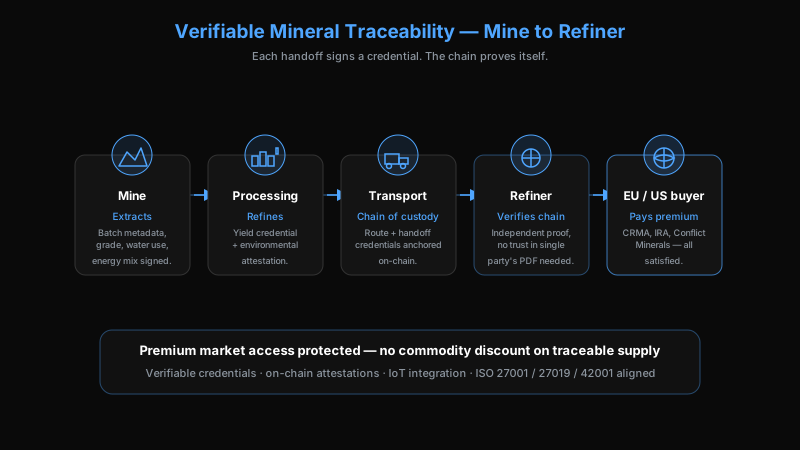
Three regulations are converging on the same point: if you want to sell minerals into the high-margin segments of the EU and US markets, you have to prove where they came from, how they were extracted, and that the conditions at the mine site meet a defined standard. The EU Critical Raw Materials Act, the EU Conflict Minerals Regulation, and the US Inflation Reduction Act's battery sourcing rules each take a different angle, but the operational requirement is the same: verifiable, auditable, end-to-end traceability.
Lithium is on every critical materials list. So is copper, cobalt, nickel, manganese. Argentina has all of them in its export portfolio. Chile, Peru, and Brazil have the rest. The Latin American mining sector is sitting on exactly the resources the energy transition needs — but those resources only command premium pricing if they arrive with the documentation.
Why the Current Documentation Stack Doesn't Work
Most operators today document responsible sourcing through a combination of ICMM principles, CRAFT or IRMA self-assessments, third-party audits, and a stack of PDFs that gets emailed to customers on request. The system technically meets some compliance thresholds. It does not survive a serious due-diligence review from a EU battery manufacturer or a US automotive OEM.
The reason is structural: PDF documentation is not verifiable at scale. An EU buyer cannot independently confirm that a specific shipment of lithium carbonate came from a specific mine that operated under specific conditions on a specific date. The buyer relies on the operator's signed statements, the auditor's signed statements, and a chain of trust that breaks at every handoff. When the regulator asks the buyer to prove the chain, the buyer can only show paper.
What Verifiable Traceability Actually Looks Like
The stack that solves this is not exotic. It's a combination of three building blocks that are all production-ready in 2026.
Verifiable Credentials at Every Handoff
Each party in the chain — mine, processing plant, transport, port, refiner — signs a cryptographic credential for the specific actions they took on a specific shipment. The credential is verifiable independently by any party with the issuer's public key. No need to trust the operator's statement on faith. The chain proves itself.
On-Chain Attestations for the High-Stakes Events
Production batches, environmental monitoring readings, third-party audit results, and ESG-relevant events get anchored on a public or permissioned blockchain. The blockchain is not the system of record — it's the tamper-evident timestamp service. When a regulator or buyer asks 'did this happen on this date and was the data unchanged afterwards', the chain answers without ambiguity.
IoT Attestations From the Field
Water consumption, energy mix, air quality, dust monitoring, and brine pumping rates get measured by instrumented sensors and submitted with cryptographic attestations of the device identity and reading integrity. The data goes into the operator's environmental system, and a digest goes on-chain. Auditors can verify the chain without needing access to the raw sensor stream.
The Three Standards Stack for Mining
The Argentine Lithium Opportunity Window
Argentine lithium production is scaling. Salta, Jujuy, and Catamarca are seeing multi-billion-dollar capex commitments from international operators and domestic players alike. The question every one of those projects has to answer in the next 18 months is: where does the output go, and at what discount versus a fully-traceable comparable?
Australian lithium projects already have or are building traceability infrastructure. Chinese refiners are integrating with traceability platforms to maintain access to European OEM customers. North American projects are funded specifically on the premise of meeting IRA sourcing requirements. If Argentina exports without traceability, it exports to the spot market at commodity pricing — not to the premium qualified-supplier segments.
What an Operator Should Do in 2026
- Map the chain. Identify every handoff from extraction to export. Identify which handoffs are within your control and which depend on third parties.
- Inventory the existing documentation. ICMM, CRAFT, IRMA, third-party audits — what already exists that can be reissued as verifiable credentials.
- Run a verifiable credentials pilot on one product line, one customer, one quarter. Prove the integration before scaling.
- Engage with at least one premium customer (EU battery maker, US automotive OEM, refiner) on what they need to see. Their requirements should drive the design, not your assumptions.
- Align internally. ESG, IT, OT, legal, and commercial all need to be in the same room when this gets designed. It's not an IT project — it's a market-access program with an IT layer.
The Closing Frame
Mineral traceability is the access requirement for the markets that pay the premium. It is not a 2030 conversation, it is not optional, and the operators that wait will not be punished by regulators — they will be punished by buyers who simply route their purchases to suppliers who can prove the chain.
Argentina has the resource. The question is whether Argentine operators build the infrastructure to capture the premium pricing those resources can command — or sell at commodity discount while better-equipped competitors take the high-margin end of the market.

Santiago Villarruel
Product Manager
Industrial engineer with over 10 years of experience excelling in digital product and Web3 development. Combines technical expertise with visionary leadership to deliver impactful software solutions.
Building on blockchain?
Tokenization, smart contracts, DeFi — we've shipped it all.
You Might Also Like
Rare Earths in LATAM: A Strategic Window That Closes if Nobody Builds the Traceability First
Why Argentina's rare-earth exploration projects sit in front of a strategic opportunity — and why the operators that engineer verifiable provenance into the design phase will define the LATAM offtake conversation.
Argentine Gold Already Lives Under LBMA and OECD Rules — The Question Is How Auditable Your Chain Actually Is
Why responsible sourcing frameworks for gold (LBMA, OECD Due Diligence Guidance) require a level of chain-of-custody documentation that PDF-based reporting no longer satisfies.
San Juan Copper Is the Next EU CRMA Conversation — and It Hasn't Started Yet
Why the world-class copper projects in San Juan need traceability and ESG infrastructure designed in from day one — and what the EU and US buyer-side already expects.