

Why Copper, Why San Juan, Why Now
Argentina's strategic copper deposits sit in San Juan. Pachón (Glencore), Los Azules (McEwen), Altar (Aldebaran), Filo del Sol (BHP-Lundin) — together they represent some of the largest undeveloped copper projects in the world. Most are in pre-construction or active development decision phase. The capex commitments being finalized today will define how these operations sell into the EU and US battery and grid markets for the next two decades.
That timing is the opportunity. Once a project is in production, retrofitting traceability infrastructure is expensive and politically harder. Engineered into the design phase — into the concentrate handling, the logistics chain, the ESG reporting layer — it becomes a competitive moat, not a compliance cost.
What the EU CRMA Says About Copper
The EU Critical Raw Materials Act, in force since May 23 2024, lists copper as a strategic raw material. The Act sets benchmark targets for EU strategic capacity (10% extraction, 40% processing, 25% recycling by 2030) and obligates EU economic operators to implement supply risk management — which translates into supplier-side requirements for provenance, ESG disclosure, and tamper-evident reporting.
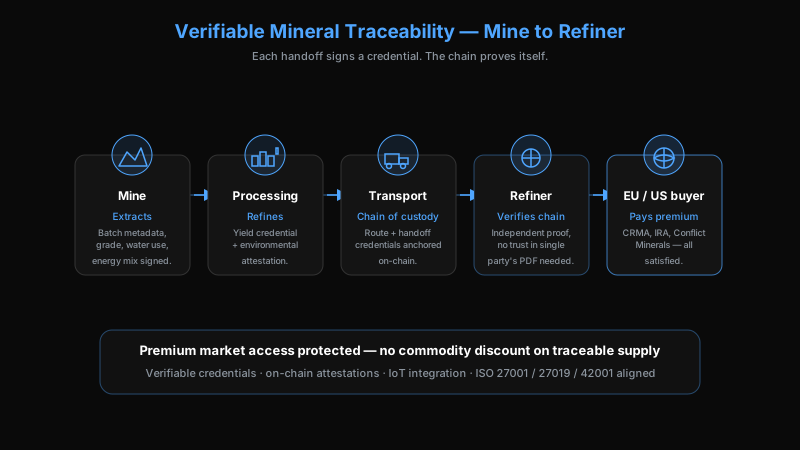
For an Argentine copper operator, the practical effect is that EU smelters and downstream EV manufacturers are increasingly specifying procurement requirements that go beyond price and grade. They are asking for verifiable origin, energy mix at extraction, water footprint, community engagement documentation — and they are asking for it in formats that can be independently audited.
The Low-Carbon Copper Premium Is Already Here
Independent of the regulatory framework, the buyer-side market is segmenting copper supply into low-carbon and standard tiers. Major copper consumers — Codelco, Glencore, BHP, automotive OEMs — have started pricing programs for verifiably low-carbon copper, where the supplier can demonstrate embedded emissions per tonne against a transparent methodology.
Low-carbon copper currently trades at modest premia, but the structural direction is clear: as EU CBAM (Carbon Border Adjustment Mechanism) and similar mechanisms scale, suppliers without verifiable embedded-emissions data will face an effective carbon discount on price. The operators with the data infrastructure in place will be paid more for the same metal.
The Stack That Solves This — Same as Lithium
What an Operator in San Juan Should Do in 2026
- Map the value chain. Identify every handoff from extraction to export. Mark which handoffs are within the operator's control and which depend on third parties.
- Engage at least one EU smelter or US OEM on what they need to see. Buyer-side requirements should drive the architecture, not internal assumptions.
- Run a verifiable credentials pilot on one production stream, one quarter of concentrate, one customer. Prove the integration before scaling.
- Inventory the existing ESG documentation. What already exists that can be reissued as verifiable credentials without rebuilding the underlying reporting.
- Align ESG, IT, OT, legal and commercial in the same room from discovery onwards. This is a market-access program with an IT layer, not the other way around.
The Closing Frame
San Juan copper is the next conversation. The projects are in pre-construction. The regulatory framework is in force. The premium pricing exists. The only question is whether Argentine operators design the traceability infrastructure in from day one — or retrofit it later under buyer-side pressure.
We've built this stack for lithium and we operate it in production for energy infrastructure. The patterns transfer directly to copper, with the advantage that you can build it right the first time.

Santiago Villarruel
Product Manager
Industrial engineer with over 10 years of experience excelling in digital product and Web3 development. Combines technical expertise with visionary leadership to deliver impactful software solutions.
Building on blockchain?
Tokenization, smart contracts, DeFi — we've shipped it all.
You Might Also Like
Argentine Lithium Needs Verifiable Traceability — Or It Loses the EU and US Premium Market
How the EU Critical Raw Materials Act and US battery regulations are turning blockchain-based mineral traceability from a nice-to-have into a market access requirement.
Rare Earths in LATAM: A Strategic Window That Closes if Nobody Builds the Traceability First
Why Argentina's rare-earth exploration projects sit in front of a strategic opportunity — and why the operators that engineer verifiable provenance into the design phase will define the LATAM offtake conversation.
Argentine Gold Already Lives Under LBMA and OECD Rules — The Question Is How Auditable Your Chain Actually Is
Why responsible sourcing frameworks for gold (LBMA, OECD Due Diligence Guidance) require a level of chain-of-custody documentation that PDF-based reporting no longer satisfies.