
When AI Starts Making Decisions, Who's Accountable?
Over the last 24 months, AI in utilities moved from curiosity to operation. Predictive demand models, generative assistants for customer service, maintenance copilots — already running in production at energy companies across Argentina, Peru, Colombia, Mexico, and Chile. What hasn't happened yet is the institutional response: when an AI participates in an operational or regulatory decision, how do you prove that decision was traceable, auditable, and conformant with a responsible management framework?
That's exactly what ISO 42001 tries to answer. And it's the question regulators, auditors, and boards are starting to ask — in some cases, already are.
What Is ISO 42001 (and Why It's Not Just Another Standard)
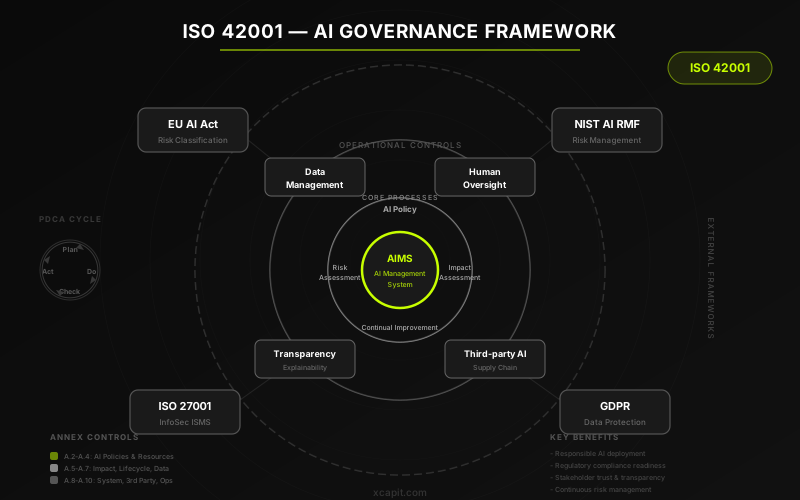
ISO 42001 was published in late 2023 by the International Organization for Standardization. It's the FIRST internationally certifiable standard for AI Management Systems. Before it existed, there were voluntary frameworks — the NIST AI RMF, OECD principles — but none with the formal structure of a certifiable ISO norm. That difference matters: a voluntary framework is a reference point; a certifiable ISO norm is something an external auditor can verify and a regulator can require as evidence.
- Identification and risk assessment of AI systems
- Policies and controls across the full model lifecycle (data, training, deployment, monitoring, retirement)
- Traceability of algorithmic decisions
- Roles and responsibilities for AI governance
- Continuous improvement under the PDCA model shared with ISO 27001 and ISO 9001
Why It Specifically Matters for the Energy Sector
Utilities are critical infrastructure. Any AI-assisted decision — from demand forecasting that feeds dispatch to maintenance prioritization models — faces a level of regulatory scrutiny that simply doesn't exist in e-commerce. There are three specific reasons why the energy sector should be paying attention now.
The AI Surface Area Is Growing Faster Than the Ability to Govern It
Shadow AI — employees using ChatGPT, Claude, or Gemini without corporate governance — is already the leading source of sensitive data leakage at utilities across the region. ISO 42001 forces an institutional response, not an individual one. Without an AI inventory, governance isn't possible.
Latin American Regulators Are Staking Out Their Position
ENRE, ENARGAS, and subnational entities are moving toward explicit algorithmic auditability requirements. The window to arrive prepared is closing. Utilities that start now will have a 12-to-24-month head start over those that wait for the requirement to become mandatory.
Institutional Investors and Multilateral Banks Are Starting to Ask
Any utility seeking financing from the IDB, CAF, or European banks will increasingly find AI governance requirements in due diligence. ISO 42001 is the legible answer for that conversation — one that a credit committee can evaluate without needing to understand the technical details of the underlying model.
ISO 27001 Isn't Enough Anymore (But You Still Need It)
Here's a common confusion: "we already have ISO 27001 — isn't that the same thing?" No. ISO 27001 protects your utility's DATA — confidentiality, integrity, availability. ISO 42001 protects the AUTOMATED DECISIONS that data feeds. They're complementary, not redundant.
For a utility in 2026, a complete answer to the regulator requires both frameworks. Having one without the other leaves a side exposed.
How to Get Started (Without Making It a Two-Year Project)
ISO 42001 can sound daunting, but its structure is deliberately aligned with ISO 27001 and ISO 9001. If you already operate under either, much of the management infrastructure is already there. What changes is the scope.
- 1. AI inventory. Identify all AI systems in use, including shadow AI. No inventory, no governance.
- 2. Gap analysis against ISO 42001. Compare current practices against the standard's controls.
- 3. Define a data perimeter. What can leave the utility's environment, what must stay on-premise, which AI providers are approved for each sensitivity level.
- 4. Technical audit trail. Every interaction with AI models must be logged, signed, and archived in a tamper-proof way. This is real engineering work, not just procedural.
- 5. Acceptable use policy for AI. Documented, communicated, trained, and monitored — having it written isn't enough.
- 6. Internal audit and, eventually, external certification.
A realistic timeline to certification for a mid-sized utility is between 12 and 24 months, depending on where you're starting from. Begin today, and you'll arrive certified while regulators are still defining the requirements — that's the position you want to be in.
The Advantage of Arriving First
ISO 42001 is still new. The first utilities in LATAM to adopt it won't be following a standard — they'll be setting one. That position carries regulatory value, reputational value, and negotiation leverage with investors and multilateral financing bodies.
The defining question of this moment isn't IF your utility will have ISO 42001. It's WHEN — and whether you arrive as a pioneer or a latecomer.

Fernando Boiero
CTO & Co-Founder
Over 20 years in the tech industry. Founder and director of Blockchain Lab, university professor, and certified PMP. Expert and thought leader in cybersecurity, blockchain, and artificial intelligence.
Exploring energy transformation?
See how we connect demand forecasting, transformer digital twins, traceability, and smart-grid software into a practical utility roadmap.
You Might Also Like
Shadow AI, ISO 42001, and the New Boardroom Risk in Oil & Gas
Why directors of oil & gas operators are starting to treat unmanaged AI use as a duty-of-care issue — and what to do in the next 90 days.
Digital transformation for utilities: modernizing energy without replacing the core
A practical guide for utilities and energy companies: how to integrate SCADA, IoT, AI, tokenization, and cybersecurity to modernize operations without replacing critical systems.
Shadow AI Is Already in Your Company: How Enterprise IT Can Take Back Control Without Saying No
Your employees are already using ChatGPT from their phones — without policy, without audit, without governance. This article lays out the three tensions enterprises face with AI adoption, why current solutions fall short, and the architecture that lets IT say yes to AI without losing control: multi-LLM orchestration, signed audit chains, and on-premise deployment.