
The Risk Moved From IT to the Boardroom
Until 2024, AI risk in oil & gas was an IT conversation. Models in production were narrow, well-bounded, and supervised. That changed when generative AI became free and ubiquitous. Today, geologists, drilling engineers, contracts officers, and joint-venture leads are pasting confidential information into ChatGPT, Claude, Gemini, and Copilot every day — not maliciously, but because the productivity gain is real and the policy vacuum is total.
That's shadow AI. And in oil & gas, where a single leaked seismic dataset, reservoir simulation, or partner agreement can have nine-figure consequences, it has stopped being a workplace nuisance and become a board-level governance failure. The directors and officers insurance market has noticed. So have the major auditors. So have the JV partners that operators report to under operating agreements written before any of this existed.
What Shadow AI Actually Looks Like in Oil & Gas
When we run AI usage audits inside operators in Argentina, Colombia, and Brazil, the same three patterns appear over and over. None of them require a sophisticated attacker. They just require an unaware workforce and zero visibility.
Reservoir and Geological Data in Public LLMs
Engineers paste well-log summaries, decline curves, and reservoir model outputs into ChatGPT to get a faster interpretation. The data is now in a third-party retention window — sometimes used to train future models, sometimes subject to discovery in litigation, almost always invisible to the operator's compliance function. Once it's out, it doesn't come back.
Contractor and JV Information Through Personal Accounts
Contracts teams use personal LLM accounts to summarize partner agreements, AFEs, and tender documents. The contractor's own confidentiality clauses are violated the moment the document is pasted in. The operator typically discovers this during a partner audit — by which point the leakage is months old and the chain of custody is unrecoverable.
OT-Adjacent Decisions Influenced by Ungoverned AI
This is the one that scares operators when they see it. Maintenance technicians, production engineers, and field supervisors are starting to ask generative AI for guidance on operational decisions — choke settings, intervention sequencing, alarm interpretation. The model isn't connected to the OT environment, but the human acting on its output is. ISO 27019 was written for OT security. It didn't anticipate this attack surface, and most operators haven't either.
Why ISO 42001 Became a Board-Level Standard
ISO 42001 was published in late 2023 as the first internationally certifiable standard for AI Management Systems. It matters because it gives boards, auditors, and regulators a common, auditable framework to ask the question: how do you govern the AI in your business? Before it existed, the answer was a collage of voluntary frameworks (NIST AI RMF, OECD principles, internal policy) that no external party could verify in a uniform way.
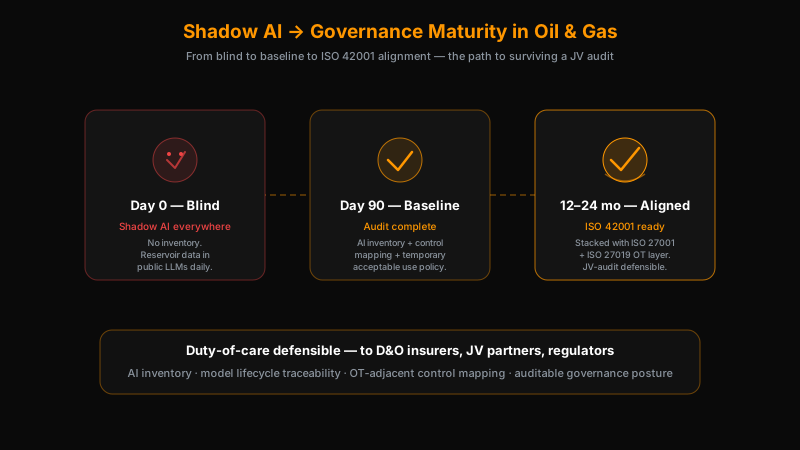
For an oil & gas operator, the value isn't the certificate. It's the discipline the standard imposes: an AI inventory, a lifecycle policy, traceability of model-assisted decisions, defined roles and responsibilities, and continuous improvement on a PDCA loop the rest of the management system already runs on. That discipline is what answers the duty-of-care question.
The Stack: ISO 27001, ISO 27019, ISO 42001
A 90-Day Shadow AI Audit — Concrete Playbook
Most operators we talk to don't need a multi-year program to start. They need to stop being blind. A 90-day audit gets you from blind to baseline. It's not the end state — it's the position from which a board can ask the next question.
- Days 1–15 — Anonymous workforce survey. What AI tools are actually being used, by whom, and for what. Expect surprises: usually 3–5x the tools IT thinks are in play.
- Days 16–30 — Egress and SaaS log review. Cross-reference the survey with network telemetry. Identify the gap between declared and actual usage.
- Days 31–60 — Inventory the AI systems your organization runs or relies on, including embedded AI in SaaS your contracts team didn't flag as AI. Classify by data sensitivity and operational impact.
- Days 61–75 — Map each AI use to a control owner. Define a temporary acceptable use policy with clear red lines for OT-adjacent decisions, reservoir data, and partner information.
- Days 76–90 — Present the inventory, the risk map, and the proposed program to the board or audit committee. This is the artifact that converts shadow AI from a rumor into a governable problem.
Where This Goes Next
The operators that arrive at the next round of JV audits with an AI inventory, a documented acceptable use policy, and a path to ISO 42001 alignment will be in a fundamentally different conversation than the ones that don't. Insurers will price them differently. Regulators will treat them differently. Boards will be able to answer the duty-of-care question without improvising.
The window to arrive prepared is open right now and closing fast. The first step is the same as it has been for every prior governance shift in this sector: know what you have before someone else tells you what you don't.

José Trajtenberg
CEO & Co-Founder
Lawyer and international business entrepreneur with over 15 years of experience. Distinguished speaker and strategic leader driving technology companies to global impact.
Exploring energy transformation?
See how we connect demand forecasting, transformer digital twins, traceability, and smart-grid software into a practical utility roadmap.
You Might Also Like
ISO 42001: The New Question Regulators and Auditors Will Ask Your Utility
Why the first internationally certifiable AI governance standard matters more than it seems for the Latin American energy sector.
Digital transformation for utilities: modernizing energy without replacing the core
A practical guide for utilities and energy companies: how to integrate SCADA, IoT, AI, tokenization, and cybersecurity to modernize operations without replacing critical systems.
Shadow AI Is Already in Your Company: How Enterprise IT Can Take Back Control Without Saying No
Your employees are already using ChatGPT from their phones — without policy, without audit, without governance. This article lays out the three tensions enterprises face with AI adoption, why current solutions fall short, and the architecture that lets IT say yes to AI without losing control: multi-LLM orchestration, signed audit chains, and on-premise deployment.