

Gold Isn't a 'Critical Raw Material' — But It's the Most Regulated Mineral by Responsible-Sourcing Standards
Gold is not on the EU CRMA strategic or critical lists. That's a function of its specific economic and geopolitical role — not an absence of regulatory pressure. The opposite is true. Gold has been under formal responsible-sourcing scrutiny since the early 2010s, longer than any other mineral, and the documentation burden on producers has grown steadily.
Two frameworks dominate: the LBMA Responsible Gold Guidance (mandatory for any producer selling into LBMA-accredited refiners — which is most of the institutional gold market) and the OECD Due Diligence Guidance for Minerals from Conflict-Affected and High-Risk Areas (referenced by virtually every downstream consumer doing due diligence).
Argentine Gold and the LBMA Path
Argentina's major gold producers — Veladero in San Juan (Barrick/Shandong Gold 50/50 JV), Cerro Vanguardia in Santa Cruz (AngloGold), Cerro Negro (Newmont), Lindero in Salta (Mineros), and San José in Santa Cruz (Hochschild/McEwen JV) — all sell into the institutional gold market. That means LBMA Responsible Gold Guidance compliance is not optional. It's the baseline.
The Guidance requires producers to demonstrate, with auditable evidence, that their gold is not associated with conflict financing, serious human rights abuses, or environmental practices that violate applicable law. The framework defines the categories. What's left to the producer is the operational infrastructure to prove compliance — and that's where PDF-based documentation increasingly fails the audit.
Where PDF Documentation Breaks Down
An LBMA refiner under audit has to demonstrate the chain of custody of every doré bar processed. The refiner relies on the producer's signed statements. The producer relies on the operations team's internal records. Those records may include transport receipts, security logs, custody handoff signatures, ESG monitoring reports — all in PDFs, scans, or spreadsheets, often signed manually.
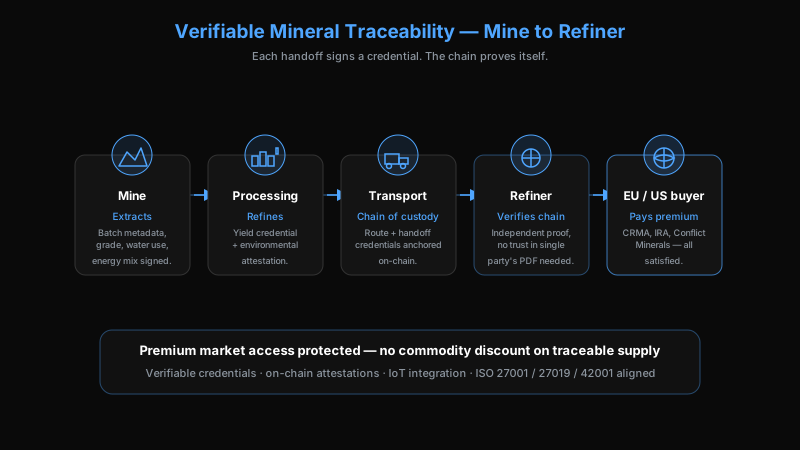
When the audit asks 'prove that this batch came from this specific operation on this specific date, and that the handling conditions met your stated standards', the answer today is a chain of trust between humans signing paper. The chain is not independently verifiable. The audit relies on the integrity of every party in the chain, with no cryptographic backstop.
What Verifiable Chain-of-Custody Actually Looks Like for Gold
Why This Matters Beyond Compliance
Responsible-sourcing infrastructure is not only about passing audits. Three buyer-side and capital-market dynamics are tightening the requirements:
- Luxury and electronics consumers — Apple, jewelry brands, watchmakers — increasingly require traceable gold and are willing to pay premia for verifiable origin. The premium is structural, not promotional.
- Institutional gold investors — ETF custodians, central bank reserve managers — are integrating responsible-sourcing screens into their procurement of physical gold.
- ESG-focused investors holding equity in gold producers screen for auditable governance posture. Producers without verifiable chain-of-custody infrastructure face higher cost of capital.
What an Argentine Gold Operator Should Do in 2026
If you operate or supply into a major Argentine gold operation, the first decision is not technical — it's strategic. Are you optimizing for the next LBMA audit cycle, or building infrastructure that compounds value across audits, ESG disclosure, and buyer-side procurement scoring? The technical stack is the same. The governance, integration, and scope are completely different conversations.
Either path requires the same foundation: a credible chain-of-custody design, smart-contract or off-chain attestation logic that survives external audit, integration with existing ESG and operational systems, and a governance framework that LBMA, OECD, and downstream consumers can all read from the same source of truth. None of that is off-the-shelf. All of it is buildable today.

José Trajtenberg
CEO & Co-Founder
Lawyer and international business entrepreneur with over 15 years of experience. Distinguished speaker and strategic leader driving technology companies to global impact.
Building on blockchain?
Tokenization, smart contracts, DeFi — we've shipped it all.
You Might Also Like
Argentine Lithium Needs Verifiable Traceability — Or It Loses the EU and US Premium Market
How the EU Critical Raw Materials Act and US battery regulations are turning blockchain-based mineral traceability from a nice-to-have into a market access requirement.
Rare Earths in LATAM: A Strategic Window That Closes if Nobody Builds the Traceability First
Why Argentina's rare-earth exploration projects sit in front of a strategic opportunity — and why the operators that engineer verifiable provenance into the design phase will define the LATAM offtake conversation.
San Juan Copper Is the Next EU CRMA Conversation — and It Hasn't Started Yet
Why the world-class copper projects in San Juan need traceability and ESG infrastructure designed in from day one — and what the EU and US buyer-side already expects.