

Why Rare Earths Are a Different Conversation
Rare earth elements — neodymium, dysprosium, praseodymium, terbium and the rest of the lanthanide group plus yttrium and scandium — are critical inputs for permanent magnets used in EV motors, wind turbines, and defense systems. The supply is heavily concentrated geographically and in a small number of refiners. Western policy makers, from the EU CRMA to the US Defense Production Act invocations, have made diversification of the rare-earth supply chain an explicit strategic priority.
For an exploration-stage rare-earth project in LATAM, that policy posture creates an opening that didn't exist for lithium or copper at the same maturity stage. The offtake conversations begin before production, and the offtake counterparty has both regulatory and procurement incentives to favor suppliers that can demonstrate verifiable, audit-grade provenance from day one.
What 'Strategic and Critical' Means in the EU CRMA Context
The EU CRMA classifies materials along two axes: strategic (key to the green and digital transitions) and critical (high supply risk plus high economic importance). Rare earth elements are on both lists. The Act sets benchmark targets — by 2030, at least 10% of EU annual consumption from EU extraction, 40% from EU processing, 25% from recycling, and no more than 65% from any single third country at any stage.
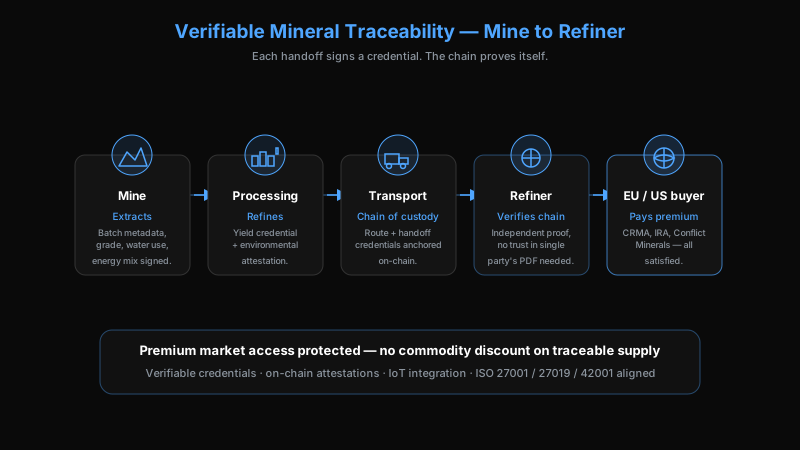
These targets translate into concrete buyer-side procurement signals. EU strategic project status, accelerated permitting in the EU, and preferential financing instruments are being structured to support diversified, transparent supply. A non-EU producer that can plug into that policy framework with verifiable traceability — for both origin and ESG conditions — is structurally favored over one that cannot.
What Argentine Rare-Earth Exploration Looks Like Today
Argentina has rare-earth exploration projects in the Andean northwest (Salta, Jujuy) and the Pampean ranges. None are at commercial production scale yet. Several are at scoping or pre-feasibility, with junior miners and majors evaluating mineralization at deposits that could become strategic assets in a 5–10 year horizon if the development path holds.
That early-stage status is the strategic advantage, not the limitation. Traceability and ESG infrastructure designed into the resource-definition and project-engineering phases costs a fraction of what retrofitting into a producing operation costs. And the resulting offtake position — being able to walk into a conversation with EU or US magnet manufacturers with an auditable provenance story ready before first concentrate — is materially different from the position a late retrofit gets.
The Stack — Same Primitives, Different Application
What an Exploration-Stage Operator Should Do in 2026
- Treat traceability infrastructure as a first-class design constraint, not a phase-2 add-on. The cost of building it in is small. The cost of retrofitting later is large.
- Identify the likely offtake counterparty profile early — EU magnet manufacturer, US defense supplier, Japanese trading house. Each has different specification preferences.
- Engage with one likely offtake counterparty to understand what their procurement scoring actually weighs. Build the documentation infrastructure to those signals.
- Build the ESG reporting layer with continuous data integrity from the baseline studies forward. Annual report PDFs are not a substitute for tamper-evident continuous data.
- Align with EU strategic project criteria where applicable. The framework exists. The recognition matters for both capital access and offtake positioning.
The Strategic Window
Rare earths in LATAM are an opportunity that doesn't repeat. The policy framework on the buyer side, the project pipeline on the supply side, and the maturity of the traceability stack on the technical side are all aligned for the first time. Operators that move now have a multi-year head start on competitors who wait.
We don't have a flagship rare-earth client yet — we are honest about that. What we bring is the same verifiable traceability stack we operate in production for adjacent regulated environments and the regulatory engagement posture that makes the long conversation viable. For the operator that wants to define how Argentine rare earths arrive to market, the first conversation costs nothing.

Fernando Boiero
CTO & Co-Founder
Over 20 years in the tech industry. Founder and director of Blockchain Lab, university professor, and certified PMP. Expert and thought leader in cybersecurity, blockchain, and artificial intelligence.
Building on blockchain?
Tokenization, smart contracts, DeFi — we've shipped it all.
You Might Also Like
Argentine Lithium Needs Verifiable Traceability — Or It Loses the EU and US Premium Market
How the EU Critical Raw Materials Act and US battery regulations are turning blockchain-based mineral traceability from a nice-to-have into a market access requirement.
Argentine Gold Already Lives Under LBMA and OECD Rules — The Question Is How Auditable Your Chain Actually Is
Why responsible sourcing frameworks for gold (LBMA, OECD Due Diligence Guidance) require a level of chain-of-custody documentation that PDF-based reporting no longer satisfies.
San Juan Copper Is the Next EU CRMA Conversation — and It Hasn't Started Yet
Why the world-class copper projects in San Juan need traceability and ESG infrastructure designed in from day one — and what the EU and US buyer-side already expects.