
Why Agricultural Credit Is Broken in Latin America
Every campaign cycle, mid-sized producers across the Southern Cone face the same problem: they have real assets — grain in a depository, cattle on the ranch, a future harvest in the ground — and they can't turn those assets into working capital fast enough or cheap enough. Banks lend, but at rates that assume opacity. Cooperatives lend, but with concentration risk. Trade finance companies lend, but their cost of capital is high and their visibility into the underlying asset is poor.
The legal instrument that's supposed to fix this — the warrant — has existed for over a century. In Argentina, Law 9.643 (1914) created the warrant system. In Brazil, Law 11.076 (2004) modernized agricultural credit instruments (CDA/WA, CPR, LCA). Paraguay, Uruguay, and Bolivia have analogous frameworks. The legal infrastructure is there. The operational infrastructure isn't.
The Three Problems That Kept Warrants From Scaling
When we map why warrants haven't scaled to their potential in the region, we find the same three problems over and over.
No Secondary Liquidity
A traditional warrant is hard to transfer between holders. Each transfer touches the depository's books, the bank's books, and a paper trail. Without a liquid secondary market, the warrant trades at a discount to fair value — and that discount is the producer's cost.
Double-Pledge Risk
Without a single source of truth that depositories, banks, and regulators all read from, the same lot of grain can be pledged twice — accidentally or intentionally. Every lender prices that risk in. Every regulator monitors against it manually. The cost of that risk premium gets paid by the producer.
Reconciliation Cost
The depository keeps a ledger. The bank keeps a ledger. The clearing house keeps a ledger. The regulator audits all three. Every entry is reconciled by hand or by batch process, and every reconciliation introduces lag and error. The cost of running that reconciliation is silently embedded in the financing cost.
What Tokenization Actually Solves
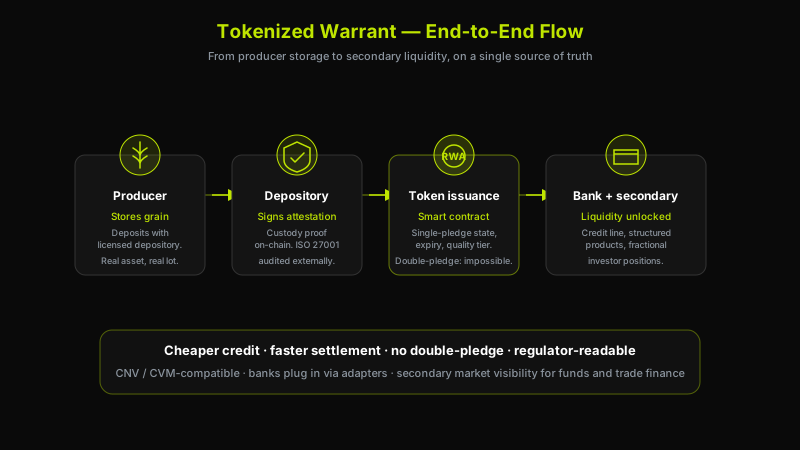
A tokenized warrant is not a cryptocurrency. It's a regulated digital representation of a legal warrant, issued on a permissioned or hybrid blockchain, with a custody attestation from the licensed depository, a legal opinion confirming the link to the underlying paper instrument, and integration points for the banks and regulators that participate in the credit market.
What changes when the warrant is tokenized:
- Transfers settle in minutes instead of days, with a tamper-evident audit trail every party can verify independently.
- Double-pledge becomes mathematically prevented at the protocol level — a token can only be in one pledged state at a time.
- Reconciliation collapses from three independent ledgers into one shared truth that all participants read from in real time.
- Secondary market participation opens up — funds, family offices, and trade finance providers can hold fractional positions in a basket of warrants instead of single concentrated exposures.
- Composability with other instruments — a warrant can be used as collateral in a smart-contract-based credit line, or bundled into a structured product without rebuilding the underlying paper chain.
The 2026 Stack — What Actually Works in Production
Theory is one thing. Production is another. Here's what the working stack looks like for a tokenized warrant program that touches a regulated environment in Latin America today.
Where the Regulators Are
Argentina's CNV (Comisión Nacional de Valores) issued frameworks for crypto-asset service providers and is incrementally clarifying the rules for tokenized financial instruments. Brazil's CVM (Comissão de Valores Mobiliários) has been more proactive, with sandbox programs and clearer guidance on tokenized receivables and agricultural credit instruments (CRA, CRI). Paraguay and Uruguay are moving slower but watching closely. The window between current ambiguity and final rules is exactly the window where early movers build the standards that get codified.
What matters operationally is that none of these regulators are saying no. They're saying: prove it, document it, integrate with us, and we'll work with you. That's an invitation, not a barrier.
What This Means for an Operator Building Now
If you're a depository, cooperative, fintech, or trade finance company looking at tokenized warrants, the first decision is not technical — it's strategic. Are you building the rails for your own portfolio, or building a platform that other participants will use? The technical stack is similar, but the governance, integration, and regulatory engagement are completely different conversations.
Either path requires the same foundation: a credible custody attestation, a smart contract that survives an external audit, an integration plan that respects existing core banking and depository systems, and a governance framework that gets regulators comfortable with the design. None of those are off-the-shelf. All of them are buildable today.
The Closing Window
Tokenized agricultural warrants are not a 2030 conversation. The legal frameworks exist. The blockchain infrastructure is mature. The depositories are open to integration. The regulators are watching and willing. What's missing is operators who decide to build before the standards solidify around someone else's stack.
In 12 to 24 months, the first generation of tokenized warrant programs will become the reference architecture for the rest of the region. The question is whether you're going to be in that first generation or integrate into someone else's later.

Antonella Perrone
COO
Previously at Deloitte, with a background in corporate finance and global business. Leader in leveraging blockchain for social good, featured speaker at UNGA78, SXSW 2024, and Republic.
Building regulated financial products?
From digital wallets to tokenized collateral and secure platforms, we build fintech systems designed for production.
You Might Also Like
Breaking the illiquidity barrier: tokenization as a financial bridge for agriculture
Farms are full of high-value, illiquid assets: stored grain, growing herds, forward contracts. How real-world asset tokenization turns them into digital collateral without liquidating them.
Agriculture as financial infrastructure: the producer's new role in the digital economy
Every tonne in the silo bag and every grazing animal has dual value. How systems orchestration turns the producer into a manager of financial infrastructure.
Can a cow become financial collateral? The case for livestock tokenization
Unique traceability, immutable digital representation and coordinated execution with authorized livestock brokers: how a herd becomes liquid collateral without ever leaving the farm.