
The extension of Argentina's CNV sandbox until 2027 is not a technical news item. It is a strategic signal for the country — and a concrete opportunity for those who already have the infrastructure ready. On April 30, 2026, the National Securities Commission (CNV) published RG 1137 for public consultation. It proposes broadening the set of assets eligible for tokenization, incorporating smaller-scale issuers into the regulatory framework and extending the sandbox until the end of 2027. To a first-time reader, it sounds technical. To those who have been following this process, it is the confirmation of something bigger.
The moment: a regulation that did not arrive overnight
Argentina has spent years building this. It is not reacting to the onchain market — it is anticipating it. And in the Latin American context, that difference will matter a great deal over the coming years.
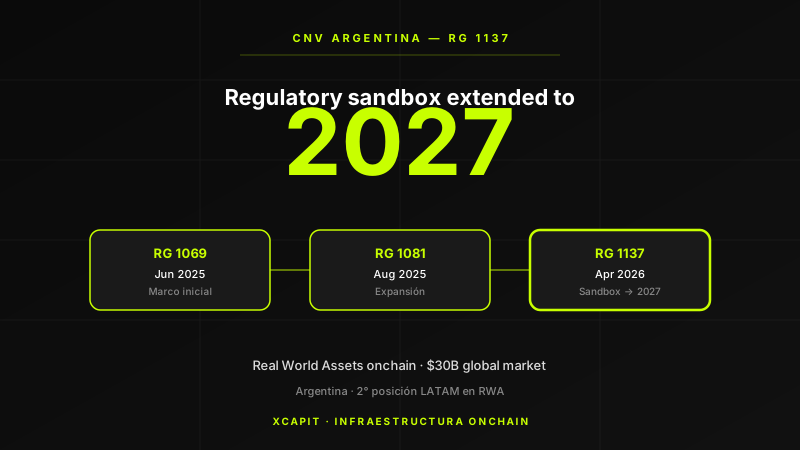
- Jun 2025 · RG 1069 — The starting point: the first resolution establishing the regulatory framework for asset tokenization in Argentina. The CNV formally enters the onchain world.
- Aug 2025 · RG 1081 — Scope expansion: a second resolution broadens the scope of the original sandbox. More assets and more eligible issuers.
- Apr 2026 · RG 1137 — Strategic confirmation: new eligible assets, smaller-scale issuers, greater operational flexibility and extension of the sandbox until the end of 2027.
"Countries that establish clear RWA frameworks first will accumulate regulatory knowledge faster, attract issuers, liquidity and institutional capital — and will be better positioned to integrate tokenized assets into the formal financial system." — Rafael De Ambrosi, CEO of TWIN, Revista Mercado, May 2026.
Global context: tokenized assets are now infrastructure
The onchain Real World Assets (RWA) market is no longer a thesis. It is the fastest-growing segment in digital finance. The largest global financial players — BlackRock, Fidelity, JPMorgan — are already issuing RWA. The question every regulator faces is no longer whether this market exists, but whether they will play an active role in shaping it. The CNV chose the first path.
- US$30B in RWA onchain distributed globally as of May 2026.
- Argentina ranks 2nd in LATAM on RWA regulatory progress, behind Brazil.
- 2027 — extension of the CNV regulatory sandbox: real runway to scale onchain products.
- 3 chained CNV resolutions in less than a year (RG 1069 · 1081 · 1137).
What RG 1137 specifically enables
- Broader universe of eligible assets: more instruments available for issuers and investors.
- Inclusion of smaller-scale issuers: democratizes access to capital markets for companies previously locked out.
- Mechanism flexibility: reduces friction for pilot projects and innovation initiatives.
- Sandbox extended through 2027: enough time to build, test and scale real products.
Xcapit's position: seven years of proven infrastructure
We did not arrive at the sandbox to see what happens. We arrived with validated infrastructure, international certifications and a robust technology engine. The regulation the CNV is building describes Xcapit's operating ecosystem precisely. For years, we have developed infrastructure to let digital value flow without friction. That requires exactly the same technological building blocks that institutional-scale Real World Asset tokenization needs.
What the CNV enables ↔ What Xcapit already has
- End-to-end traceability: every tokenized asset requires an auditable, immutable blockchain record. → Audited onchain infrastructure: every transaction recorded on a public blockchain with international certifications.
- Smaller-scale issuers: opening the market to players historically excluded. → Modular, accessible infrastructure: integration in 2 weeks, designed to operate at any issuer scale.
- Low-impact flexibility: lower barriers to entry for pilots and financial innovation. → Efficient technology development: ultra-low transaction costs (US$0.01 per transaction) to scale pilots without financial friction.
- Sandbox extended until 2027: time to build and scale real products. → 7 years of track record: infrastructure ready to use today. We didn't come to build from scratch — we came to scale what already works.
The deeper argument: well-built regulation is infrastructure
Regulation is not the enemy of innovation; it is the precondition for innovation to scale sustainably. The CNV sandbox exists to create the space where companies can learn and scale with the legal certainty that institutional investors demand. For Xcapit, this has a concrete implication: the technological market we have been building now has a regulatory framework that recognizes and enables it at institutional level.
"After Brazil, Argentina is one of the countries pushing hardest on asset tokenization. RG 1137 confirms it. And that is not a minor adjustment — it is a structural opening." — Rafael De Ambrosi, CEO of TWIN, Revista Mercado, May 2026.
What matters most about this regulatory moment is what it makes possible over the coming years: more issuers, more efficient distribution and broader access to capital markets. In that scenario, technology that already exists and has been proven has an invaluable competitive advantage.
- 2018: year Xcapit was founded — seven years before the Argentine sandbox.
- 3 CNV resolutions chained in less than a year (RG 1069 · 1081 · 1137).
- US$0.01: cost per transaction on Xcapit infrastructure vs. up to 30% on traditional systems.
We're building inside the sandbox. If your organization is exploring asset tokenization or onchain financial infrastructure in Argentina, let's talk. We have the technology, the certifications and the track record. Visit /services/blockchain-development or contact us to start the conversation. Source: Revista Mercado, "La CNV da un paso clave para el mercado financiero onchain en Argentina", Rafael De Ambrosi, May 13, 2026. RWA data: RWA.xyz, May 2026.

José Trajtenberg
CEO & Co-Founder
Lawyer and international business entrepreneur with over 15 years of experience. Distinguished speaker and strategic leader driving technology companies to global impact.
Building on blockchain?
Tokenization, smart contracts, DeFi — we've shipped it all.
You Might Also Like
Asset Tokenization in Argentina 2026: Regulatory Framework, Technical Architecture, and Why the Fideicomiso Is the Legal Vehicle
Argentina's CNV has an active tokenization sandbox expiring in August 2026. This article covers the full regulatory landscape (CNV, PSAV, BCRA), the technical architecture for tokenizing real-world assets using ERC-3643 and blockchain-native signatures, and why the fideicomiso financiero is the strongest legal vehicle available today.
Can a cow become financial collateral? The case for livestock tokenization
Unique traceability, immutable digital representation and coordinated execution with authorized livestock brokers: how a herd becomes liquid collateral without ever leaving the farm.
Tokenized Warrants Are Changing How Latin American Agriculture Gets Credit
Why the next generation of agricultural credit in Latin America runs on tokenized commodity warrants — and what the 2026 stack actually looks like.