

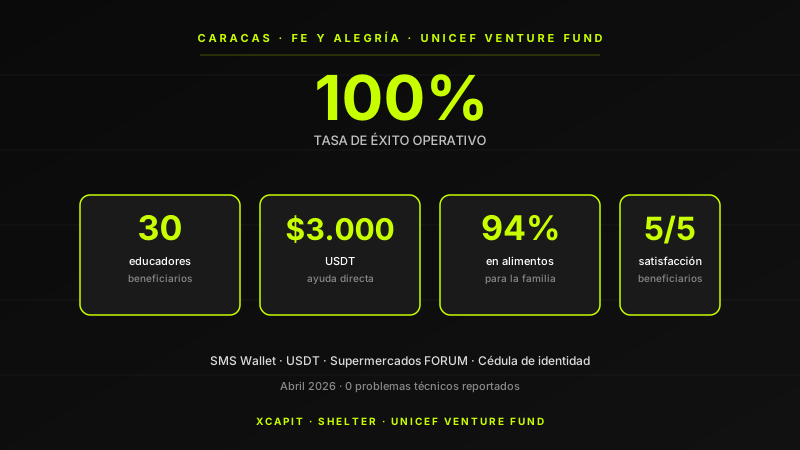
In April 2026, under the UNICEF Venture Fund, Xcapit and Fe y Alegría demonstrated that direct aid can reach educators quickly, with dignity and without middlemen. 30 teachers in Caracas each received $100 USDT in self-custodial wallets created via SMS, redeemed them at FORUM supermarkets simply by showing their national ID, and spent 94% of the benefit on food for their families. Zero technical issues. 100% operational success rate. 5/5 beneficiary satisfaction.
Context: a teaching community with vocation
José Quiroz is 44 and has spent more than two decades in the classroom. He is the Planning and Monitoring Coordinator at the Virginia de Ruiz II school, part of the Fe y Alegría network in Caracas. He also teaches digital skills and trains other teachers in educational technology. Fe y Alegría is a movement of popular and inclusive education present in more than 20 countries since 1955; its educator network works with conviction in communities that need accompaniment the most.
It was in this framework — UNICEF Venture Fund and its bet on technological solutions with real impact — that Xcapit and Fe y Alegría joined forces to design a pilot with a concrete question: can blockchain technology deliver direct aid to 30 educators in a way that is simple, dignified and fully traceable? The pilot ran under UNICEF's growth-stage financing of Xcapit, part of a global bet on digital infrastructure that reaches the most vulnerable populations with dignity and traceability.
The global challenge: up to 30% of aid is lost before it arrives
It is estimated that up to 30% of the value of global humanitarian aid is lost in administrative layers, banking intermediaries and transfer costs before reaching the beneficiary. That means that for every $100 a donor commits to a cause, only $70 actually reach those in need. The rest funds processes, fees and bureaucracy. It is not malice — it is the system's architecture. And it is exactly the problem UNICEF Ventures chose to attack by backing Xcapit.
- 30% — average loss in traditional aid due to banking and administrative intermediaries.
- 3 to 5 days — typical settlement time for a traditional cross-border humanitarian payment.
- 37% — share of adults worldwide with no formal banking access.
- 2.9 billion — people without reliable internet access.
The problem is not lack of resources or lack of will. The problem was the missing infrastructure to distribute them with dignity, speed and traceability. That is what we built — and what this pilot proved works.
The solution: four steps, zero friction
The pilot's design was intentionally simple. We did not want to test a technology. We wanted to test that technology can become invisible to the user — and that what remains is simply the aid, arriving with dignity.
- 01 · Stablecoin funding — Xcapit funded $3,000 USDT for the 30 beneficiaries. Stablecoins ensure value arrives intact, stable and traceable from origin to the pocket of those who need it.
- 02 · Self-custodial wallet via SMS — Each beneficiary received two SMS: one confirming the creation of their digital wallet, another confirming the $100 USDT deposit. No app, no required smartphone, no prior bank account.
- 03 · Redemption at FORUM supermarkets — Teachers went to FORUM locations with their national ID. Payment took seconds. As one of them put it: "it was enough to show my ID."
- 04 · Real impact at home — Staple food, proteins, hygiene products, dairy. Essential needs that, once covered, freed up the money already set aside for them, redirecting it to other postponed priorities.
Cost per transaction on Xcapit's infrastructure: $0.01 — versus up to 30% in traditional systems.
The results: 94% spent the aid on food. And the deepest impact is not measured in numbers.
When we analyzed the Fe y Alegría feedback form responses, the pattern was clear: the aid went exactly where it was most needed. Educators prioritized their families' wellbeing — and by doing so, also freed up choice in the rest of their budget. But the numbers don't capture the most important thing. What teachers described wasn't only financial relief — it was dignity. It was the possibility of buying a pair of shoes because food was already covered.
- 30 educator beneficiaries · 100% operational success rate.
- $3,000 USDT distributed · 94% spent on food for the family.
- 63% completed the operation in a single supermarket visit.
- 0 technical issues reported throughout the pilot.
- Average beneficiary age: 45 · 5/5 experience rating · 100% completed without technical assistance.
"Walking through the FORUM aisles, I saw the joy on my colleagues' faces. Many were able to save the money they had set aside for food and finally buy something else — a pair of shoes, something for themselves." — José Quiroz, Planning Coordinator, Virginia de Ruiz II School, Fe y Alegría.
What beneficiaries said
- "Receiving this benefit was real relief for my home. It helps me manage the family budget with more peace of mind and ensure good nutrition." — Yanny Núñez, Teacher.
- "It let me cover daily food expenses without sacrificing the quality of a balanced diet." — Luis Reyes, Teacher.
- "The process was fast, easy and simple — and that matters when people are busy with daily tasks." — Brito Eliur, Teacher.
- "As a teacher, it is deeply rewarding to have this kind of work incentive. Welcome — thanks to God and to you." — Reimunda Reyes, Teacher.
The multiplier effect of direct food aid is real and well-documented: when the primary need is covered, decision-making capacity is freed up across the rest of the family budget. Every $100 USDT delivered generated more than $100 of real flexibility in the household.
Conclusions: what this pilot proved — and why it matters beyond this pilot
This was not just a successful pilot. It was a proof of concept validated by UNICEF Ventures for a model that can be replicated in any context where traditional financial infrastructure fails to deliver with the speed and dignity that people deserve. We proved that blockchain can be entirely invisible to the user — and at the same time be the most efficient and traceable infrastructure available. We proved that an educator with decades of service can receive and use digital aid without any technical training. We proved that "it was enough to show my ID" is the standard any direct aid system should meet.
The next step is to scale. More Fe y Alegría network schools, long-term nutritional and financial wellbeing metrics, a broader merchant network to diversify redemption options. And to keep proving, pilot by pilot, that there is a better way to bring dignity to those who need it most.
Under the UNICEF Venture Fund, we continue to expand Shelter to new communities. We work with governments, foundations and NGOs to deploy blockchain-based direct aid infrastructure. Estimated technical integration: 2 weeks. If your organization wants to bring this model to its community, you can learn more about Shelter on our case study page or contact us directly.

Santiago Villarruel
Product Manager
Industrial engineer with over 10 years of experience excelling in digital product and Web3 development. Combines technical expertise with visionary leadership to deliver impactful software solutions.
Building on blockchain?
Tokenization, smart contracts, DeFi — we've shipped it all.
You Might Also Like
Shelter: the infrastructure that delivers aid where the system gives up
Blockchain, SMS and stablecoins serving those who need them most. No banks. No middlemen. No friction. Shelter is Xcapit's humanitarian aid disbursement platform — 167 countries reached, 70K+ people impacted, 3 pilots completed, 2 weeks of technical integration.
AidLink Kenya Pilot: 100% of Stablecoin Transfers Reached Beneficiaries
UNICEF Venture Fund published the results of AidLink's stablecoin cash transfer pilot in Nairobi: 49 beneficiaries received USDC via SMS wallet and off-ramped to M-Pesa with a 100% completion rate. Field lessons that strengthen our infrastructure.
UNICEF AidLink: How Blockchain Transforms Humanitarian Cash Transfers
Inside UNICEF's AidLink project -- the modular pipeline connecting beneficiary registration, blockchain-powered disbursement, and mobile money last-mile delivery that is redefining how humanitarian cash transfers reach the people who need them most.