
I have spent over twenty years building technology systems, and the projects that I am most convinced matter are the ones that shift power dynamics — that give people access to information that was previously available only to institutions. Blockchain technology, at its core, is a mechanism for creating records that no single party can alter or delete. When applied to government spending, this property becomes profoundly powerful: it means citizens can verify how their tax money is spent without trusting the government to tell the truth about its own behavior.
This is not a theoretical argument. At Xcapit, we have built blockchain solutions for government entities and have seen firsthand both the potential and the practical challenges. What follows is a clear-eyed assessment of where blockchain creates genuine value in public sector transparency, where it faces real limitations, and how to implement it in a way that produces results rather than pilot projects that go nowhere.
The Transparency Problem in Public Sector
The fundamental problem is not lack of data — most governments collect enormous amounts of spending data. The problem is that the data is controlled by the same entities whose behavior it is supposed to monitor. A government ministry that publishes its own procurement records is both the subject and the author of its transparency report. This creates an inherent conflict of interest that undermines trust, even when the data is accurate. Citizens, journalists, and oversight bodies have no way to verify that the published data has not been selectively edited, retroactively modified, or simply fabricated.
The scale of the problem is staggering. Transparency International estimates that corruption adds 10-25% to the cost of public procurement globally. In Latin America, where Xcapit operates and where we understand the institutional landscape deeply, corruption in public works projects has been documented to inflate costs by 30-50%. These are not victimless losses — every dollar siphoned from a school construction project or hospital equipment purchase means worse outcomes for citizens who depend on public services.
Traditional anti-corruption measures — audits, internal controls, whistleblower mechanisms — are necessary but insufficient. They operate within institutional frameworks that can themselves be compromised. An audit is only as honest as the auditor. An internal control is only as effective as the official who administers it. What blockchain offers is a structural solution: a system where the integrity of the record does not depend on the integrity of any single institution.
Blockchain for Public Procurement
Public procurement is the single largest opportunity for blockchain-enabled transparency because it represents the largest flow of public funds — typically 15-20% of GDP in developed countries and up to 30% in developing ones — and because the procurement process has clearly defined stages that map naturally to blockchain transactions.
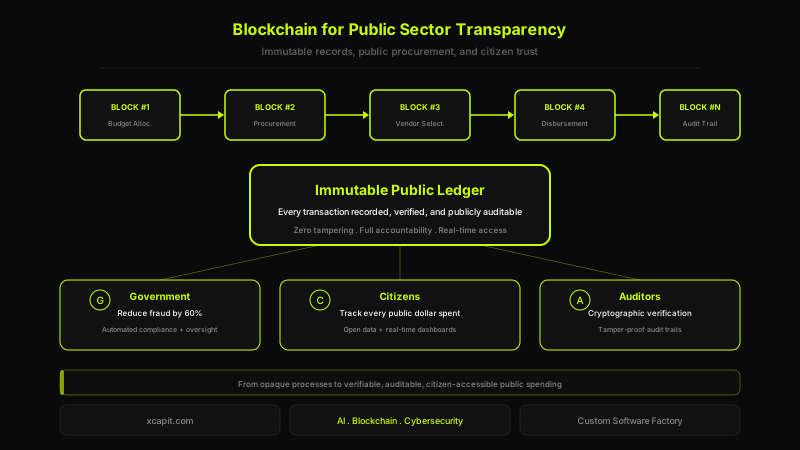
- Tender publication: The tender document, evaluation criteria, and deadlines are hashed and recorded on-chain at publication. Any subsequent modification to the tender is recorded as a separate transaction, making it impossible to change the rules after bids are submitted without leaving an immutable record.
- Bid submission: Bids are submitted as encrypted documents with on-chain timestamps. This eliminates the possibility of accepting late bids or modifying bid documents after the deadline. The encryption ensures confidentiality until the evaluation period begins.
- Evaluation and selection: Evaluation scores, committee decisions, and the rationale for vendor selection are recorded on-chain. Interested parties can verify that the stated criteria were applied consistently and that the selected vendor actually scored highest on the published criteria.
- Contract execution and payment: Milestone completion, inspection reports, and payment disbursements are recorded on-chain. Citizens can track whether the contracted work was completed before payment was released, and at what cost relative to the original contract.
The key insight is that blockchain does not prevent corruption — it prevents undetectable corruption. A dishonest official could still manipulate an evaluation, but the manipulation would be recorded on an immutable ledger that cannot be edited after the fact. This dramatically increases the risk for corrupt actors and provides journalists, civil society organizations, and opposition politicians with verifiable evidence rather than allegations.
Tracking Government Spending
Beyond procurement, blockchain can create a comprehensive, real-time picture of how government budgets flow from allocation to expenditure. The traditional budget tracking process — where citizens must file freedom of information requests and wait months for partial responses — is replaced by a system where spending data is published automatically and immutably as it occurs.
A blockchain-based budget tracking system records each disbursement as a transaction, linked to the specific budget line, ministry, project, and vendor. Smart contracts can enforce spending rules automatically — for example, preventing a disbursement that exceeds the approved budget for a specific project, or flagging a payment to a vendor that was not selected through the procurement process. The result is not just transparency but automated compliance: the system enforces the rules rather than relying on individuals to follow them.
For citizens, the interface is a public dashboard that shows — in real time — how their tax money is being spent. How much went to education versus defense? Which contractors received the most public funds? How does actual spending compare to the approved budget? These questions, which currently require extensive research and are often impossible to answer definitively, become trivially easy to answer when the underlying data is on a public blockchain.
Building Citizen Trust Through Technology
Trust in government institutions has declined globally for decades, and in many Latin American countries, it has reached historically low levels. Technology alone cannot solve this problem — it has deep roots in institutional performance, inequality, and historical experience. But technology can provide the infrastructure for accountability that makes trust possible.
The power of blockchain-based transparency is that it is trustless in the technical sense: citizens do not need to trust the government's claims about its own behavior because they can verify independently. This is a fundamentally different proposition from traditional open data initiatives, where the government publishes data that it controls and citizens must trust that it has not been manipulated. With blockchain, the cryptographic guarantees replace institutional trust.
However, trust-building requires more than technology. It requires user-friendly interfaces that make the data accessible to ordinary citizens, not just technical specialists. It requires education and outreach so that citizens know the tools exist and how to use them. And it requires institutional commitment to act on what the data reveals — a transparency system that reveals irregularities but produces no consequences will ultimately erode trust further. Technology enables accountability, but accountability requires political will.
Practical Implementation Considerations
Implementing blockchain for public sector transparency requires navigating technical, institutional, and political realities simultaneously. Based on our experience building blockchain solutions for government and public-benefit organizations at Xcapit, here are the practical considerations that determine success or failure.
- Start with a high-visibility, low-complexity use case: Public procurement for a specific sector (school construction, hospital equipment) provides clear before-and-after comparisons and directly visible citizen impact. Do not start with the entire national budget.
- Choose the right blockchain architecture: Public blockchains offer maximum transparency but raise data privacy concerns for certain government functions. Permissioned blockchains with public read access provide a practical middle ground — the government controls who writes to the chain, but anyone can verify the records.
- Invest in the user interface: A blockchain that is transparent only to people who can read raw transaction data is not transparent at all. The citizen-facing dashboard is as important as the underlying technology. Design it with real citizens, not with blockchain engineers.
- Build institutional capacity: Government staff need to understand the system well enough to operate it reliably and to explain it to citizens. Training and change management are not optional — they are core components of the implementation.
- Address legal and regulatory frameworks: In many jurisdictions, existing procurement laws assume paper-based or traditional digital processes. Implementing blockchain may require regulatory updates to recognize on-chain records as legally valid.
The technology is ready. The engineering challenges of building blockchain-based transparency systems are well understood and solvable. The real challenge is institutional adoption — convincing government leaders that transparency serves their interests, building the coalitions that create political support, and demonstrating enough value through initial implementations to justify broader deployment. At Xcapit, our experience spans both the technology and the institutional dimensions. We have built blockchain systems for organizations including UNICEF and provincial governments, and we understand that the human challenges of transparency technology are at least as important as the technical ones.

Fernando Boiero
CTO & Co-Founder
Over 20 years in the tech industry. Founder and director of Blockchain Lab, university professor, and certified PMP. Expert and thought leader in cybersecurity, blockchain, and artificial intelligence.
Building public-sector technology?
We help institutions deliver secure, traceable, citizen-centered platforms with AI, blockchain, and production software.
You Might Also Like
Digital Identity Systems for E-Government: The Blockchain Approach
How self-sovereign identity and blockchain-based citizen IDs are transforming public sector services — enabling privacy-preserving verification, reducing fraud, and modernizing government infrastructure.
Innovation from Córdoba: how do you build an ecosystem that exports technology?
Universities, labs and companies work together in Córdoba to export technology. How that ecosystem is built and what Xcapit brings to it.
Homomorphic encryption: how does AI learn from data that stays encrypted?
Banks and government agencies can use AI on sensitive data while keeping it encrypted throughout the process. How homomorphic encryption works when applied to AI.