

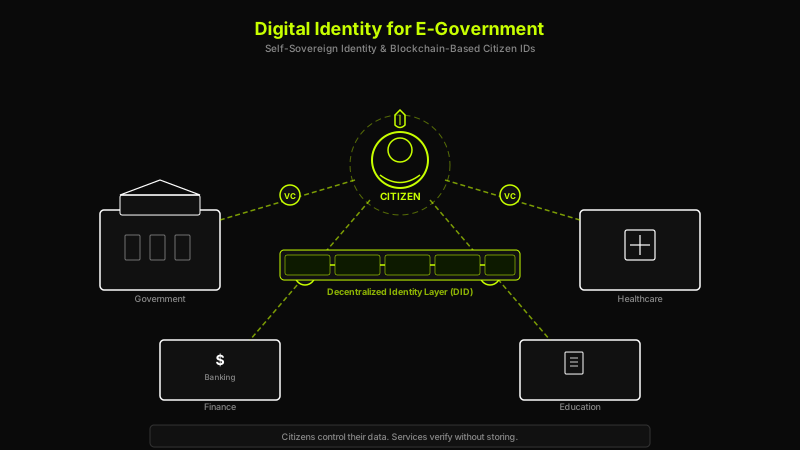
Government identity systems are, in most countries, stuck in an architecture designed for the paper age. Citizens carry physical documents — passports, national IDs, driver's licenses, birth certificates — issued by different agencies that rarely communicate with each other. Every interaction with a government service requires presenting these documents, often in person, and the service provider creates yet another copy of the citizen's data in yet another database. The result is a landscape of fragmented, duplicated, and frequently outdated identity records that are expensive to maintain, vulnerable to fraud, and deeply frustrating for citizens.
Why Governments Need Digital Identity
The World Bank estimates that approximately 850 million people worldwide lack any form of official identification. Even in countries with established ID systems, the infrastructure is often decades old, siloed across agencies, and poorly equipped for digital service delivery. The COVID-19 pandemic starkly exposed these weaknesses — governments that could not digitally verify citizen identities struggled to distribute emergency relief efficiently, while fraud in benefit programs cost billions.
Digital identity is not merely a convenience upgrade. It is foundational infrastructure for modern governance. Without reliable digital identity, e-government services remain limited, financial inclusion stalls, cross-border cooperation falters, and citizens bear an unnecessary burden of repeatedly proving who they are to institutions that already have their information. The United Nations Sustainable Development Goal 16.9 specifically targets providing legal identity for all by 2030, recognizing that identity is a prerequisite for accessing virtually every other right and service.
Self-Sovereign Identity (SSI) Explained
Self-sovereign identity represents a paradigm shift in how identity works. In traditional systems, identity is issued and controlled by an authority — the government issues your passport, the university issues your degree, the bank verifies your address. The citizen is a subject of these systems, not a participant. SSI inverts this relationship.
In an SSI system, the citizen holds their credentials in a digital wallet on their device. When they need to prove something — their age, their professional license, their citizenship — they present a verifiable credential directly to the requesting party. The verifier can cryptographically confirm that the credential was issued by a trusted authority, has not been tampered with, and has not been revoked, all without contacting the issuer or accessing a central database. The citizen chooses what to share and with whom.
- Selective disclosure: A citizen can prove they are over 18 without revealing their exact date of birth. They can prove they hold a valid medical license without revealing their home address. This minimal-disclosure principle dramatically reduces the amount of personal data floating around in various databases.
- Portability: Credentials travel with the citizen, not locked in a single country's database. A professional qualification verified in one jurisdiction can be recognized in another without bilateral agreements between every pair of countries.
- Revocation without surveillance: If a credential needs to be revoked (e.g., a suspended license), the issuer updates a revocation registry on the blockchain. Verifiers check this registry, but the issuer does not know when or where the citizen uses their credential — preserving privacy.
- Offline verification: Many SSI implementations support offline credential verification, critical for government services in areas with poor connectivity — rural offices, disaster zones, or developing regions.
Blockchain for Government ID Systems
Blockchain serves a specific, limited role in SSI systems — and understanding this role is critical to avoiding the hype. The blockchain does not store personal data. It does not contain citizen records. What it provides is a decentralized, tamper-evident registry for three things: decentralized identifiers (DIDs), credential schemas (what fields a credential contains), and revocation registries (which credentials have been revoked).
This architecture means that no single entity — not even the government — controls the identity infrastructure. A credential issued by the tax authority can be verified by the healthcare system, by a bank, or by a foreign government, all using the same underlying trust infrastructure. The blockchain ensures that the cryptographic keys and schemas used to issue and verify credentials are publicly auditable and cannot be silently altered. This is critical for government systems where public trust is paramount.
Several countries are already implementing blockchain-based identity systems. Estonia's e-Residency program, while not fully SSI, pioneered the concept of digitally portable government identity. The EU's eIDAS 2.0 regulation mandates member states to offer digital identity wallets to all citizens by 2026, with an architecture heavily influenced by SSI principles. Catalonia's IdentiCAT and British Columbia's OrgBook demonstrate that these systems work at scale in production environments. At Xcapit, our work in blockchain development and government solutions gives us direct insight into the technical and governance challenges these systems present.
Privacy and Security Considerations
The privacy properties of blockchain-based identity systems are, paradoxically, both their greatest strength and the area requiring the most careful design. Done correctly, SSI systems provide stronger privacy than any centralized alternative. Done poorly, the immutability of blockchain can create permanent privacy violations.
- No personal data on-chain: This is non-negotiable. Any system that stores personal data on a public blockchain violates GDPR's right to erasure and creates a permanent, public record of sensitive information. The blockchain stores only DIDs, schemas, and revocation status — never names, addresses, or biometric data.
- Zero-knowledge proofs: Advanced SSI systems use zero-knowledge proofs (ZKPs) to enable verification without revealing the underlying data. A citizen can prove they earn above a certain income threshold without revealing their exact salary, or prove they are a resident of a particular city without revealing their specific address.
- Correlation resistance: If every verifier receives the same credential identifier, they can collude to track a citizen's activity across services. Well-designed SSI systems use techniques like pairwise DIDs (a unique identifier for each relationship) to prevent this correlation.
- Key management: Citizens must manage cryptographic keys — lose the keys, lose access to your identity. This is a significant UX challenge that requires thoughtful solutions: social recovery mechanisms, hardware security modules in phones, and institutional backup options for vulnerable populations.
From a cybersecurity perspective, decentralized identity systems distribute risk rather than concentrating it. A breach of a centralized government ID database can expose millions of records simultaneously. In an SSI system, compromising one citizen's wallet exposes only that citizen's credentials, and the citizen can report the compromise and have affected credentials revoked. This is a fundamentally more resilient architecture for critical infrastructure.
Implementation Roadmap for Public Sector
Governments considering blockchain-based digital identity should resist the temptation to build a universal citizen ID system from day one. The most successful implementations follow a phased approach that builds institutional capability and citizen trust incrementally:
- Phase 1 — Business identity: Start with business registration and professional licensing. These use cases have clear ROI (faster registration, reduced fraud), limited privacy sensitivity, and a user population (businesses, professionals) that is motivated and technically capable of adopting new systems.
- Phase 2 — Government-to-government: Enable credential sharing between government agencies. When a citizen registers a business, the tax authority, social security agency, and municipal government all receive verified data without the citizen visiting each office separately.
- Phase 3 — Citizen-facing services: Extend digital identity to citizen services — healthcare access, social benefits, voting eligibility verification. This phase requires significant investment in UX, accessibility, and support infrastructure.
- Phase 4 — Cross-border recognition: Integrate with international identity frameworks (eIDAS, ICAO standards) to enable cross-border credential verification for travel, education, and professional mobility.
- Throughout — Governance framework: Establish clear governance for the identity system — who can issue credentials, how disputes are resolved, what happens when the technology changes. Technology is the easier part; governance is where most identity projects succeed or fail.

José Trajtenberg
CEO & Co-Founder
Lawyer and international business entrepreneur with over 15 years of experience. Distinguished speaker and strategic leader driving technology companies to global impact.
Building public-sector technology?
We help institutions deliver secure, traceable, citizen-centered platforms with AI, blockchain, and production software.
You Might Also Like
Blockchain for Public Sector Transparency: From Procurement to Citizen Trust
How blockchain technology can transform public sector transparency — enabling verifiable government procurement, trackable public spending, anti-corruption mechanisms, and meaningful citizen trust through open, immutable data.
The field's digital notary: what blockchain is (and why you don't need to understand the code to use it)
You don't need to know how a combine harvester's computer works to operate it. Blockchain is the same: a write-only record that guarantees provenance and cannot be forged.
If you can't measure it, you can't monetize it: the Córdoba and EPEC lesson applied to environmental assets in agriculture
Measure, certify and monetize. The three pillars we validated tokenizing renewable energy with EPEC, and how they transfer to the field to standardize green credits.