

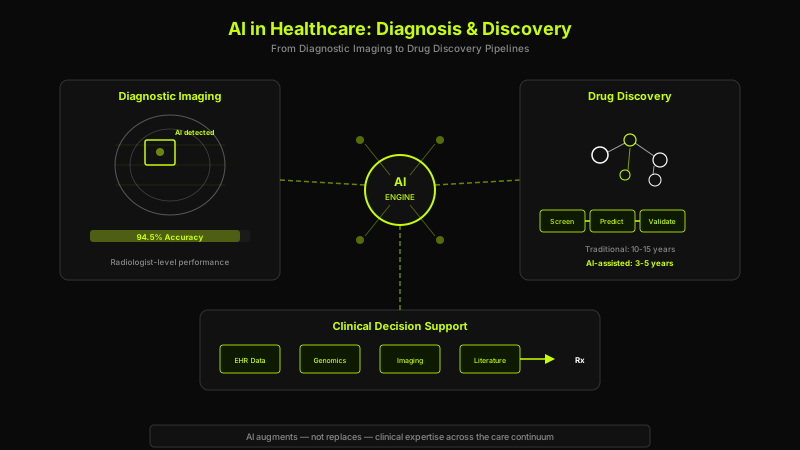
Healthcare is experiencing what might be its most significant technological transformation since the introduction of antibiotics. Artificial intelligence — specifically deep learning, natural language processing, and reinforcement learning — is not just automating existing processes. It is enabling entirely new capabilities: detecting cancers years before they would be visible to the human eye, predicting which drug molecules will bind to a target protein without synthesizing them in a lab, and synthesizing a patient's entire medical history into actionable treatment recommendations in seconds. But the gap between what AI can do in a research lab and what it delivers in a hospital ward remains significant, and closing that gap requires understanding both the technology and the unique constraints of healthcare delivery.
AI in Diagnostic Imaging
Medical imaging was the first clinical area where AI demonstrated clear, measurable impact. The reason is structural: medical images are high-dimensional data with well-defined labels (disease or no disease, malignant or benign), and the diagnostic task is fundamentally pattern recognition — exactly the problem deep learning excels at.
In dermatology, Stanford researchers demonstrated in 2017 that a convolutional neural network could classify skin cancer with accuracy comparable to board-certified dermatologists. Google Health's AI system for detecting diabetic retinopathy from retinal fundus photographs achieved a sensitivity of 97.5% and specificity of 93.4% in clinical validation — outperforming the majority of ophthalmologists in the study. In mammography, AI systems are now routinely used as a second reader in European breast screening programs, catching cancers that human radiologists miss while reducing false positive rates.
However, the deployment reality is more nuanced than the research headlines suggest. AI imaging systems are highly sensitive to distribution shift — a model trained on images from one scanner type, patient population, or imaging protocol may perform poorly on images from a different context. An AI system that achieves 95% accuracy on the dataset it was trained on might drop to 80% when deployed in a hospital with different equipment. This is not a hypothetical concern; it has been documented repeatedly in real-world deployments and is one of the primary reasons why regulatory bodies require extensive clinical validation before approval.
- Radiology triage: AI systems automatically prioritize urgent findings (pneumothorax, intracranial hemorrhage, pulmonary embolism) in imaging queues, ensuring that critical cases reach a radiologist within minutes rather than hours. This is one of the highest-value, lowest-risk applications of AI in imaging.
- Quantitative analysis: AI extracts precise measurements — tumor volume, organ dimensions, vascular calcification scores — that are time-consuming and error-prone when done manually. These quantitative biomarkers enable more objective tracking of disease progression.
- Screening at scale: In resource-limited settings, AI can enable screening programs that would be impossible with available human expertise. Detecting tuberculosis from chest X-rays in rural clinics, screening for diabetic retinopathy in primary care, and triaging cervical cancer in low-income countries are applications where AI's impact on health equity is most direct.
- Multi-modal integration: The most advanced systems combine imaging data with clinical notes, lab results, and genomic data to provide integrated diagnostic assessments — moving beyond what any single imaging study can reveal.
Drug Discovery and Development
If diagnostic imaging is where AI first proved itself in healthcare, drug discovery is where it may ultimately have the greatest impact. The traditional drug development pipeline is extraordinarily expensive (averaging $2.6 billion per approved drug, according to the Tufts Center for Drug Development) and painfully slow (10-15 years from initial discovery to market approval). The failure rate is staggering — roughly 90% of drugs that enter clinical trials never reach patients.
AI is attacking this problem at multiple stages. In target identification, machine learning models analyze genomic data, protein interaction networks, and disease pathway models to identify novel therapeutic targets that human researchers might not have considered. In molecular screening, generative AI models design novel molecular structures optimized for specific properties — binding affinity, selectivity, solubility, toxicity — exploring a chemical space far larger than any physical library could contain.
AlphaFold's breakthrough in protein structure prediction — solving a problem that had stumped computational biology for 50 years — has been transformative. Knowing a protein's 3D structure is essential for designing drugs that interact with it precisely. Previously, determining a single protein structure could take months or years of experimental work. AlphaFold can predict it in minutes with near-experimental accuracy. The AlphaFold Protein Structure Database now contains predicted structures for over 200 million proteins — essentially every protein known to science.
The results are beginning to materialize in the clinic. Insilico Medicine's AI-discovered drug for idiopathic pulmonary fibrosis entered Phase II clinical trials, making it one of the first entirely AI-originated drugs to advance this far. Recursion Pharmaceuticals uses AI to analyze cellular images at massive scale to identify drug candidates for rare diseases. Xcapit's expertise in AI and machine learning development extends to building the kind of data pipelines, model architectures, and deployment infrastructure that underpin these breakthroughs.
Clinical Decision Support Systems
Clinical Decision Support Systems (CDSS) represent perhaps the most ambitious — and most challenging — application of AI in healthcare. The goal is to integrate all available patient data (electronic health records, imaging, lab results, genomic profiles, published medical literature) and provide clinicians with evidence-based recommendations at the point of care.
The potential is enormous. Studies have shown that diagnostic errors affect approximately 12 million Americans annually, and medication errors injure 1.5 million people each year. AI-powered CDSS can flag drug interactions, identify patients at risk for sepsis hours before clinical signs appear, suggest evidence-based treatment protocols adjusted for individual patient characteristics, and alert clinicians when test results or vital signs deviate from expected patterns.
The challenge is that clinical decision-making involves far more than pattern recognition. It requires understanding patient preferences, weighing uncertain evidence, making judgment calls with incomplete information, and communicating with empathy. The most effective CDSS designs position AI as an information aggregator and anomaly detector that surfaces relevant information for the clinician's consideration — not as an autonomous decision-maker. Alert fatigue is a well-documented problem: if the system generates too many alerts, clinicians learn to ignore them all, defeating the purpose entirely.
Regulatory and Ethical Challenges
The regulatory landscape for AI in healthcare is evolving rapidly but remains fragmented and uncertain. The FDA has authorized over 900 AI/ML-enabled medical devices as of 2025, but most are in radiology and relatively low-risk categories. For higher-risk applications — AI systems that directly influence treatment decisions or operate autonomously — the regulatory pathway is less clear.
- Continuous learning: Traditional medical device regulation assumes a fixed product. AI systems that continuously learn and update from new data challenge this model fundamentally. The FDA's proposed framework for modifications to AI/ML-based Software as a Medical Device is a step forward, but many questions remain unresolved.
- Bias and equity: AI systems trained on data from predominantly white, affluent patient populations perform worse on underrepresented groups. A dermatology AI trained mostly on light-skinned patients may miss skin cancers in dark-skinned patients. Addressing this requires not just technical solutions (diverse training data, fairness metrics) but institutional commitment to health equity.
- Explainability: Deep learning models are often black boxes — they can identify a tumor in an image but cannot explain why they classified it that way. In healthcare, where decisions must be justified and communicated to patients, this lack of explainability is a significant barrier to adoption. Regulatory bodies increasingly require that AI systems provide some form of interpretable output.
- Liability: When an AI system contributes to a misdiagnosis, who is liable? The AI developer, the hospital that deployed it, or the clinician who relied on it? Existing medical malpractice frameworks are not designed for this scenario, and different jurisdictions are approaching the question differently.
- Data privacy: Healthcare data is among the most sensitive personal information. Training AI systems requires access to large datasets, creating tension between the need for data to build effective models and patients' rights to privacy. Techniques like federated learning and differential privacy offer promising solutions, allowing models to learn from data without the data leaving the hospital's control.
The Path Forward
The most productive framing for AI in healthcare is augmentation, not replacement. The goal is not to build autonomous AI doctors — it is to give human clinicians superpowers. An AI system that can screen 10,000 retinal images overnight does not replace the ophthalmologist; it ensures that the ophthalmologist's scarce expertise is focused on the cases that truly need it, while patients who would otherwise wait months for screening receive timely care.
Organizations considering AI adoption in healthcare should invest in data infrastructure first — clean, standardized, interoperable health data is the foundation on which all AI applications depend. They should start with applications that augment rather than replace clinical workflows, focus on areas where the evidence base is strong (imaging triage, drug interaction checking, sepsis prediction), and build internal capability to evaluate and validate AI systems rather than relying entirely on vendor claims. The cybersecurity implications of connecting AI systems to hospital networks must also be addressed from the outset — healthcare is already the most targeted sector for cyberattacks, and AI systems create new attack surfaces that must be defended.

Fernando Boiero
CTO & Co-Founder
Over 20 years in the tech industry. Founder and director of Blockchain Lab, university professor, and certified PMP. Expert and thought leader in cybersecurity, blockchain, and artificial intelligence.
Ready to leverage AI & Machine Learning?
From predictive models to MLOps — we make AI work for you.
You Might Also Like
Innovating faster doesn't mean building faster: it means validating first
AI makes it possible to build prototypes in hours, but it introduces a new risk: building too fast without having validated whether the solution answers a real need. Why speed today is measured by the ability to validate.
What is a Product Builder and why will it be one of the most important roles in digital transformation?
When building gets faster and faster, the challenge becomes knowing what is worth building. What a Product Builder does, how they connect business and technology, and why AI amplifies their work without replacing their judgement.
If everyone has Artificial Intelligence, where will the competitive advantage be?
AI is no longer a barrier to entry: today it is within reach of companies of every size. Why the difference is no longer about using AI, but about how it is used and the quality of the architecture that integrates it.