

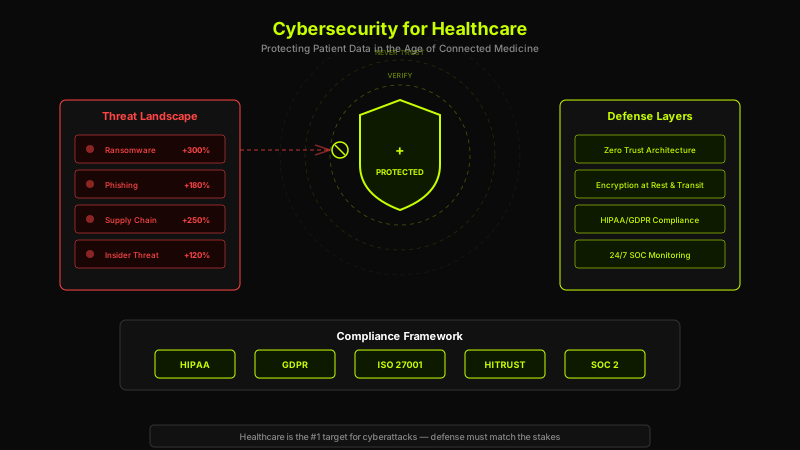
Healthcare organizations face a cybersecurity paradox. They hold some of the most sensitive data in existence — patient medical records, genetic information, mental health histories, substance abuse treatment records — and yet they operate in environments where security has historically been an afterthought. Hospital networks were designed for clinical workflow, not cyber defense. Medical devices run outdated software that cannot be patched without recertification. Clinicians, whose primary mission is patient care, resist security measures that add friction to already demanding workflows. The result is an industry that is simultaneously the most targeted by attackers and the least prepared to defend itself.
The Healthcare Threat Landscape
The numbers tell a stark story. Healthcare data breaches have increased by over 300% since 2018. The average healthcare record sells for $250 on dark web markets — compared to $5.40 for a credit card number — because medical records contain enough personally identifiable information to enable identity theft, insurance fraud, and prescription drug fraud simultaneously. Unlike a stolen credit card, which can be cancelled and replaced, a stolen medical record is permanent — you cannot change your blood type, medical history, or genetic profile.
Ransomware has emerged as the most devastating threat to healthcare. The 2020 attack on Universal Health Services disrupted operations at 400 facilities for three weeks, costing an estimated $67 million. The attack on Scripps Health in 2021 took systems offline for four weeks, during which emergency patients were diverted to other hospitals. Most alarmingly, researchers at the University of Minnesota found a statistical link between hospital ransomware attacks and increased patient mortality — when IT systems go down, patients die.
- Ransomware: Attacks on healthcare have tripled since 2020, with average ransom demands exceeding $1.5 million. Double extortion — encrypting systems AND threatening to publish stolen data — is now standard practice.
- Phishing: Over 90% of healthcare breaches start with a phishing email. Clinical staff, who work under time pressure and are trained to be helpful, are particularly susceptible to social engineering attacks.
- Supply chain attacks: Healthcare organizations depend on hundreds of vendors — EHR providers, billing systems, insurance interfaces, medical device manufacturers — and each vendor connection is a potential attack vector. The 2023 MOVEit breach affected dozens of healthcare organizations through a single file transfer software vulnerability.
- Insider threats: Not all threats are external. Disgruntled employees, curious staff accessing celebrity medical records, and careless handling of PHI (Protected Health Information) account for a significant percentage of healthcare breaches.
- Medical device vulnerabilities: Many medical devices — infusion pumps, imaging systems, patient monitors — run on legacy operating systems that no longer receive security updates. These devices are connected to hospital networks but cannot be easily patched without affecting their clinical functionality.
Protecting Patient Data: Beyond Compliance
Compliance with HIPAA (in the US), GDPR (in Europe), and similar regulations worldwide establishes a baseline for data protection — but compliance and security are not the same thing. An organization can be fully HIPAA-compliant and still be highly vulnerable to attack. HIPAA was written in 1996, before ransomware, before cloud computing, before IoT medical devices. Its security rule establishes broad requirements (access controls, audit trails, encryption) but leaves implementation details to the organization.
A robust healthcare security posture requires going beyond what regulations mandate. This means implementing encryption not just for data in transit (which HIPAA requires) but for all data at rest and in use. It means deploying endpoint detection and response (EDR) on all devices, not just servers. It means conducting regular penetration testing — not the annual checkbox exercise, but genuine adversarial testing that simulates real-world attack scenarios. And it means investing in a Security Operations Center (SOC) that provides 24/7 monitoring and incident response capability.
At Xcapit, our cybersecurity practice helps organizations move beyond compliance to genuine security. Our experience with ISO 27001 certification — the international standard for information security management — has given us a structured methodology for assessing risk, implementing controls, and continuously improving security posture in complex, regulated environments.
Ransomware and Hospital Systems
Ransomware attackers target hospitals for a simple reason: the pressure to pay is enormous. When a hospital's systems go down, patients cannot receive scheduled treatments, emergency departments are diverted, surgical procedures are delayed, and clinicians are forced to work with paper records — a process most young physicians have never practiced. The calculus for hospital administrators is brutally clear: pay the ransom and restore systems in hours, or refuse to pay and potentially face weeks of degraded care, millions in recovery costs, and the possibility of patient harm.
Defending against healthcare ransomware requires a multi-layered approach. Prevention starts with the basics: patching known vulnerabilities, segmenting networks so that a breach in one department does not spread to the entire hospital, implementing multi-factor authentication for all access to clinical systems, and filtering email to block phishing attempts. But prevention alone is insufficient — organizations must assume they will be breached and prepare accordingly.
- Immutable backups: Maintain offline, air-gapped backups of all critical systems and data. Test restoration procedures regularly — a backup that cannot be restored is not a backup. The backup strategy must cover not just data but system configurations, application states, and credential stores.
- Incident response planning: Develop and regularly rehearse a ransomware-specific incident response plan. This plan must include clinical downtime procedures — how the hospital operates when IT systems are unavailable. Every department should know how to continue patient care using paper-based fallback processes.
- Network segmentation: Isolate medical devices, administrative systems, and clinical workstations on separate network segments. If ransomware compromises the billing department, it should not be able to reach the ICU's infusion pumps or the radiology department's imaging systems.
- Threat intelligence: Subscribe to healthcare-specific threat intelligence feeds (H-ISAC, CISA healthcare advisories) that provide early warning of threats targeting the sector. Many ransomware attacks exploit known vulnerabilities for which patches are available — timely intelligence enables timely patching.
Zero Trust for Healthcare Networks
Traditional network security operates on a perimeter model: trust everything inside the network, verify everything outside. This model fundamentally fails in healthcare. Doctors access patient records from personal devices. Nurses use shared workstations. Telehealth providers connect from home. Medical device vendors require remote access for maintenance. The perimeter has dissolved — there is nothing left to defend.
Zero-trust architecture replaces the perimeter with continuous verification: never trust, always verify. Every access request — regardless of where it originates — must be authenticated, authorized, and encrypted. The principle of least privilege ensures that each user can access only the specific data and systems required for their current task. A nurse on the cardiology ward can access their patients' cardiac records but not the oncology database. A lab technician can submit results but not read clinical notes.
- Identity-centric security: Every user, device, and application must have a verifiable identity. Multi-factor authentication is non-negotiable. Context-aware access policies can adjust permissions based on location, device health, time of day, and behavioral patterns.
- Micro-segmentation: Move beyond network-level segmentation to application-level micro-segmentation. Protect individual workloads, databases, and services with their own access policies. This limits blast radius — even if an attacker compromises one system, they cannot move laterally to others.
- Continuous monitoring and analytics: Zero trust requires real-time visibility into all network activity. Security Information and Event Management (SIEM) systems, combined with User and Entity Behavior Analytics (UEBA), can detect anomalous access patterns that indicate a compromised account or insider threat.
- Encrypted everywhere: All data — at rest, in transit, and ideally in use — must be encrypted. This includes internal network traffic, not just external communications. If an attacker gains network access, encryption ensures they cannot read the data they intercept.
Building a Security-First Culture
Technology alone cannot secure a healthcare organization. The most sophisticated firewalls and intrusion detection systems are defeated when a nurse clicks a phishing link, when a physician shares their password with a colleague for convenience, or when an administrator disables security controls because they slow down a clinical application. Security culture — the collective attitudes, behaviors, and norms around cybersecurity — is the foundation on which all technical controls depend.
Building security culture in healthcare requires understanding the clinical mindset. Clinicians are trained to prioritize patient care above all else. Security measures that interfere with patient care will be circumvented, not followed. The most effective approach is to design security that is invisible to the clinical workflow — single sign-on that eliminates password fatigue, proximity-based authentication that unlocks workstations when a nurse's badge is nearby, and role-based access controls that automatically present each user with exactly the information they need.
Security awareness training should be continuous, role-specific, and tied to real-world scenarios. Generic annual training videos do not change behavior. Simulated phishing campaigns that provide immediate feedback, tabletop exercises that walk clinical leaders through ransomware scenarios, and department-specific training that addresses the unique risks of each clinical area (radiology imaging systems, pharmacy systems, laboratory information systems) are far more effective. Leadership must visibly champion security — when the CEO and CMO demonstrate that security is a patient safety issue, not just an IT issue, the culture shifts.

Antonella Perrone
COO
Previously at Deloitte, with a background in corporate finance and global business. Leader in leveraging blockchain for social good, featured speaker at UNGA78, SXSW 2024, and Republic.
Need a security partner you can trust?
Pentesting, ISO 27001, SOC 2 — we secure your systems.
You Might Also Like
Why Vulnerability Scanners Don't Replace a Pentest — and How AI Changes the Equation
Scanners like Nuclei and ZAP detect known CVEs but miss the vulnerabilities that actually get companies breached: IDOR, privilege escalation, race conditions, and business logic flaws. This article explains why, shows benchmark data (47 findings vs 0), and introduces a third option: AI-driven pentesting that reasons like a human attacker at scanner speed and cost.
Agenda 2030 as a value accelerator: the hidden market behind agricultural traceability
Corporate sustainability targets are not a bureaucratic burden: they are the biggest accelerator of new markets agribusiness has seen this century. How to capture that value.
Argentine Lithium Needs Verifiable Traceability — Or It Loses the EU and US Premium Market
How the EU Critical Raw Materials Act and US battery regulations are turning blockchain-based mineral traceability from a nice-to-have into a market access requirement.