
Every enterprise technology leader eventually faces the same inflection point: the tools that served the company at one scale become constraints at the next. The CRM requires increasingly creative workarounds. The ERP vendor's roadmap diverges from your operational reality. The integration layer between five different SaaS products consumes more engineering time than building the actual features your business needs. At that point, the question is not whether something needs to change — it is whether you should build the replacement yourself or buy a better commercial product.
Having guided dozens of enterprises through this decision at Xcapit, I have observed that the organizations that get it right treat it as a strategic portfolio decision rather than a binary choice. They build where building creates competitive advantage and buy where buying reduces operational distraction. The framework that follows is based on patterns we have seen across fintech, energy, and government clients — sectors where the stakes of getting this wrong are particularly high.
The Build vs Buy Framework
The first step is to categorize every software need into one of three buckets: commodity, differentiating, and mission-critical. Commodity software supports standard business processes that are essentially identical across companies — payroll, basic accounting, email, project management. There is no competitive advantage in how you process payroll. For these, buying is almost always correct. Differentiating software directly supports your competitive advantage — the algorithms that price your products, the workflow that defines your customer experience, the analytics that inform your strategic decisions. For these, building is almost always correct. Mission-critical software sits in between: it must work reliably and be deeply integrated, but it may not be unique to your company.
- Commodity functions (buy): Payroll, basic HR, email, project management, file storage, video conferencing. The market has optimized these. Building them is reinventing the wheel.
- Differentiating capabilities (build): Customer-facing platforms, proprietary algorithms, core operational workflows, data pipelines that create unique insights. These are where your business creates value that competitors cannot easily replicate.
- Mission-critical but non-differentiating (evaluate carefully): ERP, CRM for complex sales processes, compliance reporting, security monitoring. These require deep customization but may not need to be built from scratch.
The mistake most organizations make is treating the third category as if it belongs entirely in bucket one or bucket two. A CRM might be commodity for a company with simple B2C sales, but it is deeply differentiating for an enterprise with complex B2B relationships, custom pricing models, and regulatory requirements that no off-the-shelf product handles well. The categorization must be specific to your business, not generic.
When Custom Software Wins
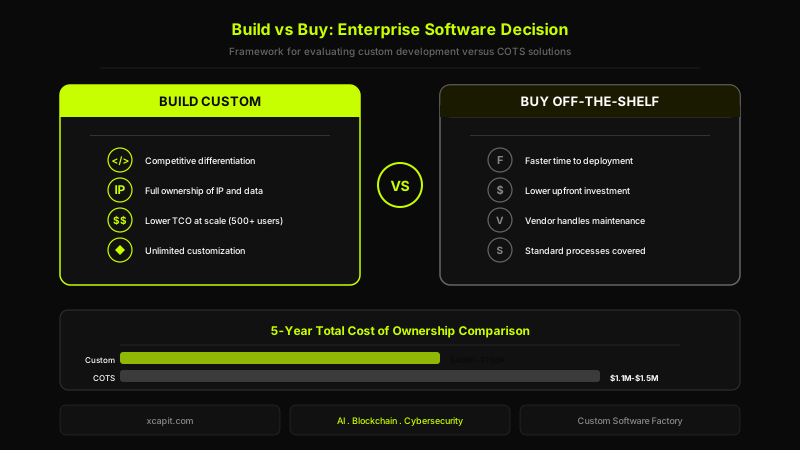
Custom software is the right investment when four conditions converge. First, the capability is central to how your business creates value. If your logistics optimization algorithm is what makes you faster than competitors, outsourcing that to a vendor's generic product means surrendering your advantage. Second, your requirements diverge significantly from what commercial products offer. If you spend more time configuring workarounds than using features, the product is fighting you rather than serving you. Third, you need deep integration with existing systems that commercial products' APIs cannot support at the required depth. Fourth, your user base is large enough that per-seat licensing makes commercial products prohibitively expensive over time.
At Xcapit, we have seen this pattern clearly in the energy sector, where utilities need monitoring and analytics platforms that integrate with legacy SCADA systems, real-time sensor data, and regulatory reporting in ways that no off-the-shelf energy management product handles adequately. We have seen it in fintech, where compliance requirements specific to Argentine regulation require custom workflows that generic compliance tools cannot accommodate. And we have seen it in government, where procurement transparency and citizen-facing systems require customization levels that commercial platforms cannot provide. For these scenarios, our custom software development approach delivers solutions that become long-term assets rather than recurring expenses.
When Off-the-Shelf Makes Sense
Commercial off-the-shelf software is the right choice more often than custom software advocates typically admit. When your process is standard and well-understood — accounting, basic CRM, email marketing, project management — these are solved problems. When you need to move fast with a limited budget, particularly at startup stage, SaaS products provide working solutions in days rather than months. When the domain is heavily regulated with established standards, vendors invest millions in maintaining compliance that would be impractical to replicate internally. When your user base is small — under 50 people — per-seat costs are manageable, and the operational burden of maintaining custom software exceeds its benefits.
The critical point is that buying is not a permanent decision. Many of the best technology organizations start with commercial products, learn from the constraints they encounter, and then build custom replacements when they have enough operational knowledge to design something genuinely better. Shopify built its own deployment system after years of using commercial tools. Stripe built its own fraud detection after learning from third-party products. The sequence matters: buy first to learn, build later to differentiate.
Total Cost of Ownership Analysis
The most common error in build-vs-buy analysis is comparing the upfront cost of building against the first-year cost of buying. This comparison is meaningless. The correct comparison is total cost of ownership over a five-year horizon, because that is the realistic lifecycle of enterprise software before major replacement or refactoring becomes necessary.
For a typical enterprise application serving 300 users, the five-year TCO breakdown looks approximately like this. Commercial software: licensing fees ($150-$300 per user per month) compound to $2.7M-$5.4M over five years, plus implementation consulting ($100K-$300K), plus customization and integration costs ($50K-$200K per year), plus the opportunity cost of working within the vendor's constraints. Custom software: initial development ($300K-$600K depending on complexity), ongoing maintenance and evolution ($60K-$120K per year), plus infrastructure costs ($20K-$50K per year). The custom total comes to roughly $700K-$1.4M over five years — and at the end, you own the asset.
The numbers shift dramatically with scale. At 50 users, commercial software is almost always cheaper. At 500 users, custom software is almost always cheaper. The crossover point is typically between 150 and 300 users for most enterprise applications. But TCO alone does not tell the whole story — you also need to account for vendor lock-in risk, integration flexibility, and the strategic value of owning your technology stack.
The Hybrid Approach
The most sophisticated enterprises do not make a single build-or-buy decision. They maintain a portfolio of technology investments where each component is sourced based on where it sits in the commodity-differentiating spectrum. The key to making this work is architecture: specifically, designing clean integration boundaries between bought and built components so that replacing one does not require rewriting the other.
An API-first architecture is essential for the hybrid approach. Every system — whether built or bought — exposes its capabilities through well-defined APIs. Data flows through an integration layer that you control, not through point-to-point connections that create brittleness. This means you can swap a commercial CRM for a custom one without touching your billing system. You can replace a homegrown analytics tool with a commercial one without rewiring your data pipeline. The integration layer becomes the most valuable piece of architecture in the organization, because it preserves optionality.
At Xcapit, we have helped enterprise clients implement exactly this pattern — building the differentiating custom components while integrating them cleanly with commercial products for commodity functions. The result is a technology stack that optimizes both cost and competitive advantage. If you are evaluating your own software portfolio and need a structured assessment, our team has the cross-domain expertise to guide that analysis objectively.

Santiago Villarruel
Product Manager
Industrial engineer with over 10 years of experience excelling in digital product and Web3 development. Combines technical expertise with visionary leadership to deliver impactful software solutions.
Need custom software that scales?
From MVPs to enterprise platforms — built right.
You Might Also Like
Custom software or an existing solution? How to make the best decision for your company
Buy or build is one of the most important decisions in any digital transformation project. When each option makes sense, why the right question is not binary, and how to assess long-term impact.
What is technical debt and why can it slow down a company's innovation?
Technical debt does not appear on any balance sheet, but it makes every new feature more expensive and limits your ability to adopt AI or automation. What it is, how to spot it, and why modernizing does not mean starting from scratch.
Software Factory vs In-House Development: A Decision Framework for 2026
A balanced, data-driven guide for CTOs and engineering leaders comparing in-house development teams with software factory partnerships. Includes cost breakdowns, decision criteria, hybrid models, and a structured framework to make the right choice for your organization.