
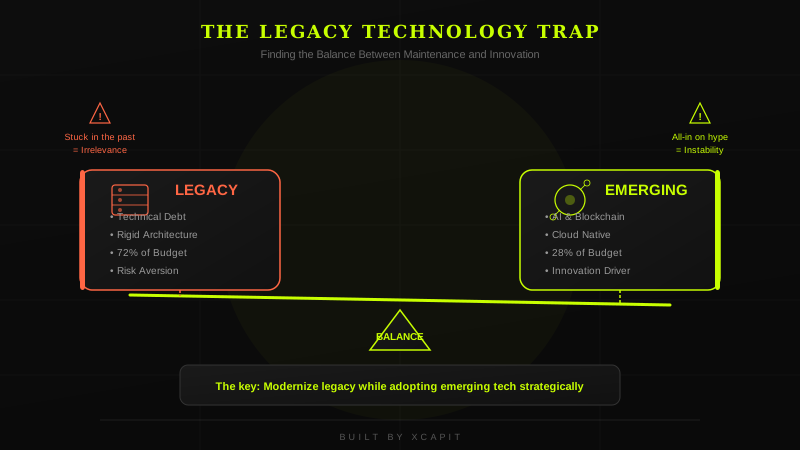
Few conversations generate as much tension in technology teams as the one confronting legacy modernization with emerging technology investment. On one side, the pressure to innovate: implementing artificial intelligence, exploring blockchain, deploying autonomous agents. On the other, operational reality: core systems that have been running for decades, sustaining the business and impossible to shut down without serious consequences. The trap lies in believing you must choose one path. The reality is that success depends on finding the balance between both.
The Mirage of Investing Only in the Emerging
The emerging technology narrative is seductive. Promises of exponential productivity with generative AI, absolute transparency with blockchain, intelligent automation with autonomous agents generate legitimate enthusiasm. But when those projects are implemented on infrastructure not designed to support them, the results are usually disappointing.
AI models that need to access data trapped in monolithic databases without APIs. Autonomous agents that cannot interact with 15-year-old ERP systems. Tokenization projects that require integrations with platforms that do not support modern standards. The result is a graveyard of pilots that worked in the lab but never reached production because the underlying infrastructure was not ready.
The Weight of Legacy: The Safer but Slower Path
The opposite approach -- concentrating all investment on modernizing existing infrastructure before thinking about innovation -- is more conservative but carries its own risks. Fully modernizing a banking core, a power grid management system, or an insurance platform can take years. Meanwhile, competitors who found ways to innovate without waiting to have everything modern capture market share, attract talent, and set standards that are later difficult to match.
Furthermore, pure modernization rarely generates organizational enthusiasm. Business teams want to see tangible impact, not just infrastructure improvements invisible to the end user. Without the promise of visible innovation, it is difficult to maintain the executive commitment and budget necessary for a long-term modernization program.
Balance as Strategy
Organizations that successfully navigate this tension do not choose an extreme. They develop an explicit strategy that balances three elements.
- Modernize the essential: They identify which legacy components are real bottlenecks for innovation and modernize those first. They do not try to rewrite everything: they focus on data layers, APIs, and integration points that unlock the most valuable initiatives.
- Invest with purpose: They select emerging technology projects that have a clear connection to measurable business outcomes and can work with current infrastructure or limited modernizations. They do not chase the latest trend: they chase value.
- Security in both worlds: They ensure that both modernized systems and new initiatives meet the security and compliance standards their industry requires. Security cannot be an add-on for the new or an assumption for the old.
Why Achieving Balance Is So Difficult
If the strategy is conceptually simple, execution is extraordinarily complex. Organizations face real barriers that cannot be solved with a nice framework.
Rigid budgets
Technology budgets tend to be compartmentalized: one bucket for maintenance, another for new projects. Moving money between categories requires approvals that take months. This rigidity prevents the flexible allocation a balanced portfolio needs. Organizations that solve this create unified transformation budgets with their own governance.
Cultural silos
Operations teams maintaining legacy and innovation teams exploring emerging technologies usually operate in separate worlds, with different metrics, different incentives, and even different vocabularies. Without explicit coordination mechanisms, their agendas diverge and projects requiring both perspectives become orphaned.
Dual talent scarcity
It is difficult to find professionals who understand both legacy systems and emerging technologies. Mainframe specialists rarely know AI, and blockchain experts seldom have worked with two-decade-old ERPs. This talent gap makes integration projects slower and more expensive than they should be.
Slow governance
Approval processes designed for predictable IT projects do not work for initiatives requiring rapid iteration. When an AI project needs three months of approvals to access data from the legacy system, the opportunity window closes before the team can even start.
Recommendations for Finding Balance
- Build a balanced portfolio: Allocate explicit investment to both modernization and innovation, with differentiated success metrics for each front. Do not measure a modernization project with innovation metrics or vice versa.
- Measure by business outcomes: Both modernization and innovation must link to concrete business outcomes. Operational cost reduction, revenue increase, time-to-market improvement, risk reduction. Technical metrics are necessary but not sufficient.
- Progressive modernization: Instead of trying to rewrite everything at once, adopt a progressive approach that modernizes what unlocks the most value first. APIs over legacy systems, data layers accessible for AI, interfaces that enable integration with new technologies.
- Create integration labs: Spaces where legacy and innovation teams work together testing how emerging technologies connect with existing infrastructure. These labs reduce integration project risk and accelerate learning.
- Choose specialized partners: Working with providers who understand both worlds -- with experience in both modernization and emerging technologies -- avoids provider fragmentation and ensures that architecture decisions contemplate the full picture.
The Cost of Not Balancing
Organizations that do not find this balance pay a high price. Those that only modernize lose competitive relevance. Those that only innovate accumulate technical debt and projects that do not scale. Those that do neither face accelerated obsolescence while their more agile competitors capture the market.
At Xcapit we understand this tension because we live it with our clients every day. We are an evolved software factory that combines modernization capabilities with emerging technology expertise. Our Innovation Lab is a space where legacy and emerging tech are tested together, under ISO 27001 security standards. We work with energy utilities that need to connect SCADA with renewable energy data platforms, with banks that need to integrate AI scoring with 20-year-old transactional cores, and with international organizations that need blockchain solutions compatible with existing infrastructure in countries with limited connectivity.
If your organization is stuck in the tension between modernizing and innovating, you probably need not more diagnostics but an execution plan that addresses both fronts. At Xcapit we design that plan and execute it. Learn how we work or contact us to discuss your case.

Fernando Boiero
CTO & Co-Founder
Over 20 years in the tech industry. Founder and director of Blockchain Lab, university professor, and certified PMP. Expert and thought leader in cybersecurity, blockchain, and artificial intelligence.
Need custom software that scales?
From MVPs to enterprise platforms — built right.
You Might Also Like
Custom software or an existing solution? How to make the best decision for your company
Buy or build is one of the most important decisions in any digital transformation project. When each option makes sense, why the right question is not binary, and how to assess long-term impact.
What is technical debt and why can it slow down a company's innovation?
Technical debt does not appear on any balance sheet, but it makes every new feature more expensive and limits your ability to adopt AI or automation. What it is, how to spot it, and why modernizing does not mean starting from scratch.
Software Factory vs In-House Development: A Decision Framework for 2026
A balanced, data-driven guide for CTOs and engineering leaders comparing in-house development teams with software factory partnerships. Includes cost breakdowns, decision criteria, hybrid models, and a structured framework to make the right choice for your organization.