
Innovation does not happen by accident. It also does not happen just because a company has technical talent or access to emerging technologies. It happens when a system exists that is designed to convert promising ideas into functional, secure, and scalable products. That system, at Xcapit, is called Labs. Xcapit Labs was born from a simple conviction: the gap between experimentation and real impact is where most innovations die. We designed Labs to close that gap.
The Trap of Innovation Without Execution
The technology industry has a problem that is rarely discussed honestly: there is more innovation in presentations than in production. Companies invest millions in pilots, hackathons, and proofs of concept that demonstrate something is technically possible, but they never become products that users actually use and the business can monetize.
The reasons are multiple: the pilot works in a controlled environment but does not survive contact with real infrastructure. Security was not considered from the start and adding it afterward requires redesigning the architecture. The team that built the prototype cannot maintain it because the knowledge was concentrated in one or two people. The product works for 100 users but collapses with 10,000.
Xcapit Labs was designed to attack each of these problems. It is not a space for generating nice ideas: it is a machine for converting ideas into real products.
A Lab Designed to Close the Gap
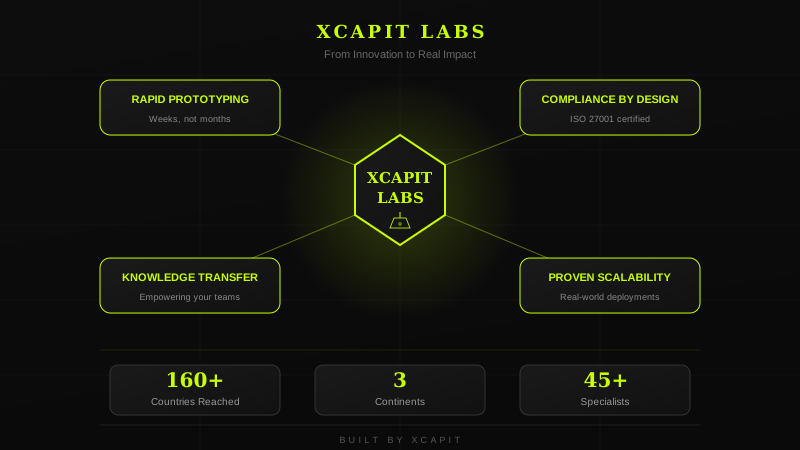
Labs is structured around four pillars that attack the root causes of the gap between experimentation and impact.
Pillar 1: Rapid Prototyping
Validation speed is key. In Labs, ideas become functional prototypes in weeks, not months. This allows testing business hypotheses with real users before committing large investments. We use combinations of emerging technologies -- AI with blockchain, digital identity with tokenization, autonomous agents with smart contracts -- and test them in realistic scenarios before proposing them to a client. When we arrive with a solution, it has already been validated.
Pillar 2: Compliance by Design
Security and regulatory compliance are not layers added at the end. In Labs, every prototype is built under the ISO 27001 standards that govern all of Xcapit's operations. This means that what comes out of Labs does not need to be redesigned for compliance: it already complies from the first version. For clients in fintech, energy, government, and healthcare, this is not an optional feature: it is a mandatory requirement.
Pillar 3: Knowledge Transfer
One of the most frequent problems in corporate innovation is dependence on the team that built the prototype. If that team leaves or moves to another project, the knowledge is lost. Labs solves this with an explicit knowledge transfer model: accessible technical documentation, training sessions for client teams, and architectures designed to be maintainable by people who did not build them originally.
Pillar 4: Proven Scalability
A prototype that works for 100 users is not a product. Labs tests each solution under realistic scale conditions before declaring it production-ready. This includes load testing, infrastructure cost evaluation at scale, and architecture design that can grow without costly redesigns. The difference between a demo and a product is the ability to operate under real market conditions.
Innovation That Crosses Borders and Industries
One of the most powerful advantages of Labs is its ability to transfer learnings across industries. What we learn building self-custodial wallets for financial inclusion in Africa teaches us patterns we apply to fintech solutions in Latin America. What we discover designing renewable energy data platforms for EPEC informs our work with other utilities. The security patterns we implement for the financial sector transfer to government solutions.
This cross-pollination is not accidental: it is a direct consequence of having a centralized lab where all of the company's expertise converges. Blockchain engineers work alongside AI specialists. Cybersecurity experts review every design. Product managers bring the business perspective. The result is innovation informed by real experience across multiple contexts.
Global Validation
Labs is not a theoretical space. It has been validated by organizations operating in the most demanding contexts in the world.
- UNICEF: We built and deployed a self-custodial Web3 wallet that reached millions of users in over 160 countries. The product was born in Labs, iterated with real field feedback, and scaled to global production.
- IDB: We explored and prototyped real-world asset tokenization solutions, validating technical and regulatory viability before moving to implementation.
- EPEC: We designed a renewable energy data management platform connecting measurement, analysis, and reporting under industrial security standards.
- NaranjaX: We developed credit scoring and data analytics solutions integrating AI with the client's existing transactional systems.
More Than Technology: A Learning Ecosystem
Labs is not just a development space. It is a learning ecosystem that feeds the innovation capacity of the entire company and our clients.
- University alliances: We work with universities for applied research in AI, blockchain, and cybersecurity. This gives us access to the latest research while also training talent that understands the real needs of industry.
- Continuous training: Xcapit teams participate in regular training cycles within Labs, ensuring that expertise stays current and is evenly distributed across the organization.
- Applied research: We do not do research for the pleasure of publishing papers. Every research line in Labs is linked to a real business problem we have identified in our work with clients.
Competing with Agility Without Losing Security
The challenge most organizations face is that speed and security seem like contradictory goals. Moving fast implies cutting corners on security. Being secure implies moving slowly. Labs resolves this tension because security is integrated into the process, not added as a final step. Our team of over 45 specialists operates under ISO 27001 certified processes, which means security does not slow down innovation: it is part of it.
For our clients, this means they can innovate with the confidence that every product coming out of Labs meets the most demanding security standards of their industry. They do not have to choose between speed and security: they get both.
If your organization needs to turn ideas into real products with security, speed, and scalability, Labs is the model that makes it possible. Learn how Xcapit Labs can power your next innovation project. Contact us for a no-obligation conversation.

Fernando Boiero
CTO & Co-Founder
Over 20 years in the tech industry. Founder and director of Blockchain Lab, university professor, and certified PMP. Expert and thought leader in cybersecurity, blockchain, and artificial intelligence.
You Might Also Like
Custom software or an existing solution? How to make the best decision for your company
Buy or build is one of the most important decisions in any digital transformation project. When each option makes sense, why the right question is not binary, and how to assess long-term impact.
Software Factory vs In-House Development: A Decision Framework for 2026
A balanced, data-driven guide for CTOs and engineering leaders comparing in-house development teams with software factory partnerships. Includes cost breakdowns, decision criteria, hybrid models, and a structured framework to make the right choice for your organization.
Building Lasting Tech Partnerships: An Enterprise Guide
How to evaluate, structure, and maintain technology partnerships that deliver long-term value — from vendor selection criteria to partnership maturity models and the red flags that predict failure.