

The role of the technology provider is changing irreversibly. For decades, the relationship between organizations and their technology providers was based on a simple transaction: I define what I need, you build it, I pay you by the hour or by delivery. That model worked while projects were predictable and technology was stable. But in a world where artificial intelligence, blockchain, and advanced cybersecurity redefine the rules of the game every quarter, organizations need something fundamentally different: a strategic partner who understands the business as well as the technology.
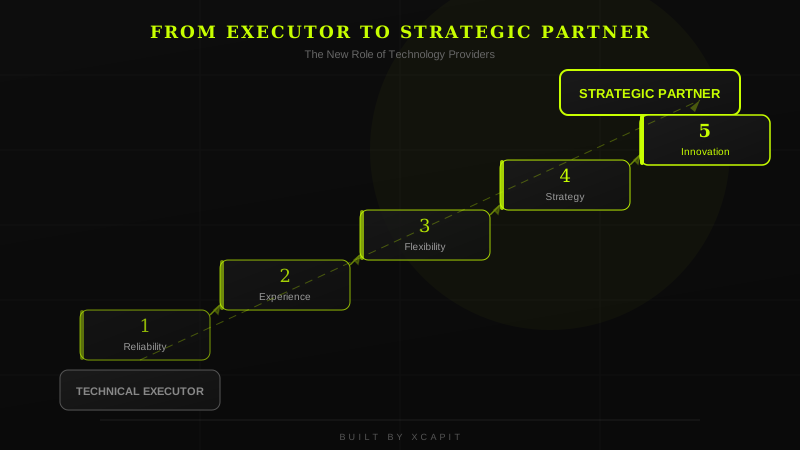
The 10 Attributes of the Strategic Partner
1. Reliability and compliance
The foundation of any strategic relationship is trust. For decision-makers, trust means the provider delivers on promises, that its processes are certified and auditable, and that it can demonstrate compliance with relevant regulatory standards. It is not about having a certification logo on the website: it is about operating with processes that are maintained under permanent audit. At Xcapit, our ISO 27001 certification is not a commercial badge: it is how we work every day.
2. Validated experience
Organizations no longer accept promises of capability. They need evidence: real cases, impact metrics, verifiable references. A provider that claims blockchain experience but cannot show a product in production loses credibility immediately. Validated experience is demonstrated with results, not slides.
3. Flexibility
Emerging technology projects rarely follow the original plan. Requirements change, priorities reshuffle, budgets adjust. A strategic partner needs the operational flexibility to adapt to these changes without every adjustment requiring a contractual renegotiation. This means engagement models that allow scaling up or down, shifting project focus, and redistributing effort according to real needs.
4. Strategic accompaniment
A technical executor builds what it is asked. A strategic partner asks why before building what. Strategic accompaniment means the provider understands the client's business objectives, challenges requirements that do not align with those objectives, and proposes alternatives the internal team would not have considered. This requires business expertise in addition to technical expertise.
5. Shared innovation and knowledge transfer
The provider as partner does not just innovate for the client: it innovates with the client. This includes sharing methodologies, transferring technical knowledge to internal teams, and co-developing solutions where intellectual property and learnings are distributed fairly. The goal is that the client becomes more capable after working with the provider, not more dependent.
6. Continuous support
The relationship does not end with delivery. A strategic partner offers continuous support that includes monitoring, evolutionary maintenance, security updates, and guidance through regulatory changes. Emerging technology products require constant attention: AI models need retraining, smart contracts need periodic audits, security architectures need updating against new threats.
7. Ecosystem orchestration
Few complex projects are solved by a single provider. The strategic partner has the capacity to orchestrate an ecosystem of partners, integrators, and platforms, coordinating the pieces so the final result is coherent. This requires system vision, not just expertise in one component.
8. Cost and metrics transparency
Organizations are tired of opaque invoices and estimates that double without explanation. A strategic partner is transparent in its costs, shares verifiable progress metrics, and is measured by business outcomes, not just hours worked. This transparency builds trust and enables better investment decisions.
9. Global scale with local adaptation
In a globalized market, providers need the capability to operate across multiple geographies without losing the ability to adapt to local particularities: regulation, culture, infrastructure, language. Deploying a digital identity solution in Latin America is not the same as in sub-Saharan Africa, even though the base technology may be identical.
10. ESG commitment
Environmental, social, and governance criteria have stopped being an aspirational differentiator. They are a requirement. Organizations actively evaluate the ESG commitment of their providers: carbon footprint, team diversity, social impact of projects, transparent corporate governance. A provider that cannot demonstrate genuine commitment in these dimensions is excluded from the conversation.
The Future: Each Attribute Deepens
These 10 attributes are not static. Each one is deepening as the market matures. Compliance will require real-time automation and auditing. Shared innovation will evolve toward more sophisticated IP co-ownership models. Ecosystem orchestration will demand more robust integration platforms. Metrics transparency will include real-time dashboards with business impact indicators.
Providers who understand this evolution and prepare for it will consolidate as indispensable partners. Those who continue operating with the transactional model of the past will be left with the projects nobody else wants.
Xcapit: More Than a Technology Provider
At Xcapit we built ourselves around these 10 attributes because we understood from the beginning that the technical transaction does not generate lasting value. Our team of over 45 specialists in AI, blockchain, and cybersecurity does not just deliver code: it co-designs solutions, transfers knowledge, accompanies product evolution, and is measured by business outcomes.
We have demonstrated this in the most demanding contexts in the world: with UNICEF deploying wallets in over 160 countries, with the IDB exploring real-world asset tokenization, with NaranjaX and Banco Industrial building fintech solutions under strict regulation, and with EPEC transforming renewable energy data management. In every case, our role was that of strategic partner, not technical executor.
If your organization needs a technology partner that meets these 10 attributes and demonstrates it with real results, we would love to talk. Learn how we work at Xcapit or contact us directly.

Fernando Boiero
CTO & Co-Founder
Over 20 years in the tech industry. Founder and director of Blockchain Lab, university professor, and certified PMP. Expert and thought leader in cybersecurity, blockchain, and artificial intelligence.
You Might Also Like
Custom software or an existing solution? How to make the best decision for your company
Buy or build is one of the most important decisions in any digital transformation project. When each option makes sense, why the right question is not binary, and how to assess long-term impact.
Software Factory vs In-House Development: A Decision Framework for 2026
A balanced, data-driven guide for CTOs and engineering leaders comparing in-house development teams with software factory partnerships. Includes cost breakdowns, decision criteria, hybrid models, and a structured framework to make the right choice for your organization.
Building Lasting Tech Partnerships: An Enterprise Guide
How to evaluate, structure, and maintain technology partnerships that deliver long-term value — from vendor selection criteria to partnership maturity models and the red flags that predict failure.