

The technology provision market is at an inflection point. Providers that continue operating with past models -- selling hours, promising generic capability, and competing on price -- will become irrelevant in the coming years. Those that survive and thrive will be the ones who take five strategic steps that completely redefine the relationship with their clients and their market position.
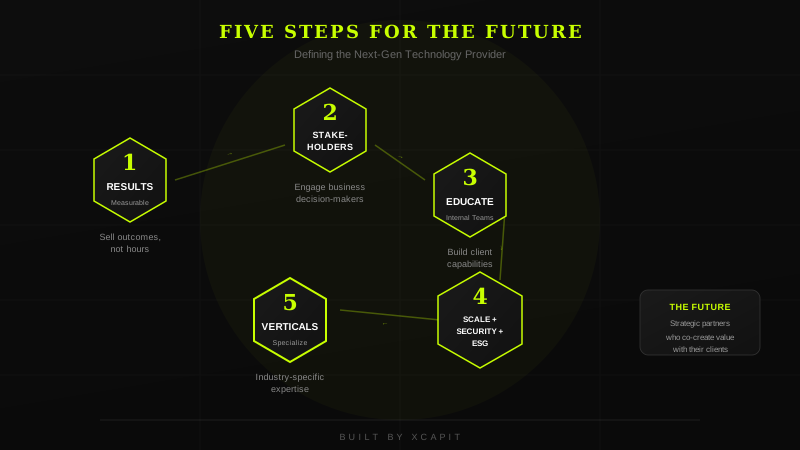
Step 1: Define Yourself by Business Results
The first and most transformative step: stop selling on technical capabilities and start defining yourself by the business results you generate. Nobody hires an AI provider because they want AI. They hire one because they want to reduce operational costs, increase revenue, improve customer experience, or make better decisions. The provider that understands this structures its entire value proposition around outcomes, not outputs.
This implies deep changes in how proposals are presented, how contracts are structured, and how success is measured. Instead of 'we deliver a machine learning model in 12 weeks,' the conversation becomes 'we reduce your fraud rate by 30% in 6 months.' Instead of billing by the hour, models where the provider shares the risk and reward of the outcome are explored.
At Xcapit we have defined ourselves by results from day one. We do not tell a client we build a Web3 wallet: we show them that with UNICEF we reached millions of users in over 160 countries and enabled humanitarian transfers in contexts where the traditional financial system does not operate. The product is the means; the result is what matters.
Step 2: Broaden the Stakeholder Range
Historically, technology providers spoke with the CIO or IT director. The second step is broadening that conversation to a much wider range of stakeholders: the CFO who needs to understand ROI, the COO who needs to see operational impact, the Chief Risk Officer who needs to evaluate risks, the Board that needs to understand strategic implications.
Investment decisions in emerging technology are no longer made only in the IT department. They involve finance, operations, compliance, legal, and often senior leadership. A provider that can only speak in technical jargon loses access to the real decision-makers. Knowing how to translate technological possibilities into business, risk, and opportunity language is a fundamental capability.
At Xcapit our conversations begin long before the code. We work with business, compliance, and leadership teams to align the technological vision with the organization's strategic objectives. This is not added value: it is how we design solutions that actually get adopted and generate impact.
Step 3: Educate on New Models and Technology Combinations
The third step is assuming an active educational role. Most organizations do not understand the practical implications of emerging technology combinations: blockchain with AI for verifiable systems, digital identity with tokenization for new ownership models, autonomous agents with smart contracts for automation without human intervention.
A provider that merely executes what it is asked leaves value on the table. One that educates its clients on what is possible -- with concrete examples, not generic slides -- builds a trust relationship and positions itself as the natural partner to implement those possibilities.
At Xcapit we educate with real examples: we show how the combination of blockchain and AI enabled autonomous wallets with UNICEF, how real-world asset tokenization is changing the rules at the IDB, how integrating AI with credit scoring transformed NaranjaX's capabilities. We do not talk about what could be: we talk about what already is.
Step 4: Prioritize Scalability, Security, and Sustainability
The fourth step is making scalability, security, and sustainability non-negotiable pillars of every solution. Not as extras added if the budget allows, but as design requirements incorporated from the first architecture decision.
Scalability means designing for real volume, not for the demo. Security means verifiable certifications, not generic declarations. Sustainability means considering the environmental, social, and governance impact of each solution, not because it is fashionable but because clients demand it as a selection criterion.
At Xcapit these three pillars are integrated into our daily operations. We design for scale because we have operated products serving millions of users. We guarantee security with our ISO 27001 certification applied from design. And we measure our ESG impact because our clients -- from UNICEF to energy utilities -- require it as a working condition.
Step 5: Bet on Verticals and Ecosystems
The fifth step is abandoning the pretense of being good at everything and specializing in specific verticals where deep expertise can be developed. The generalist provider that promises to do anything competes with thousands of identical companies. The one that specializes in fintech, energy, government, or social impact builds expertise that is hard to replicate.
But vertical specialization does not mean isolation. The future belongs to providers that combine vertical depth with the ability to orchestrate ecosystems: implementation partners, technology platforms, regulators, universities. Value creation no longer happens in a single provider but in the network of relationships that provider activates and coordinates.
At Xcapit our vertical bet is clear: fintech, energy, government, and social impact. In each of these verticals we have built real solutions for real organizations -- UNICEF, IDB, EPEC, NaranjaX, Banco Industrial -- and generated expertise that gives us a significant advantage when entering new projects. At the same time, we orchestrate an ecosystem that includes university alliances, implementation partners, and regulator relationships that amplifies our capacity to generate impact.
The Five Steps in Action
These five steps are not a theoretical list of aspirations. They are concrete moves that the most successful providers in the market are already executing. And each step reinforces the others: defining by results (step 1) requires talking with the right stakeholders (step 2), which is facilitated by educating on possibilities (step 3), which become credible when demonstrated with scale, security, and sustainability (step 4), and which deepen with vertical expertise and ecosystem (step 5).
- Step 1 (Results) + Step 2 (Stakeholders): When you talk about business results, the CFO and COO want to be in the conversation. When you talk about development hours, only IT shows up.
- Step 3 (Education) + Step 4 (Scale/Security/ESG): Educating on what is possible only has credibility if you can demonstrate it with implementations that scale and are secure.
- Step 5 (Verticals/Ecosystem): Vertical specialization gives context to everything above. Talking about AI in the abstract is not the same as talking about AI applied to credit scoring in regulated fintech.
If you are evaluating how to position your technology organization for the future, or if you need a provider that already operates with these five principles, we would love to talk. Learn how we work at Xcapit or contact us to explore how we can work together.

Fernando Boiero
CTO & Co-Founder
Over 20 years in the tech industry. Founder and director of Blockchain Lab, university professor, and certified PMP. Expert and thought leader in cybersecurity, blockchain, and artificial intelligence.
You Might Also Like
Custom software or an existing solution? How to make the best decision for your company
Buy or build is one of the most important decisions in any digital transformation project. When each option makes sense, why the right question is not binary, and how to assess long-term impact.
Software Factory vs In-House Development: A Decision Framework for 2026
A balanced, data-driven guide for CTOs and engineering leaders comparing in-house development teams with software factory partnerships. Includes cost breakdowns, decision criteria, hybrid models, and a structured framework to make the right choice for your organization.
Building Lasting Tech Partnerships: An Enterprise Guide
How to evaluate, structure, and maintain technology partnerships that deliver long-term value — from vendor selection criteria to partnership maturity models and the red flags that predict failure.