

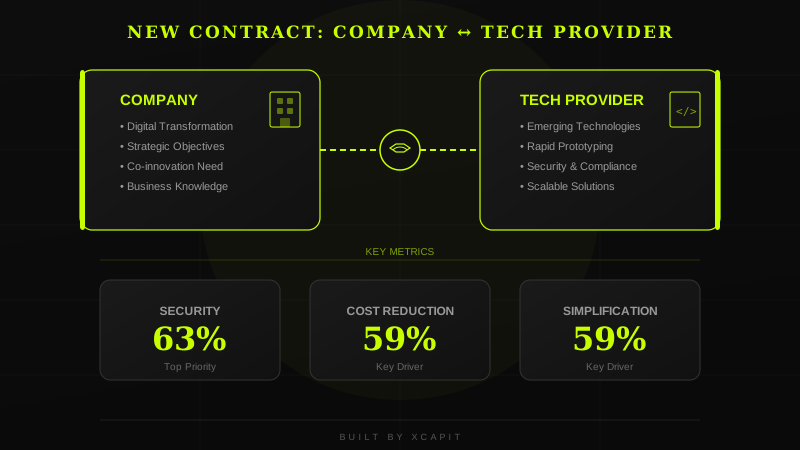
The relationships between companies and technology providers are at a tipping point. On one hand, clients depend more than ever on their ICT partners to sustain critical operations, implement emerging technologies and enable new business models. On the other, they face a landscape of technological complexity, rising costs and security risks that forces them to rethink who they work with and under what conditions.
The result is a clear trend: provider consolidation, greater demands on the relationship and a search for real differentiation.
The Consolidation Wave
According to the EY Tech Horizon Report 2025, more than a third of companies globally plan to consolidate their ICT provider base in the next 12 months. The trend cuts across sectors but is especially strong in manufacturing (43%) and financial services (42%).
Why this decision? The report identifies three main drivers:
- Minimize security and compliance risks (63%): fewer providers means more control.
- Reduce costs (59%): consolidation enables better negotiation and eliminates redundancies.
- Reduce technological complexity (59%): fewer providers means fewer integrations.
Other relevant motivations include avoiding dependency on small providers with limited stability (53%), achieving greater accountability with key partners (49%) and reassigning work to more reliable providers (18%).
The Impact on the Provider Ecosystem
This dynamic favors larger players. But it also opens up a risk: many smaller providers may be left out if they fail to show clear differentiation. This does not mean they are doomed, but the bar changes: they must demonstrate unique expertise and sector specialization.
The New Demand: Improving the Relationship
Companies expect much more from their technology providers than simple technical execution. The EY Tech Horizon Report reveals the priorities:
- Clearer articulation of emerging technologies (38%).
- Better understanding of the client's business (26%).
- Greater flexibility in the relationship (18%).
- Expertise in ESG and GenAI (12%).
- Deeper collaboration (7%).
Sector Differences
Each industry has its own priorities when evaluating the relationship with technology providers:
- Automotive: technology articulation (33%) and business understanding (28%).
- Energy: business understanding (40%).
- Financial services: business understanding (42%).
- Government: flexibility (34%).
A Mindset Shift
What is happening is a profound shift in how companies conceive their relationship with technology providers. From transactional to strategic. From a fragmented ecosystem to a reduced portfolio with deeper relationships. From valuing only technical capability to demanding a clear narrative about how technology drives business outcomes.
The Limits of Staff Augmentation Models
In this context, staff augmentation models are exposed. The risk is becoming a commodity. The future will not be determined by how many programmers a partner can add, but by who helps translate innovation into concrete results.
Consolidation, Proximity and Differentiation
At Xcapit, we understand this shift in the contract. As a consolidated partner with experience in over 160 countries, we invest in client proximity and combine ready-made products with custom developments. In a world where companies seek fewer providers but stronger relationships, we take on the role of strategic partner that simplifies and accelerates technology adoption.

Fernando Boiero
CTO & Co-Founder
Over 20 years in the tech industry. Founder and director of Blockchain Lab, university professor, and certified PMP. Expert and thought leader in cybersecurity, blockchain, and artificial intelligence.
Need custom software that scales?
From MVPs to enterprise platforms — built right.
You Might Also Like
Custom software or an existing solution? How to make the best decision for your company
Buy or build is one of the most important decisions in any digital transformation project. When each option makes sense, why the right question is not binary, and how to assess long-term impact.
What is technical debt and why can it slow down a company's innovation?
Technical debt does not appear on any balance sheet, but it makes every new feature more expensive and limits your ability to adopt AI or automation. What it is, how to spot it, and why modernizing does not mean starting from scratch.
Software Factory vs In-House Development: A Decision Framework for 2026
A balanced, data-driven guide for CTOs and engineering leaders comparing in-house development teams with software factory partnerships. Includes cost breakdowns, decision criteria, hybrid models, and a structured framework to make the right choice for your organization.