
The technology market is changing faster than provision models can adapt. Organizations no longer simply seek technical resources: they seek trust, technology articulation, and deep business understanding. According to the EY Tech Horizon 2025 report, the priority for decision-makers is no longer just finding talent but finding partners who understand the complexity of combining emerging technologies with each industry's operational reality.
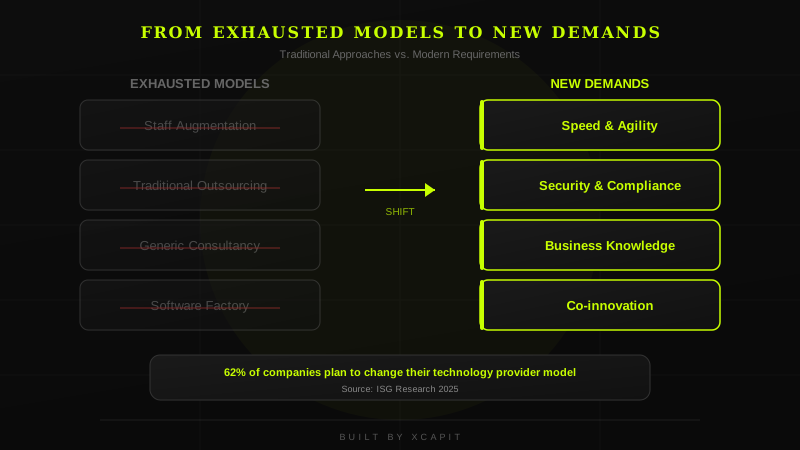
The Models Falling Behind
Staff augmentation
The staff augmentation model was designed to solve a simple problem: not enough hands. When an organization needed more developers, it hired hourly profiles through a provider. The model works when the need is purely about volume and domain knowledge already exists internally. But when the challenge is implementing artificial intelligence, blockchain, or advanced cybersecurity architectures, adding people who understand neither the technology nor the business solves nothing. In fact, it usually adds complexity without adding value.
Massive outsourcing
Massive offshore software factories thrived by offering volume at low cost. Large teams, competitive rates, and standardized delivery. But standardization is precisely what fails when projects require real technological innovation. A team of 50 generic developers cannot replace 10 specialists who understand how to design an AI agent architecture, implement decentralized identity, or audit smart contracts. Massive outsourcing optimizes costs; organizations today need to optimize results.
Diagnostic consultancies
Major consultancies contribute strategic frameworks and high-level diagnostics. However, many stop at the recommendation. They deliver a 200-page report on why the organization needs to adopt AI, but they do not build the solution. The gap between strategic diagnosis and technical execution is where most transformation projects are lost. Organizations are tired of paying for recommendations that nobody implements.
Traditional software factory
The classic software factory takes requirements, estimates, develops, and delivers. It is a linear, predictable model that works well for projects with defined scope and known technology. But emerging technology projects rarely have those characteristics. Requirements evolve as the organization learns. Technology changes during development. Value is discovered through iteration, not in the initial specification. A software factory that cannot iterate, learn, and co-create with the client becomes obsolete against current demands.
What Organizations Actually Want
Speed as standard
Organizations no longer tolerate 12 or 18-month development cycles to reach an MVP. They need to validate ideas in weeks, not quarters. This requires teams that combine technical experience with rapid prototyping capability and an iteration culture that does not wait to have everything perfect before putting something into production.
Security and compliance as structural elements
Security has stopped being a checkbox at the end of the project. In regulated industries -- fintech, healthcare, energy, government -- compliance is a design requirement, not an add-on. Organizations need providers who think about security from the first line of code and have certifications to back it up, not just good intentions.
Deep business knowledge
A provider that does not understand financial regulation cannot build a robust fintech solution. One that does not know the dynamics of the energy sector cannot design a renewable energy management platform. Domain knowledge has stopped being a nice-to-have: it is the difference between a project that works technically and one that generates real business value.
Co-innovation
Organizations do not want providers that merely execute. They want partners that bring ideas, challenge assumptions, and propose approaches the internal team would not have considered. Co-innovation requires a level of trust and expertise that can only be built with providers who understand both the technology and the business context.
ESG and GenAI differentiation
Environmental, social, and governance commitments have moved beyond aspirational. They are provider selection criteria. Similarly, the ability to integrate generative AI responsibly and effectively is a real differentiator. Organizations seek providers that can demonstrate a track record in both dimensions, not just talk about them in a sales presentation.
The Xcapit Model: An Alternative Designed for the New Context
Xcapit does not fit any of the traditional models because it was designed to operate at the intersection where those models fail. Our approach combines five elements that respond directly to what the market demands.
- Replicable products + custom development: We have proprietary products proven in production -- like our wallet deployed with UNICEF in over 160 countries -- that accelerate delivery time. But we also design 100% custom solutions when the problem requires it. This combination lets us move fast without sacrificing specificity.
- ISO security by design: We do not add security at the end. We are an ISO 27001 certified company, and our development processes integrate security and compliance from the initial architecture. For our clients in fintech, energy, and government, this is not optional: it is the foundation on which we build.
- Innovation lab: Xcapit Labs is our space for rapid prototyping and validation. Here we test combinations of emerging technologies -- AI with blockchain, digital identity with tokenization, autonomous agents with smart contracts -- before proposing them to a client. When we arrive with a solution, it has already been validated in a controlled environment.
- Specialized talent: Over 45 specialists with real expertise in AI, blockchain, cybersecurity, and custom development. These are not generic profiles resold: they are professionals who have built production products for organizations like UNICEF, the IDB, EPEC, NaranjaX, and Banco Industrial.
- Cross-industry vision: Having worked in fintech, energy, government, social sector, and banking gives us a perspective that providers specialized in a single vertical lack. We can transfer learnings from one sector to another, identify patterns, and avoid mistakes we have already seen in another context.
Cases That Demonstrate the Model
UNICEF chose us to build a self-custodial Web3 wallet that reached millions of users in developing countries. The IDB trusted us to explore real-world asset tokenization. EPEC, the largest electricity distributor in Cordoba, selected us to manage renewable energy data. NaranjaX and Banco Industrial worked with us on credit scoring and data analytics solutions. In every case, the model we delivered was not staff augmentation, nor outsourcing, nor consulting: it was strategic partnership with world-class technical execution.
If your organization feels that its current technology provider is not up to the challenges it faces, the issue is probably not people but the model. At Xcapit we designed an approach that responds to the real demands of today's market. Learn how we work or contact us to explore how we can help.

Fernando Boiero
CTO & Co-Founder
Over 20 years in the tech industry. Founder and director of Blockchain Lab, university professor, and certified PMP. Expert and thought leader in cybersecurity, blockchain, and artificial intelligence.
Need custom software that scales?
From MVPs to enterprise platforms — built right.
You Might Also Like
Custom software or an existing solution? How to make the best decision for your company
Buy or build is one of the most important decisions in any digital transformation project. When each option makes sense, why the right question is not binary, and how to assess long-term impact.
What is technical debt and why can it slow down a company's innovation?
Technical debt does not appear on any balance sheet, but it makes every new feature more expensive and limits your ability to adopt AI or automation. What it is, how to spot it, and why modernizing does not mean starting from scratch.
Software Factory vs In-House Development: A Decision Framework for 2026
A balanced, data-driven guide for CTOs and engineering leaders comparing in-house development teams with software factory partnerships. Includes cost breakdowns, decision criteria, hybrid models, and a structured framework to make the right choice for your organization.