
Every time an organization invests in artificial intelligence, blockchain, or advanced automation, it takes for granted that technology will be the bottleneck. Budgets concentrate on licenses, infrastructure, and technical proofs of concept. Yet recent evidence paints a different picture: the hardest barriers to overcome are not technological but human. Lack of internal capabilities, organizational silos, and absence of clear business cases stall more projects than any hardware or software limitation.
Upskilling: Investing in Capabilities, Not Just Tools
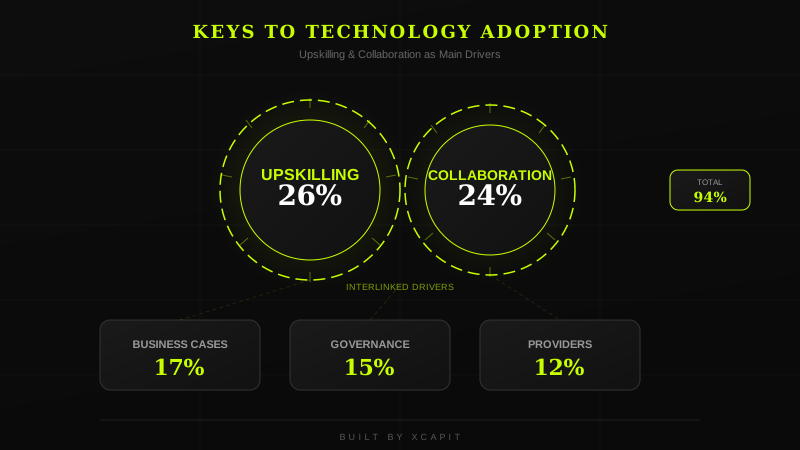
Twenty-six percent of surveyed companies identify workforce education and upskilling as the top priority for accelerating technology adoption. This finding is revealing because it shifts the conversation from the technical domain to the talent domain. It is not enough to buy the best AI platform or hire a blockchain provider if the people who will operate, maintain, and scale those solutions do not understand their fundamental principles.
Upskilling does not mean turning everyone into programmers. It means an operations leader understands what a machine learning model can and cannot do. A finance team grasps the implications of tokenizing an asset. A project manager knows how to estimate effort in a smart contract development. Without that shared knowledge floor, every emerging technology project becomes a black box dependent on a handful of experts, and that dependency kills scalability.
At Xcapit we see this firsthand: clients who invest in training their teams before or during implementation achieve faster adoption, less integration friction, and greater capacity to evolve solutions without depending forever on the provider. Our knowledge transfer model is designed precisely for this: building internal capability while delivering the solution.
Cross-Functional Collaboration: Breaking the Silos That Stall Innovation
Twenty-four percent of companies identify cross-functional collaboration as the second most important action. This number reflects a widespread frustration: emerging technology does not fit traditional org charts. An AI project applied to the supply chain needs input from operations, technology, finance, and compliance. A blockchain pilot for traceability requires alignment among IT, legal, suppliers, and commercial partners.
When these teams operate in silos, projects stall in internal negotiations, contradictory requirements, and misaligned priorities. The technology is ready long before the organization. Breaking those silos is not an abstract cultural topic: it requires concrete mechanisms. Cross-disciplinary teams with clear mandates, shared governance, common metrics, and workspaces where decisions are made with the complete business perspective.
Strategic Clarity: From Pilot to Business Case
Seventeen percent point to the need for clearer business cases. Many organizations have run AI or blockchain pilots without an explicit connection to measurable business outcomes. The pilot works technically but cannot justify scaling because nobody defined from the start what business problem it solves, how much solving it is worth, and how success is measured.
This strategic clarity cannot be the sole responsibility of the technology department. Business leaders need to participate in formulating the case from day one. The role of a provider like Xcapit is to facilitate that conversation: translating technological possibilities into concrete business impact, helping define success metrics, and designing the scaling path before writing the first line of code.
Agile Governance: Deciding at Market Speed
Fifteen percent of organizations identify the need for more agile governance models. Approval processes designed for traditional IT projects -- long evaluation cycles, multi-stage committees, exhaustive documentation before any investment -- are incompatible with the speed that technology innovation demands.
Agile governance does not mean absence of control. It means decision structures that allow fast experimentation, learning from results, and scaling what works without going through six months of approvals. Frameworks such as governance boards with tiered decisions, innovation budgets with executive autonomy, and biweekly progress reviews replace bureaucracy without sacrificing accountability.
Provider Collaboration: The Ecosystem as Multiplier
Twelve percent mention deeper collaboration with technology providers. This point is key because it reflects a shift in the client-provider relationship. It is no longer about hiring development hours or buying a packaged solution. Organizations need providers that function as extensions of their teams, understand the business context, and contribute knowledge the organization does not have internally.
At Xcapit we understand this role because we exercise it every day. Our team of over 45 specialists in AI, blockchain, and cybersecurity works as an integrated part of our clients' teams. We do not deliver code and disappear: we co-design solutions, transfer knowledge, and accompany the product's evolution. Our work with organizations like UNICEF, the IDB, and energy utilities like EPEC demonstrates that the co-innovation model generates results no transactional model can match.
The Mindset Shift: From Experimentation to Execution
Behind these five factors lies a fundamental mindset shift. The era of perpetual pilots is ending. The organizations that will capture real value from emerging technologies are those investing in the human and organizational capabilities needed to move from experimentation to execution at scale.
This means treating technology adoption as an integral transformation program, not as an IT project. It means investing in talent before investing in tools. It means designing the organization for collaboration, not for control. And it means choosing providers who understand that their role does not end with technical delivery but extends to capability building, knowledge transfer, and creating sustainable competitive advantages.
At Xcapit we bring this philosophy to practice: specialized talent with experience in over 160 countries, rapid prototyping methodologies that accelerate validation, proprietary products proven in demanding contexts, and custom solutions designed to be compatible with existing infrastructure. We do not sell technology: we build the organizational capability to leverage it.
If your organization is looking to accelerate emerging technology adoption and needs a partner who understands both the technical and human dimensions, we would love to talk. At Xcapit we combine deep expertise in AI, blockchain, and cybersecurity with a work model designed to build lasting internal capabilities. Learn more about our services or contact us directly to discuss your case.

Fernando Boiero
CTO & Co-Founder
Over 20 years in the tech industry. Founder and director of Blockchain Lab, university professor, and certified PMP. Expert and thought leader in cybersecurity, blockchain, and artificial intelligence.
You Might Also Like
Custom software or an existing solution? How to make the best decision for your company
Buy or build is one of the most important decisions in any digital transformation project. When each option makes sense, why the right question is not binary, and how to assess long-term impact.
Software Factory vs In-House Development: A Decision Framework for 2026
A balanced, data-driven guide for CTOs and engineering leaders comparing in-house development teams with software factory partnerships. Includes cost breakdowns, decision criteria, hybrid models, and a structured framework to make the right choice for your organization.
Building Lasting Tech Partnerships: An Enterprise Guide
How to evaluate, structure, and maintain technology partnerships that deliver long-term value — from vendor selection criteria to partnership maturity models and the red flags that predict failure.