

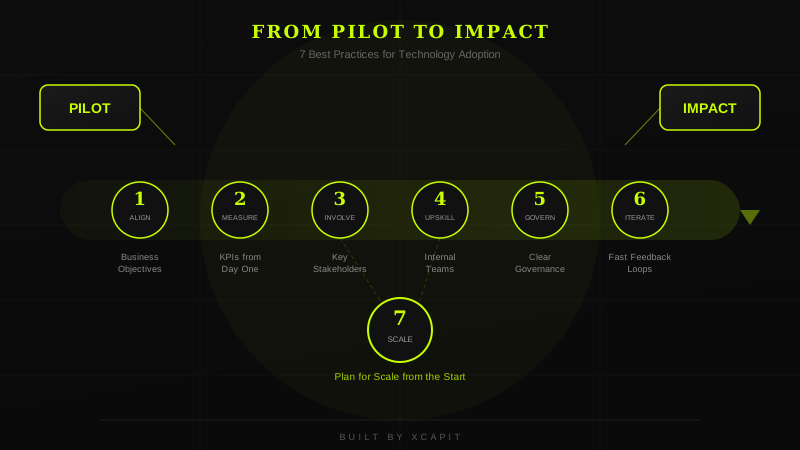
Launching a technology pilot is relatively easy. The hard part — and the valuable part — is turning that pilot into real impact at scale. Most organizations discover that the leap between a successful proof-of-concept and a production deployment is far more complex than they anticipated. It is not just about technology: it involves strategy, talent, organizational culture and risk management.
Analyzing companies that consistently scale, we find seven practices that repeat. They are not magic formulas but operational disciplines that reduce friction between innovation and implementation.
1. Connect Innovation with Business Strategy
The most common mistake is treating innovation as a technology exercise disconnected from business objectives. The pilots that scale are those that from their inception have a clear link to a strategic priority: reducing operational costs, opening a new revenue channel, improving customer experience or complying with an emerging regulation.
When the connection to strategy is explicit, the project has natural executive sponsors, clear success metrics and a solid argument for obtaining the resources needed to scale.
2. Design for Scale from the Start
Many pilots are built with the mindset of 'if it works, we will figure out how to scale later.' This generates technical debt from day one. Architecture decisions, technology selection, the data model and integrations must consider the scale scenario from the design phase.
This does not mean over-engineering. It means making conscious decisions: choosing technologies that support growth, designing APIs that allow future integrations and defining a data model that does not need to be rebuilt when volume multiplies.
3. Build and Care for Talent
Technological innovation depends on specialized talent, and that talent is scarce. Companies that scale successfully invest in building teams with the right competencies, retaining key profiles and creating an environment where continuous learning is part of the culture.
It is not just about hiring senior developers. It is about having people who understand both the technology and the business domain, who can translate business requirements into viable technical solutions and who have the discipline to execute with quality.
4. Move Fast with Discipline
Speed without discipline generates chaos. Discipline without speed generates irrelevance. Companies that scale find the balance: short development cycles, continuous feedback loops, frequent releases — but with automated testing, rigorous code reviews, minimum viable documentation and reliable deployment processes.
Discipline does not slow down speed; it makes it sustainable. A team that delivers fast but generates production incidents every week is not being agile — it is accumulating operational debt.
5. Break Organizational Silos
Pilots that stall frequently do so because they live in a silo — an innovation team, an internal lab, a business unit that experimented in isolation. Scaling requires cross-functional coordination: technology, operations, compliance, marketing, finance.
The most effective organizations create explicit mechanisms to break silos: multidisciplinary squads, steering committees with diverse representation, and communication channels that connect the technical team with business stakeholders.
6. Manage Risks from the Start
Many teams treat risk management as something done at the end, when they are already in production. Companies that scale well incorporate it from the design phase: they identify technical, regulatory, operational and market risks before investing significant resources.
This includes having a contingency plan for the most likely scenarios, defining clear go/no-go criteria for each phase, and maintaining transparent communication with stakeholders about known risks and their mitigation.
7. Create Collaboration Ecosystems
No company can scale innovation in isolation. Collaboration ecosystems — with technology providers, implementation partners, communities of practice and in some cases even competitors — multiply execution capability and reduce risk.
The companies that achieve the greatest impact are those that build long-term relationships with partners who understand their business, bring complementary expertise and share the commitment to outcomes.
The Common Pattern
Companies that scale innovation share a consistent pattern: they treat innovation as an organizational process, not an isolated technology experiment. They connect technology with strategy, design for scale, invest in talent, maintain operational discipline, break silos, manage risks proactively and build collaboration ecosystems.
At Xcapit, we accompany organizations on this path with solutions proven in over 160 countries, ISO compliance, specialized talent and proprietary products developed at Xcapit Labs. We are not just another provider — we are the partner that helps turn pilots into impact.

Fernando Boiero
CTO & Co-Founder
Over 20 years in the tech industry. Founder and director of Blockchain Lab, university professor, and certified PMP. Expert and thought leader in cybersecurity, blockchain, and artificial intelligence.
You Might Also Like
Custom software or an existing solution? How to make the best decision for your company
Buy or build is one of the most important decisions in any digital transformation project. When each option makes sense, why the right question is not binary, and how to assess long-term impact.
Software Factory vs In-House Development: A Decision Framework for 2026
A balanced, data-driven guide for CTOs and engineering leaders comparing in-house development teams with software factory partnerships. Includes cost breakdowns, decision criteria, hybrid models, and a structured framework to make the right choice for your organization.
Building Lasting Tech Partnerships: An Enterprise Guide
How to evaluate, structure, and maintain technology partnerships that deliver long-term value — from vendor selection criteria to partnership maturity models and the red flags that predict failure.