

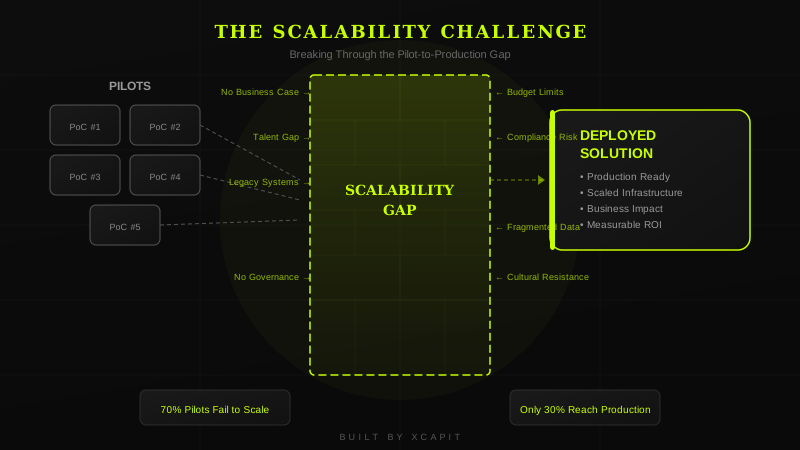
There is a paradox that defines the current technology landscape: enthusiasm for innovation has never been higher, but the proportion of companies that manage to scale their technology initiatives beyond the pilot is in decline. EY Tech Horizon Report data shows a growing gap between intention and execution — more companies experiment, but fewer achieve real deployments at scale.
This phenomenon is not just a statistic. It has concrete consequences: investments that fail to generate returns, frustrated teams, and a gradual loss of internal credibility for innovation and technology departments.
The Paradox: More Innovation, Less Deployment
The numbers are clear. Companies are investing more than ever in pilots for artificial intelligence, blockchain, IoT and other emerging technologies. But when the conversion rate is measured — how many pilots reach production and generate measurable impact — the percentages are falling. The problem is not a lack of innovation but the inability to scale it.
The 8 Obstacles of the Scalability Challenge
Analyzing stalled cases, we find eight recurring obstacles that explain why so many promising pilots never generate real impact.
1. Technical Debt and Legacy Systems
Existing infrastructure is the first major obstacle. Legacy systems were not designed to integrate with modern technologies, and the technical debt accumulated over years makes each new integration more costly and risky than the last. Scaling a pilot on a fragile foundation is like building a second story on weak foundations.
2. Pilots Disconnected from Strategy
Many pilots are born as bottom-up initiatives from enthusiastic technical teams but without an explicit connection to the business's strategic priorities. When the time comes to request a budget for scaling, there is no clear business case nor an executive sponsor to back it.
3. Specialized Talent Scarcity
A pilot can work with a small team of experts. Scaling requires multiplying that talent — and in emerging technologies like AI, blockchain and cybersecurity, specialized talent is scarce and expensive. Companies that cannot attract, develop or retain that talent remain stuck in the pilot phase.
4. Slow Processes and Organizational Silos
Traditional organizational structures — with hierarchical approvals, rigid annual budgets and isolated departments — are not designed for the speed that innovation requires. An agile pilot crashes into corporate bureaucracy when it attempts to scale.
5. Regulatory and Compliance Risks
In regulated industries — fintech, healthcare, energy, government — scaling a technology solution means complying with regulatory frameworks that did not exist when the pilot was designed. Teams that fail to anticipate these requirements discover too late that their solution needs fundamental modifications to be compliant.
6. Misaligned Incentives
Incentives across different stakeholders are frequently misaligned. The innovation team wants to experiment; operations wants stability; finance wants short-term returns; compliance wants to minimize risks. Without a mechanism to align these incentives, each area optimizes locally and the overall project stalls.
7. Integration Complexity
A pilot can work in isolation. Scaling requires integrating with existing systems: ERP, CRM, legacy databases, third-party APIs, operational workflows. Integration complexity grows exponentially and is frequently underestimated.
8. Cultural Resistance to Change
Perhaps the most underestimated obstacle. The people who will need to use the new technology daily may resist out of fear of change, lack of training, or simply because the pilot was designed without considering their actual workflow. Cultural adoption is as important as technical implementation.
How to Overcome the Scalability Challenge
Overcoming these obstacles requires an approach that goes beyond the purely technological. At Xcapit, we address the scalability challenge with five concrete differentiators: solutions proven in over 160 countries that reduce implementation risk, custom development capability to adapt solutions to each organization's specific context, ISO compliance that facilitates adoption in regulated environments, specialized talent in AI, blockchain and cybersecurity, and proprietary products developed at Xcapit Labs that accelerate time-to-market.
The key is not having the best technology — it is having the comprehensive approach and operational experience to turn a promising pilot into a deployment that generates measurable impact.

Fernando Boiero
CTO & Co-Founder
Over 20 years in the tech industry. Founder and director of Blockchain Lab, university professor, and certified PMP. Expert and thought leader in cybersecurity, blockchain, and artificial intelligence.
You Might Also Like
Custom software or an existing solution? How to make the best decision for your company
Buy or build is one of the most important decisions in any digital transformation project. When each option makes sense, why the right question is not binary, and how to assess long-term impact.
Software Factory vs In-House Development: A Decision Framework for 2026
A balanced, data-driven guide for CTOs and engineering leaders comparing in-house development teams with software factory partnerships. Includes cost breakdowns, decision criteria, hybrid models, and a structured framework to make the right choice for your organization.
Building Lasting Tech Partnerships: An Enterprise Guide
How to evaluate, structure, and maintain technology partnerships that deliver long-term value — from vendor selection criteria to partnership maturity models and the red flags that predict failure.