

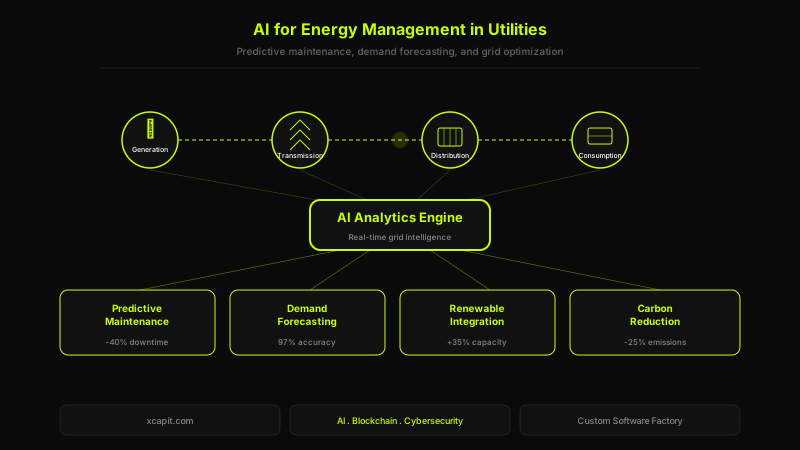
The energy sector is experiencing a convergence of pressures that makes artificial intelligence not merely useful but operationally necessary. Aging grid infrastructure, increasing renewable energy penetration, evolving regulatory requirements for emissions reporting, and rising consumer expectations for reliability and transparency — these forces are hitting utilities simultaneously. The organizations that deploy AI effectively will navigate this transition successfully. Those that do not will face escalating maintenance costs, stranded assets, and an inability to meet decarbonization targets.
At Xcapit, we have worked with energy utilities in Latin America — including provincial electric companies managing thousands of kilometers of distribution infrastructure — and the patterns we have observed are remarkably consistent. The utilities that achieve meaningful returns from AI investment share three characteristics: they start with a specific, measurable operational problem rather than a general 'AI strategy'; they invest in data infrastructure before investing in models; and they treat AI as a tool that augments experienced operators rather than replaces them. What follows is a practical guide to the four highest-impact applications of AI in energy management, based on what we have seen work in production.
Predictive Maintenance for Grid Infrastructure
The traditional approach to grid maintenance is either reactive — fix it when it breaks — or time-based — inspect and replace on a fixed schedule regardless of actual condition. Both approaches are expensive and suboptimal. Reactive maintenance causes unplanned outages that cost utilities between $5,000 and $50,000 per hour in direct costs, plus regulatory penalties and customer dissatisfaction. Time-based maintenance wastes resources by replacing equipment that still has years of useful life while sometimes missing components that are about to fail between scheduled inspections.
AI-powered predictive maintenance analyzes data from multiple sources — vibration sensors on transformers, thermal imaging of transmission lines, oil quality measurements in high-voltage equipment, weather data, historical failure records — to predict which assets are likely to fail and when. The models learn patterns that human inspectors cannot detect: subtle correlations between ambient temperature variations, load patterns, and transformer degradation that precede failure by weeks or months.
- Transformer health monitoring: Machine learning models analyzing dissolved gas analysis, oil temperature, and load history can predict transformer failures 3-6 months in advance with over 85% accuracy, allowing planned replacement during low-demand periods.
- Transmission line risk assessment: Computer vision applied to drone imagery, combined with weather data and vegetation growth models, identifies sections at high risk of failure or wildfire ignition — a capability that would require thousands of manual inspection hours to replicate.
- Distribution network fault prediction: Pattern recognition across smart meter data, SCADA telemetry, and historical outage records can identify developing faults in the distribution network before they cause customer-affecting outages.
- Substation equipment lifecycle optimization: AI models that consider actual operating conditions rather than manufacturer specifications can extend equipment service life by 20-30% for assets in favorable conditions while flagging premature aging in stressed equipment.
Our experience building custom software for energy utilities has shown that the data integration challenge is typically harder than the AI modeling challenge. Most utilities have the sensor data they need, but it exists in siloed systems that were never designed to share information. Building the data pipeline that aggregates SCADA, GIS, work management, and sensor data into a unified analytics platform is the critical first step — and it is where custom development becomes essential, because no off-the-shelf product integrates cleanly with every utility's unique combination of legacy systems.
AI-Powered Demand Forecasting
Accurate demand forecasting is the foundation of efficient grid operation. Every megawatt of unnecessary generation capacity that a utility keeps online 'just in case' represents wasted fuel, increased emissions, and higher costs that ultimately flow to ratepayers. Conversely, underestimating demand leads to emergency purchases on spot markets at premium prices or, in extreme cases, rolling blackouts.
Traditional demand forecasting relies on statistical methods — regression models based on temperature, day of week, and historical patterns. These methods achieve reasonable accuracy under normal conditions but struggle with non-linear effects: the exponential increase in air conditioning demand above certain temperature thresholds, the impact of electric vehicle charging patterns, the demand reduction during major cultural events, and the increasing variability introduced by distributed solar generation. Machine learning models handle these non-linearities significantly better.
Modern AI demand forecasting systems ingest diverse data streams — weather forecasts (including cloud cover for solar prediction), economic indicators, event calendars, social media sentiment, smart meter data at granular geographic levels, and historical demand patterns at 15-minute resolution. Deep learning architectures such as LSTM networks and transformer-based models can capture temporal dependencies that traditional statistics miss. The result is 95-97% accuracy at 24-hour horizons and 90-93% accuracy at 7-day horizons — improvements of 3-5 percentage points over statistical baselines that translate to millions of dollars in operational savings annually for mid-sized utilities.
Optimizing Renewable Energy Integration
The fundamental challenge of renewable energy is intermittency. Solar generation peaks at midday when demand may not. Wind generation fluctuates with weather patterns that do not align with consumption needs. As renewable penetration increases — and regulatory mandates in most countries require it to — the grid must absorb increasingly variable supply without compromising reliability.
AI addresses this challenge at multiple levels. Short-term generation forecasting uses satellite imagery, atmospheric models, and historical patterns to predict solar and wind output 15 minutes to 48 hours ahead, enabling operators to pre-position conventional generation capacity accordingly. Intelligent storage dispatch algorithms determine optimal battery charge and discharge schedules based on predicted renewable output, demand forecasts, and electricity price signals. Dynamic grid balancing systems use real-time optimization to continuously adjust the generation mix as conditions change, minimizing curtailment of renewable energy while maintaining frequency and voltage stability.
The impact is substantial. Utilities deploying AI-optimized renewable integration report 25-35% increases in renewable energy absorption capacity without additional grid infrastructure investment. This means more clean energy reaches consumers, curtailment losses decrease, and the economic case for further renewable investment improves. For utilities in Latin America — where solar and wind resources are abundant but grid infrastructure is often constrained — this capability is transformative. At Xcapit, our work in the energy sector, including projects with provincial utilities, has given us deep understanding of the specific integration challenges that utilities face in this region.
Reducing Carbon Footprint with AI
Beyond operational efficiency, AI enables utilities to measure, manage, and reduce their carbon footprint with a precision that was previously impossible. Emissions tracking systems that combine generation data, fuel consumption records, and grid flow analysis can calculate real-time carbon intensity across the entire system — not just annual averages that obscure hourly and seasonal variation. This granular measurement is the foundation for meaningful reduction.
AI-optimized dispatch algorithms can explicitly incorporate carbon intensity as an objective alongside cost and reliability. When multiple generation options can meet demand, the system selects the lowest-carbon mix that satisfies all constraints. Combined with accurate demand and renewable generation forecasting, this approach can reduce system-level emissions by 15-25% without building any new generation capacity — simply by operating existing assets more intelligently. For utilities facing ESG reporting requirements and carbon reduction targets, this capability provides both the measurement infrastructure and the operational lever to demonstrate genuine progress.
Implementation Strategy for Utilities
The practical path to AI deployment in utilities follows a sequence that respects the sector's operational realities: these are organizations where a software failure can mean blackouts, where regulatory oversight is intense, and where the workforce has deep domain expertise that must be integrated rather than bypassed.
- Phase 1 — Data foundation (3-6 months): Audit existing data sources, establish data quality baselines, build integration pipelines that unify SCADA, GIS, AMI, and work management data. This is not glamorous but it determines whether everything that follows succeeds or fails.
- Phase 2 — Pilot deployment (3-4 months): Select one high-impact use case — typically predictive maintenance for a specific equipment class — and deploy a working system with clear success metrics. The goal is to demonstrate value while building organizational confidence.
- Phase 3 — Scaling and integration (6-12 months): Expand successful pilots to additional use cases and geographic areas. Build the operational workflows that embed AI insights into daily decision-making. Train operators to work with AI recommendations rather than ignore them.
- Phase 4 — Advanced optimization (ongoing): Deploy multi-objective optimization systems that balance cost, reliability, and emissions simultaneously. Integrate across the full value chain from generation to consumption.
At each phase, the technology must serve the operators rather than the other way around. The best AI systems in utilities are the ones that experienced grid operators trust enough to act on — and that trust is earned through accuracy, transparency, and a track record of useful recommendations. If you are a utility evaluating AI investment, our team at Xcapit combines deep AI development expertise with practical experience in the energy sector. We build the custom platforms that connect your existing infrastructure to intelligent analytics.

Fernando Boiero
CTO & Co-Founder
Over 20 years in the tech industry. Founder and director of Blockchain Lab, university professor, and certified PMP. Expert and thought leader in cybersecurity, blockchain, and artificial intelligence.
Exploring energy transformation?
See how we connect demand forecasting, transformer digital twins, traceability, and smart-grid software into a practical utility roadmap.
You Might Also Like
If you can't measure it, you can't monetize it: the Córdoba and EPEC lesson applied to environmental assets in agriculture
Measure, certify and monetize. The three pillars we validated tokenizing renewable energy with EPEC, and how they transfer to the field to standardize green credits.
Digital transformation for utilities: modernizing energy without replacing the core
A practical guide for utilities and energy companies: how to integrate SCADA, IoT, AI, tokenization, and cybersecurity to modernize operations without replacing critical systems.
Shadow AI, ISO 42001, and the New Boardroom Risk in Oil & Gas
Why directors of oil & gas operators are starting to treat unmanaged AI use as a duty-of-care issue — and what to do in the next 90 days.