
Every technology leader eventually faces this decision: should we build an internal engineering team from scratch, or should we partner with a software factory to develop and ship our products? The answer seems like it should be straightforward, but in practice it depends on a matrix of factors — budget constraints, hiring timelines, technical complexity, organizational culture, and strategic priorities — that are different for every company.
This guide provides a structured, honest framework for making that decision. It is not an argument for one model over the other. Both approaches have real strengths and real limitations. The goal is to help you evaluate which model — or which combination — matches your specific situation in 2026.
What Is a Software Factory?
The term 'software factory' refers to a professional services company that designs, builds, and maintains custom software for clients. Unlike freelancers, a software factory operates as a structured organization with defined processes, quality controls, project management, and multidisciplinary teams. Unlike traditional agencies that may focus on websites or marketing, software factories specialize in engineering complex systems — enterprise platforms, fintech products, AI/ML applications, blockchain infrastructure, mobile products.
It is important to distinguish a software factory from staff augmentation. In a staff augmentation model, you hire individual contractors who plug into your existing team and operate under your management. In a software factory model, you engage a complete team — including project managers, architects, developers, QA engineers, and DevOps specialists — that operates as an autonomous unit responsible for delivering outcomes, not just hours. The software factory owns the process and methodology; you own the product and strategic direction.
A good software factory brings something no individual hire can: a system. They have solved the same categories of problems repeatedly, have established architectural patterns, pre-built components, CI/CD pipelines, security practices, and quality assurance processes that would take an in-house team years to develop organically. They trade novelty for reliability — which, for most business software, is exactly the right trade.
Pros and Cons of In-House Development
Building an internal engineering team is the default aspiration for most technology companies, and for good reason. It can be the right model. But the advantages come with costs that are often underestimated.
Advantages of In-House
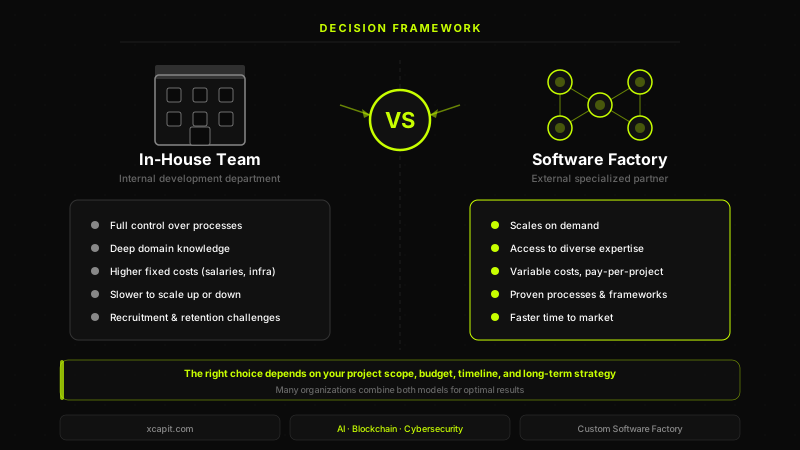
- Full control over priorities and execution — Your team works exclusively on your product. You set the sprint goals, you decide what gets built next, you own the daily trade-off decisions between speed and quality. There is no competing client pulling resources away.
- Deep institutional knowledge — Over time, an in-house team develops an understanding of your business domain, your users, your technical debt, and your architectural decisions that no external partner can fully replicate. This accumulated context is genuinely valuable and compounds over years.
- Cultural alignment — In-house engineers become part of your organizational culture. They attend all-hands meetings, understand company strategy, build relationships with product managers and stakeholders, and develop loyalty to the mission. This alignment often translates into better product decisions.
- IP protection is straightforward — When the code is written by your employees, on your equipment, during work hours, IP ownership is clean and unambiguous under most employment law frameworks.
- Long-term cost efficiency at scale — For companies that need 20+ engineers permanently, an in-house team is often cheaper per engineer-year than a software factory over a 5-year horizon, especially if the company is based in a region with competitive salary markets.
Disadvantages of In-House
- Hiring is slow and expensive — The average time to hire a senior software engineer in 2026 is 3 to 6 months, including sourcing, interviewing, offer negotiation, and notice periods. Recruiting costs (agency fees, job board postings, technical assessments, interviewer time) add $15,000-$30,000 per hire in the US. A bad hire — which happens in roughly 20% of engineering hires — costs 6-9 months of salary plus the opportunity cost of delayed delivery.
- Fixed costs are high and inflexible — Salaries, benefits, office space, equipment, software licenses, training, and management overhead are fixed whether your team is fully utilized or between projects. A 5-person engineering team in the US costs $850,000 to $1.3 million per year fully loaded. In Argentina, the same team costs $300,000-$450,000 — still a significant fixed commitment.
- Technology expertise is limited to who you hire — If your product requires React, Python, AWS, and blockchain expertise, you need engineers who cover all those skills. If a new project requires Rust, machine learning, or a specific compliance framework, you either hire more people (months of delay) or ask your existing team to learn on the job (risky for production systems).
- Retention is a constant challenge — The average tenure of a software engineer is 2.2 years. Every departure means knowledge loss, productivity disruption, and a new 3-6 month hiring cycle. In competitive markets, retention requires above-market compensation, strong engineering culture, and meaningful technical challenges — all of which demand ongoing investment.
- Management overhead scales non-linearly — Managing 3 engineers is not the same as managing 12. Beyond 5-6 engineers, you need team leads, an engineering manager, and formal processes for code review, sprint planning, on-call rotations, performance reviews, and career development. This management infrastructure costs 15-25% of total team costs.
Pros and Cons of a Software Factory
Partnering with a software factory is not outsourcing in the pejorative sense of the word. The best software factories operate as true technology partners with aligned incentives. But the model has genuine limitations that should be weighed honestly.
Advantages of a Software Factory
- Speed to productivity — A software factory can assemble a team of 3-8 experienced engineers and start delivering within 2 to 4 weeks. Compare this to the 3-6 month timeline for each in-house hire. For companies with time-sensitive projects, this difference alone can justify the model.
- Breadth of expertise — A 50-person software factory has specialists across multiple technologies, frameworks, and domains. Your project gets the right expert for each component — a blockchain architect for the smart contract layer, a React specialist for the frontend, an ML engineer for the recommendation engine — without hiring all of them permanently.
- Elastic scalability — Need to double the team for a 3-month push before a major launch? A software factory can accommodate that. Need to scale down after the release? No layoffs required. This elasticity is impossible with in-house teams without either overstaffing or traumatic workforce reductions.
- Established processes and quality systems — Mature software factories have battle-tested CI/CD pipelines, code review practices, QA frameworks, security protocols, and project management methodologies. An in-house team starting from scratch takes 12-18 months to develop comparable process maturity.
- Reduced management burden — The software factory manages its own engineers: hiring, training, career development, performance management, retention, benefits, equipment. Your involvement is at the product and strategy level, not the people management level. For a startup founder or a CTO already stretched thin, this is significant.
- Variable cost structure — Software factory engagements are typically OpEx (monthly retainers or time-and-materials billing) rather than CapEx. You pay for capacity when you need it and can adjust or pause the engagement based on business conditions. This flexibility is particularly valuable for startups and mid-market companies with variable funding cycles.
Disadvantages of a Software Factory
- Less control over daily execution — You can define what gets built and the quality standards, but you have less visibility into how the team spends each hour. Different software factories manage this transparency gap differently — some provide detailed time tracking and open communication channels; others operate more like a black box. Choose carefully.
- Knowledge concentration risk — If all your product knowledge lives within the software factory team, you are dependent on that partner. If the relationship ends — or key team members rotate to other projects — you can face a painful knowledge transfer period. Mitigating this requires disciplined documentation, shared repositories, and overlap periods during transitions.
- Cultural distance — No matter how good the communication, an external team will never have the same ambient understanding of your business that internal employees develop. They do not overhear hallway conversations about customer complaints, they do not attend the company retreat, they do not feel the urgency of a board meeting. This gap is manageable but real.
- Potential misalignment of incentives — A software factory's business model rewards them for maximizing billable hours or extending engagement duration. A good partner aligns with your goals; a mediocre one does not. Due diligence on references, retention rates, and engagement histories is essential.
- IP and confidentiality require explicit contracts — Unlike employment relationships where IP assignment is standard, software factory engagements require explicit work-for-hire agreements, NDAs, and IP assignment clauses. These are not difficult to establish but must be addressed upfront and reviewed by legal counsel.
When to Choose In-House Development
In-house development is the stronger choice when the software is not just a tool your company uses but is the core of what your company does. Here are the scenarios where building internally makes the most strategic sense.
- Software IS your product — If you are a SaaS company, a platform business, or a tech startup whose entire value proposition is the software itself, you need engineers who eat, sleep, and breathe your product. The institutional knowledge, iteration speed, and cultural alignment of an in-house team are critical when the software is the business.
- You need to maintain long-term proprietary advantage — If your competitive moat depends on proprietary algorithms, unique data pipelines, or technical innovations that must stay strictly confidential, in-house development gives you the tightest control over that intellectual property.
- You have the time and resources to hire properly — If your timeline allows 6-12 months of team building before major delivery milestones, and your budget supports the fully loaded costs of a permanent team, in-house gives you the best long-term economics for sustained development work.
- Your engineering culture is a strategic asset — Companies like Stripe, Airbnb, and Nubank invest heavily in engineering culture because it drives talent attraction, retention, and product quality. If your brand depends on being a top engineering destination, building that culture in-house is non-negotiable.
- Regulatory requirements mandate internal control — Certain industries (defense, classified government work, specific healthcare applications) have regulatory requirements that make external development partnerships impractical or require such extensive compliance overhead that the advantage disappears.
When to Choose a Software Factory
A software factory partnership is the stronger choice when speed, flexibility, or specialized expertise outweigh the benefits of permanent headcount. These scenarios consistently favor the external model.
- You need to ship fast — A startup that has secured funding and needs to deliver an MVP in 3 months cannot afford to spend those 3 months hiring. A software factory delivers a working team in weeks, not quarters.
- The project has a defined scope and timeline — Digital transformations, platform migrations, compliance overhauls, and specific product launches are finite initiatives. Hiring a permanent team for a 6-month project means you will need to find work for them after — or let them go. A software factory engagement scales naturally to the project boundary.
- You need technology expertise you do not have — If your project requires blockchain development, AI/ML engineering, cybersecurity auditing, or another specialized skill set, building that expertise in-house for a single project is impractical. A software factory with a roster of specialists gives you immediate access without permanent headcount.
- Your budget favors OpEx over CapEx — Startups with runway constraints, companies with seasonal development needs, and organizations that need to demonstrate value before committing to long-term investment all benefit from the variable cost structure of a software factory engagement.
- You want to validate before you commit — Some companies use a software factory to build the initial product, prove market fit, and then gradually build an in-house team that takes ownership of the codebase. This phased approach reduces risk significantly — you invest in permanent team only after the product has proven its value.
- Your core team is at capacity — Even companies with strong in-house teams sometimes need more capacity than they can absorb. A software factory can take on a parallel workstream — a mobile app, an integration layer, a data pipeline — without disrupting the core team's focus.
The Hybrid Model: The Best of Both Worlds
In practice, the most effective technology organizations in 2026 do not choose exclusively between in-house and external teams. They build a hybrid model that leverages the strengths of each approach while mitigating the weaknesses.
The hybrid model typically looks like this: a small in-house core team (CTO/VP Engineering, 1-2 senior architects, a product manager) owns the technical vision, product roadmap, architectural decisions, and code review standards. A software factory provides the execution capacity — the development teams that build features, write tests, manage deployments, and handle the day-to-day engineering work under the strategic direction of the in-house core.
This model offers several advantages. The in-house core maintains institutional knowledge and strategic control. The software factory provides scalable capacity without the fixed cost burden of a large permanent team. The in-house architects ensure code quality and architectural consistency across the external team's output. And the model can evolve over time — you can gradually increase the in-house team as the company grows, shifting more work internally when the economics justify it.
The hybrid model works best when the in-house and external teams operate as one unit. Shared Slack channels, joint sprint ceremonies, merged code repositories, and unified deployment pipelines. The worst version of the hybrid model is when the two teams operate in silos — the in-house team doing the 'important' work while the external team handles 'overflow' — which creates resentment, knowledge gaps, and quality inconsistencies. Integration requires intentional effort and strong leadership.
Cost Comparison: Real Numbers for 2026
Cost is rarely the sole deciding factor, but it is always a factor. Here is a realistic comparison for a 5-person engineering team delivering a mid-complexity product over 12 months.
In-House Team: US-Based
A team of 5 engineers (2 senior, 2 mid-level, 1 junior) in the US carries these costs. Base salaries: $680,000-$900,000/year ($160K-$200K for seniors, $120K-$150K for mid-level, $80K-$100K for junior). Benefits and overhead (health insurance, 401K match, PTO, payroll taxes, equipment, office/remote stipends): add 25-35%, bringing the total to $850,000-$1,215,000/year. Recruiting costs to assemble this team: $75,000-$150,000 (agency fees or 4-6 months of recruiter salary plus tools). Ramp-up time: 3-6 months to hire, 1-3 months for each engineer to reach full productivity. Realistic productive output in Year 1: 7-9 months of full-team delivery. First-year total cost including recruiting and ramp: $950,000-$1,350,000.
In-House Team: Argentina/LATAM-Based
The same 5-person team in Argentina costs significantly less. Base salaries: $210,000-$330,000/year ($3,500-$5,500/month for seniors, $2,500-$4,000/month for mid-level, $1,500-$2,500/month for junior). Benefits and overhead (social security contributions, vacation, aguinaldo, equipment): add 30-40%, bringing the total to $275,000-$460,000/year. Recruiting costs: $20,000-$40,000. Ramp-up timeline is similar: 2-4 months to hire (slightly faster market), 1-2 months to productivity. First-year total cost: $320,000-$520,000. The LATAM talent market is highly competitive for top-tier engineers, and salaries have been rising 10-15% annually in USD terms. These ranges reflect current market rates, not historical ones.
Software Factory: LATAM-Based
A 5-person team from a LATAM-based software factory (dedicated team model) typically costs $25,000-$50,000/month depending on seniority mix and the factory's positioning. That translates to $300,000-$600,000/year. This includes project management, QA, DevOps, and engineering management overhead that you would need to hire separately for an in-house team. There are no recruiting costs, no ramp-up delay (2-4 weeks to start), no benefits administration, and no retention risk on your side. First-year total cost: $300,000-$600,000 with productive output starting in month 1.
The unit economics shift as you extend the timeline. Over 3 years, the in-house LATAM team becomes cheaper on a per-engineer basis (assuming low turnover). Over 1-2 years, the software factory is typically more cost-effective when you factor in the hidden costs of hiring, management overhead, and attrition. The crossover point depends heavily on your retention rate and management efficiency.
Decision Framework: A Structured Checklist
Use this framework to evaluate your specific situation. For each factor, honestly assess which model better fits your current reality — not where you aspire to be in three years, but where you are today.
- Timeline to first delivery — If you need productive engineering output within 4 weeks: software factory. If you can wait 4-6 months to assemble a team: in-house is viable.
- Project duration — For a defined initiative under 12 months: software factory. For ongoing product development spanning multiple years: in-house or hybrid.
- Technology breadth required — If the project spans 3+ technology domains (e.g., frontend + backend + blockchain + AI): software factory provides broader access. If it is concentrated in 1-2 domains: in-house can cover it.
- Budget structure — If you need predictable monthly costs with flexibility to scale up or down: software factory (OpEx). If you have the budget for long-term salaries and can absorb fixed costs through low-utilization periods: in-house (CapEx/OpEx mix).
- Strategic importance of the software — If the software IS your product and defines your competitive position: lean heavily toward in-house for the core, with a software factory for acceleration. If the software supports your business but is not the business itself: a software factory can handle it end-to-end.
- Existing technical leadership — If you have a strong CTO or VP Engineering who can direct external teams: hybrid model works well. If you have no technical leadership: hiring a technical leader first and using a software factory for execution is safer than trying to build an entire team from scratch.
- Hiring market conditions — If you are in a city with abundant engineering talent and a strong employer brand: in-house hiring is feasible. If you are competing for talent in a tight market or need niche specialists: a software factory bypasses the hiring bottleneck.
- Risk tolerance — If you cannot afford a 6-month delay from a bad hire or a slow ramp-up: software factory reduces this risk. If you can absorb early-stage inefficiency in exchange for long-term team stability: in-house is the better long-term investment.
- Organizational readiness — If you have engineering management capabilities, established development processes, and the infrastructure to support a team: in-house is straightforward. If you are building from zero: a software factory provides the process and structure while you develop internal capabilities.
If your answers point clearly in one direction, the decision is straightforward. If they split roughly evenly, the hybrid model — an in-house technical core augmented by a software factory — is almost certainly the right approach.
Common Mistakes to Avoid
Regardless of which model you choose, these are the mistakes that most commonly lead to poor outcomes.
- Choosing in-house purely for control — Control is valuable, but it comes at a cost. If you do not have the management capacity to exercise that control effectively, you end up with an expensive team that drifts without direction. An unmanaged in-house team underperforms a well-managed external one.
- Choosing a software factory purely on price — The cheapest option is rarely the most cost-effective. A factory billing $20/hour with a team that misses deadlines and produces buggy code will cost you more than one billing $60/hour that delivers on time with production-quality output. Evaluate total cost of delivery, not hourly rate.
- Underestimating the transition cost — Whether you are transitioning from in-house to external, external to in-house, or between software factories, the knowledge transfer and ramp-up period is real. Budget 4-8 weeks of reduced productivity during any transition.
- Treating the software factory as a vendor instead of a partner — The build-it-and-throw-it-over-the-wall approach produces mediocre results regardless of how talented the external team is. The best outcomes come from integrated collaboration: shared goals, transparent communication, joint problem-solving.
- Not investing in documentation — This applies to both models but is especially critical with external teams. Architecture decision records, API documentation, deployment runbooks, and onboarding guides are insurance against knowledge loss. Make documentation a first-class deliverable, not an afterthought.
The companies that get this decision right do not treat it as a permanent, binary choice. They evaluate their needs at each stage of growth, remain open to shifting the balance between internal and external capacity, and invest in the processes — documentation, code standards, communication frameworks — that make any model work effectively. The model matters less than the discipline with which you execute it.

José Trajtenberg
CEO & Co-Founder
Lawyer and international business entrepreneur with over 15 years of experience. Distinguished speaker and strategic leader driving technology companies to global impact.
Need custom software that scales?
From MVPs to enterprise platforms — built right.
You Might Also Like
Custom software or an existing solution? How to make the best decision for your company
Buy or build is one of the most important decisions in any digital transformation project. When each option makes sense, why the right question is not binary, and how to assess long-term impact.
What is technical debt and why can it slow down a company's innovation?
Technical debt does not appear on any balance sheet, but it makes every new feature more expensive and limits your ability to adopt AI or automation. What it is, how to spot it, and why modernizing does not mean starting from scratch.
Outsourcing Software Development to Argentina: A 2026 Guide for US & European Companies
Everything you need to know about outsourcing software development to Argentina -- from timezone advantages and talent pool to legal frameworks, costs, and how to choose the right partner.