
Argentina's software industry is projected to reach $2.7 billion by 2026, making it one of the most dynamic technology markets in Latin America. With over 700 development companies competing for international contracts — from boutique studios to enterprise-scale software factories — the selection problem is not finding a partner. It is finding the right one. Most decision-makers default to comparing hourly rates, a metric that reveals almost nothing about long-term value. The difference between a successful technology partnership and a costly misfire comes down to how rigorously you evaluate what matters: engagement fit, domain expertise, security posture, and innovation capability. This guide provides the framework.
Why Argentina? The Nearshore Advantage
Before evaluating individual companies, it helps to understand why Argentina specifically has become a preferred destination for nearshore software development. The country's advantages are structural, not circumstantial — they are built into its education system, economic structure, and geographic position.
- 4th largest tech talent pool in Latin America, with over 115,000 software professionals and strong growth driven by world-class universities (UBA, ITBA, Universidad Nacional de Córdoba) that produce 15,000+ engineering graduates annually.
- Cost structure of $25-99/hr versus $150-300/hr in the US — representing 40-80% savings on comparable talent. Argentina's economic dynamics create exceptional value at the senior and architect level specifically.
- 1-3 hour timezone overlap with US East Coast and 4-6 hours with Western Europe — enabling real-time collaboration rather than the asynchronous relay that plagues offshore engagements with 8-12 hour gaps.
- High English proficiency among senior developers and technical leads, particularly in the Córdoba and Buenos Aires technology ecosystems where international work is the norm.
- A strong fintech and blockchain ecosystem — Argentina ranks among the global leaders in crypto adoption and has produced companies operating across DeFi, digital payments, and tokenization.
- Cultural alignment with US and European work styles: direct communication, problem-surfacing behavior, and professional norms that reduce the management overhead common in higher-context cultures.
The 4 Engagement Models Explained
The engagement model you choose determines the economics, management burden, and quality ceiling of your partnership. Mismatching model to situation is one of the most expensive mistakes in software outsourcing — more costly, often, than choosing the wrong vendor within the right model. Each model has a specific sweet spot.
Staff Augmentation
Individual developers or small groups are embedded into your existing teams, working under your technical leadership and processes. Pros: maximum flexibility, fast onboarding (1-2 weeks), direct control over priorities. Cons: you bear the management overhead, knowledge stays with your organization only if you manage knowledge transfer, and you need existing technical leadership to direct the work. Best for: filling specific skill gaps, scaling existing teams during peak periods, or accessing specialists (blockchain, AI, cybersecurity) that you cannot hire locally.
Dedicated Teams
A self-managed team works exclusively on your project with a team lead or tech lead provided by the partner. Pros: deep product knowledge accumulation, team cohesion, long-term stability. Cons: minimum commitment (typically 6+ months), slower initial velocity as the team ramps up. Best for: ongoing product development where continuity matters more than flexibility, and where you want your partner to own execution quality rather than just providing bodies.
Project-Based (Software Factory)
The partner takes ownership of delivering a defined product or feature set, with fixed scope, timeline, and typically fixed price. Pros: clear accountability, predictable cost, reduced management burden on your side. Cons: scope changes are expensive, the partner controls architecture and technical decisions, less flexibility mid-stream. Best for: well-defined products, MVPs, system migrations, or platform builds where requirements are stable and you want turnkey delivery.
Innovation Lab / Co-creation
A collaborative R&D engagement where the partner contributes not just engineering execution but technical vision, prototyping capability, and domain expertise in emerging technologies. Pros: access to frontier capabilities (AI agents, blockchain protocols, advanced cybersecurity), shared risk on innovation, faster path from concept to proof of concept. Cons: requires strong alignment on vision and goals, outcomes are less predictable than project-based work. Best for: exploring AI, blockchain, or emerging technology applications where you need a partner who has built production systems in the domain, not just theoretical knowledge.
The most advanced partners in Argentina offer hybrid models that combine elements of these approaches. Companies like Xcapit, for example, blend software factory execution rigor with innovation lab co-creation capability — allowing clients to get predictable delivery on their core product while simultaneously exploring frontier technology applications with the same team.
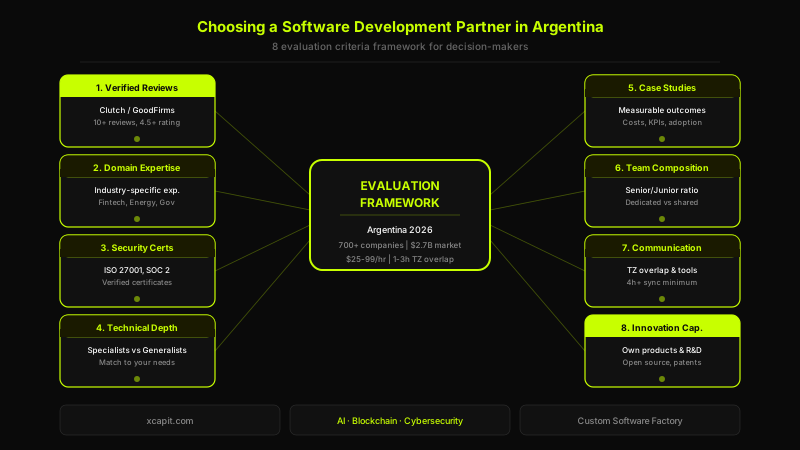
8 Evaluation Criteria That Actually Matter
RFPs and vendor evaluations in software development tend to focus on the wrong things — team size, years in business, logo walls of past clients. These criteria select for large, established firms that may or may not be the right fit. The following eight criteria are what actually predict partnership quality.
1. Verified Client Reviews
Platforms like Clutch and GoodFirms provide verified, anonymity-protected client reviews that cannot be fabricated. Look for a minimum of 10+ reviews with a 4.5+ average rating. Read the detailed reviews, not just the scores — pay attention to how the company handled problems, not just how well things went when everything was smooth. A company with 15 reviews averaging 4.7 that includes honest accounts of challenges overcome is more trustworthy than one with 5 perfect scores.
2. Domain Expertise
Generic software development capability is commodity. What differentiates a partner is whether they have built production systems in your specific domain — fintech, energy, government, healthcare, logistics. Domain expertise means they understand the regulatory constraints, the common integration patterns, the user expectations, and the failure modes specific to your industry. Ask for case studies in your vertical, not just a general portfolio.
3. Security Certifications
ISO 27001 and SOC 2 Type II are the baseline certifications that demonstrate a company takes information security seriously at an organizational level — not just as a project-level concern. Ask to see the actual certificates, not just logos on a website. Any company that claims security expertise but cannot produce current certification should be questioned. For blockchain and fintech projects specifically, ask about smart contract audit methodologies and penetration testing practices.
4. Technical Depth vs. Breadth
Some companies are deep specialists — they excel in a narrow set of technologies and domains. Others are broad generalists who can staff almost any project. Neither is inherently better; the question is which matches your need. If you need a blockchain protocol implementation, you want a specialist who has done it before. If you need a standard web application, a capable generalist may be more cost-effective. Be wary of companies that claim deep expertise in everything — true depth is narrow by definition.
5. Case Studies with Measurable Outcomes
The difference between a marketing case study and a useful one is specificity. 'We helped a fintech company improve their platform' tells you nothing. 'We reduced transaction processing costs by 34% through smart contract automation for a company processing $2M monthly in cross-border payments' tells you a great deal. Demand measurable outcomes: cost reductions, performance improvements, user adoption numbers, time-to-market acceleration. If a company cannot quantify the impact of their work, they likely have not measured it.
6. Team Composition
Ask for the exact team that will work on your project, including seniority levels, years of experience, and relevant domain background. Understand the ratio of senior to junior engineers — a team with one senior and five juniors will produce different quality than three seniors and two mid-levels, even if the total headcount and blended rate look similar. Ask whether resources are dedicated or shared across projects. Insist on meeting the key technical leads before signing.
7. Communication and Timezone Overlap
Clarify the communication infrastructure: what tools (Slack, Teams, Jira), what cadence (daily standups, weekly demos, sprint reviews), what language proficiency level for each team member, and how many hours of real-time overlap you will have daily. Best practice is a minimum of 4 hours of overlap for synchronous collaboration. Ask about escalation procedures — when something goes wrong at 4 PM your time, who do you call and what is the response time commitment?
8. Innovation Capability
Does the company build its own products, maintain an R&D lab, contribute to open source, or hold patents? Companies that innovate internally tend to bring stronger problem-solving to client work because their engineers are accustomed to thinking beyond requirements — they think about product-market fit, architecture scalability, and technology selection at a strategic level. A company like Xcapit, which maintains its own products (Shelter, AidLink) alongside client work, demonstrates this dual capability.
Red Flags to Watch For
In a market with 700+ providers, filtering out problematic partners early saves significant evaluation time. These warning signs should prompt caution or elimination.
- No verifiable reviews on third-party platforms — relying solely on testimonials on their own website.
- No published case studies with named clients or measurable outcomes.
- No security certifications (ISO 27001, SOC 2) and no clear security methodology.
- Unwillingness to share team composition, individual CVs, or allow you to interview proposed team members.
- Rates significantly below market ($10-15/hr for senior developers) — at this pricing, you are getting juniors labeled as seniors, shared resources across multiple clients, or both.
- No clear software development methodology — no mention of agile practices, sprint cadence, code review processes, or CI/CD infrastructure.
- High turnover indicators: vague answers about team stability, inability to show long-tenure employees, or reluctance to commit specific named individuals to your project.
Pricing Benchmarks: What to Expect in 2026
Understanding the current market rate structure helps you evaluate proposals realistically. These ranges reflect quality Argentine development companies — firms with verified reviews, security certifications, and demonstrated delivery capability. Rates below these ranges typically indicate quality compromises.
- Junior developers (1-3 years): $20-35/hr
- Mid-level developers (3-6 years): $35-55/hr
- Senior developers and tech leads (6-10+ years): $55-99/hr
- Architects, specialists, and principal engineers: $80-150/hr
- Note: Blockchain and AI/ML specialists command a 20-40% premium over general software development rates at equivalent seniority levels
For fixed-price project engagements, current market benchmarks are: $15,000-$50,000 for MVPs and proof-of-concept products; $50,000-$200,000 for full product builds with multiple integrations; $200,000+ for enterprise platform development, complex system migrations, or multi-year engagements. These ranges assume standard complexity — projects involving real-time systems, blockchain protocol work, or advanced AI typically land at the upper end or above.
10 Questions to Ask Before Signing
These questions are designed to surface the information that actually predicts partnership success. Ask them in your evaluation meetings and pay attention to the specificity and candor of the answers.
- What is your information security certification status, and can you provide current certificates (not just claims)?
- What is the average tenure of your senior engineers, and what is your annual developer turnover rate?
- How do you handle intellectual property ownership — will all code, documentation, and artifacts be assigned to us with a clean IP transfer?
- Describe your escalation process: when a project is off-track, who gets involved and what specific actions are triggered?
- Are you willing to sign our NDA and data processing agreement, or do you require using your own templates?
- What compliance certifications do you hold beyond ISO 27001 (SOC 2, GDPR readiness, industry-specific standards)?
- How flexible are you on technology stack — will you work with our preferred technologies, or do you require using your own?
- What does post-launch support look like — SLAs, response times, dedicated support team vs. rotating on-call?
- Can you provide three references from clients in our industry or with similar project complexity who we can speak with directly?
- What is your approach to knowledge transfer — how do you ensure we are not locked into a dependency on your team?
Making Your Decision
The right software development partner in Argentina is not the cheapest option — it is the one that combines technical excellence with domain expertise, certified security practices, and the innovation capability to solve problems you have not yet defined. The companies that deliver the most value over multi-year partnerships are those that bring a point of view to your technology strategy, not just engineering labor.
Companies like Xcapit demonstrate this by combining software factory execution discipline with innovation lab R&D capability, ISO 27001 certified security, and real-world case studies across fintech, energy, humanitarian aid, and government — including work with UNICEF, major utilities, and leading fintech platforms. That combination of rigor and ambition is what separates a vendor from a partner.
Argentina's software industry offers genuine world-class capability at compelling economics. The framework in this guide will help you find the partner who can deliver on that promise for your specific needs. If you want to discuss your evaluation criteria or compare engagement models for your situation, we are available to share our perspective — learn more about our approach at /how-we-work and /engagement-models.

José Trajtenberg
CEO & Co-Founder
Lawyer and international business entrepreneur with over 15 years of experience. Distinguished speaker and strategic leader driving technology companies to global impact.
Need custom software that scales?
From MVPs to enterprise platforms — built right.
You Might Also Like
Outsourcing Software Development to Argentina: A 2026 Guide for US & European Companies
Everything you need to know about outsourcing software development to Argentina -- from timezone advantages and talent pool to legal frameworks, costs, and how to choose the right partner.
Custom software or an existing solution? How to make the best decision for your company
Buy or build is one of the most important decisions in any digital transformation project. When each option makes sense, why the right question is not binary, and how to assess long-term impact.
Software Factory vs In-House Development: A Decision Framework for 2026
A balanced, data-driven guide for CTOs and engineering leaders comparing in-house development teams with software factory partnerships. Includes cost breakdowns, decision criteria, hybrid models, and a structured framework to make the right choice for your organization.