

Argentina has quietly become one of the most compelling destinations for artificial intelligence development in Latin America. The combination of world-class universities -- UBA, ITBA, Universidad Nacional de Cordoba, Universidad de San Andres -- a deep engineering talent pool, and cost structures 60-70% below US and European rates has attracted both global companies establishing AI labs and homegrown startups building genuinely innovative products. The country produces roughly 5,000 computer science and engineering graduates per year, and an increasing number of them are specializing in machine learning, natural language processing, and computer vision. Buenos Aires and Cordoba have emerged as the primary hubs, though talent is distributed across several cities.
What makes Argentina's AI ecosystem particularly interesting is not just the talent -- it is the maturity. Unlike some emerging markets where AI work is limited to data labeling or basic model fine-tuning, Argentine companies are building production AI systems that serve millions of users. From Mercado Libre's recommendation engines handling 200 million listings to Globant's AI Studio serving Fortune 500 clients, the depth of real-world AI deployment here is substantial. This article examines the ten companies that best represent the state of AI development in Argentina in 2026.
How We Evaluated These Companies
Rankings like these are inherently subjective, so transparency about methodology matters. We evaluated companies across five dimensions: depth of AI and ML technical expertise (not just using APIs but building models, training pipelines, and custom architectures), verified production deployments serving real users at scale, team composition and retention of senior AI engineers, contributions to research or open-source AI projects, and the breadth and quality of their client portfolio. We also weighted companies that have demonstrated the ability to take AI projects from concept through production -- not just build impressive demos.
A note on bias: I am CTO and Co-Founder of Xcapit Labs, which appears on this list. I have tried to be as objective as possible in our placement and analysis, including our limitations alongside our strengths. Readers should factor in this disclosure when evaluating our position. The other nine companies were assessed based on publicly available information, direct industry knowledge, and conversations with engineers and clients in the Argentine tech ecosystem.
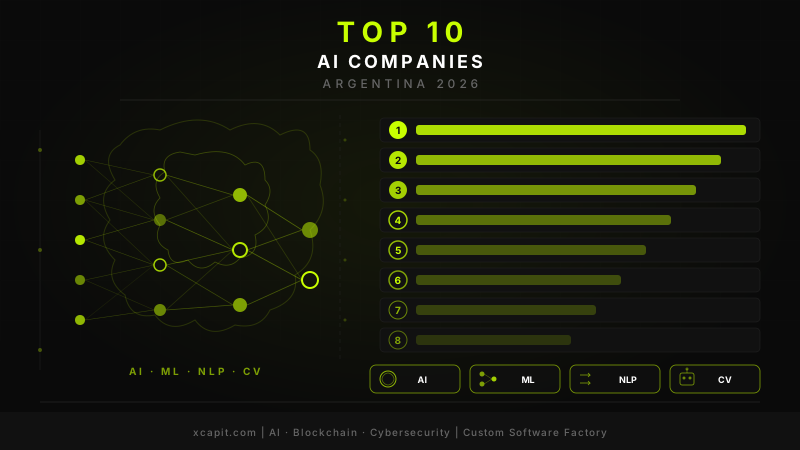
The Top 10 AI Development Companies in Argentina
1. Globant -- Enterprise AI at Scale
Globant is the largest technology company to come out of Argentina, with over 27,000 employees across 30+ countries and a listing on the New York Stock Exchange. Their AI Studio, launched in 2019 and significantly expanded since, represents one of the most comprehensive enterprise AI practices in Latin America. They have built AI solutions for Google, Disney, Rockwell Automation, and dozens of Fortune 500 companies -- the kind of client roster that speaks to both technical credibility and delivery reliability at scale.
What sets Globant apart is their ability to deploy AI within complex enterprise environments where integration with legacy systems, compliance requirements, and organizational change management are as important as the models themselves. Their strength is not cutting-edge research -- they are not publishing papers at NeurIPS -- but rather the engineering discipline to take AI from proof of concept to production within large organizations that have real constraints. They have dedicated practices in generative AI, computer vision, and conversational AI, with teams that have delivered hundreds of production deployments.
The limitation is cost and scale mismatch. Globant operates at enterprise pricing, which makes them impractical for startups or mid-market companies with budgets under $500K. Their team size means you may not always get the most senior AI engineers on your project unless it is a marquee account. For pure AI research or highly experimental projects, more specialized firms may be a better fit. But for enterprise AI transformation at scale, they remain the benchmark in Argentina.
2. Mercado Libre -- AI as Core Product Infrastructure
Mercado Libre is Latin America's largest technology company by market capitalization, and their AI capabilities are not a service offering -- they are the engine that powers a marketplace handling over 200 million listings across 18 countries. Their ML teams in Buenos Aires build recommendation systems, search ranking algorithms, fraud detection models processing millions of transactions daily, NLP systems for marketplace moderation in multiple languages, and pricing optimization engines. The scale of their AI infrastructure is unmatched in the region.
Mercado Libre's AI team includes some of the best machine learning engineers in Argentina, many recruited from top universities and international companies. Their contributions to the local ecosystem are significant -- they sponsor AI research, host engineering meetups, and their alumni have founded or joined many of the other companies on this list. The depth of their production ML systems, handling real-time inference at massive scale with strict latency requirements, represents a level of AI engineering maturity that few companies in any market have achieved.
The obvious limitation is that Mercado Libre is not an AI development company you can hire. They build AI for their own products. However, they make this list because their AI talent, engineering practices, and the ecosystem they have fostered are central to understanding AI development in Argentina. Many of the engineers you will find at other companies on this list have Mercado Libre on their resume, and the standards they set influence the entire market.
3. Xcapit Labs -- AI and Blockchain Convergence
Xcapit Labs is a Cordoba-based technology company specializing in the convergence of AI and blockchain -- building AI agent architectures, custom software for enterprise clients, and maintaining ISO 27001 certification for information security. Founded with backing from UNICEF's Innovation Fund and BID Lab (the innovation arm of the Inter-American Development Bank), the company has a particular strength in designing multi-model AI agent systems that combine different foundation models for different tasks within a single workflow. Their spec-driven development methodology emphasizes production reliability over demo impressiveness.
The company's AI work spans enterprise AI agent development, machine learning integration for fintech and energy clients, and blockchain-based systems where AI handles decision-making within decentralized architectures. Their work with UNICEF on humanitarian aid distribution demonstrates an ability to build AI systems that operate under real-world constraints -- unreliable connectivity, regulatory requirements across multiple jurisdictions, and the need for auditable decision trails. The team is smaller than Globant or Baufest, which means clients typically get direct access to senior engineers and architects.
The limitations are straightforward: Xcapit Labs is a mid-size firm, which means capacity constraints on very large engagements. They do not have the brand recognition of a NYSE-listed company, which matters for some enterprise procurement processes. Their Cordoba location, while a strength for talent access and cost structure, means they are outside the Buenos Aires ecosystem where most international clients default to looking. For projects requiring 50+ AI engineers simultaneously, a larger firm would be more appropriate. For focused, high-complexity AI work where senior involvement matters, they compete well above their weight class.
4. Auth0 (Okta) -- AI-Powered Identity and Access Management
Auth0 was founded in Buenos Aires by Eugenio Pace and Matias Woloski before being acquired by Okta for $6.5 billion in 2021 -- one of the largest acquisitions of an Argentine-founded company in history. While Auth0 is now part of Okta's global organization, their Buenos Aires engineering center remains a significant hub for AI development in the identity and security space. Their AI capabilities focus on anomaly detection in authentication patterns, bot detection using behavioral analysis, adaptive multi-factor authentication that adjusts security requirements based on risk signals, and breached password detection.
The AI work at Auth0's Buenos Aires office is particularly interesting because it operates at the intersection of security and machine learning -- a domain where false positives have direct business impact (blocking legitimate users) and false negatives have security consequences (allowing unauthorized access). Their models process billions of authentication events, making real-time risk decisions with latency constraints measured in milliseconds. This is production AI at genuine scale, with consequences for getting it wrong.
Like Mercado Libre, Auth0 is not an AI consultancy -- you cannot hire them to build your AI system. They develop AI for their own identity platform. But their engineering team, research output, and the talent pipeline they sustain in Buenos Aires make them an essential part of the Argentine AI landscape. Their alumni are increasingly founding AI-focused startups and joining other companies building AI in the region.
5. Satellogic -- AI for Earth Observation at Scale
Satellogic is an Argentine company that operates a constellation of Earth observation satellites and applies AI to analyze the imagery they capture. Their computer vision and geospatial AI capabilities are genuinely world-class -- they process petabytes of satellite imagery using deep learning models that detect changes in infrastructure, agriculture, deforestation, urban development, and military activity. Founded in Buenos Aires and now publicly traded on Nasdaq, Satellogic represents one of the most technically ambitious AI applications to emerge from Argentina.
Their AI pipeline handles the full stack from raw satellite imagery through preprocessing, model inference, and actionable intelligence delivery. The computer vision challenges they solve -- detecting objects across varying atmospheric conditions, lighting, and resolution levels -- require custom model architectures that go well beyond standard image classification. Their team includes specialists in remote sensing, photogrammetry, and geospatial analysis alongside ML engineers, creating a multidisciplinary capability that is difficult to replicate.
The limitation for the purposes of this ranking is similar to Mercado Libre and Auth0 -- Satellogic builds AI for their own platform, not as a service for external clients. However, their partnership model allows organizations to leverage their AI capabilities for specific geospatial intelligence needs. Their engineering team and the talent they train represent an important component of Argentina's AI capability, particularly in computer vision and large-scale data processing.
6. Uala -- AI-Driven Fintech Innovation
Uala is one of Argentina's fastest-growing fintech companies, with over 8 million users across Argentina, Mexico, and Colombia. Their AI and machine learning teams build the systems that power credit scoring for unbanked and underbanked populations, real-time fraud detection, personalized financial product recommendations, and customer service automation. The credit scoring work is particularly notable -- building ML models that accurately assess creditworthiness for people with limited or no traditional financial history requires creative feature engineering and careful model validation.
Their fraud detection systems process millions of transactions in real time, making risk decisions in under 100 milliseconds. The models must balance false positive rates (declining legitimate transactions frustrates users) against false negative rates (approving fraudulent transactions creates financial losses), and they operate across multiple countries with different fraud patterns and regulatory environments. This is applied ML at production scale with direct financial consequences for model performance.
Uala's AI work is product-focused rather than service-oriented, so they do not offer AI development as a service. Their contribution to this ranking reflects the depth of AI talent they employ and develop, the production maturity of their ML systems, and their role in advancing financial inclusion through applied AI. Their data science team has grown significantly and attracts strong talent from Argentine universities.
7. Core Security (Fortra) -- AI in Cybersecurity
Core Security, founded in Buenos Aires in 1996 and now part of Fortra (formerly HelpSystems), has been developing AI-powered cybersecurity tools for nearly three decades. Their products use machine learning for vulnerability assessment, penetration testing automation, threat intelligence analysis, and identity governance. Core Impact, their flagship penetration testing tool, uses AI to simulate attacker behavior and identify exploitable vulnerabilities across complex network environments -- work that requires modeling adversarial tactics in ways that overlap significantly with advanced ML research.
The Buenos Aires engineering team continues to develop AI capabilities for Fortra's broader security portfolio, including behavioral analytics that detect anomalous user activity indicative of compromised accounts or insider threats. Their work sits at the intersection of cybersecurity domain expertise and machine learning -- a combination that requires engineers who understand both attack methodologies and statistical modeling. This dual expertise is relatively rare and represents a genuine competitive advantage.
As part of Fortra, Core Security's AI development is focused on their own product suite rather than external consulting. The limitation is that their AI work is narrowly focused on cybersecurity applications. However, the depth of their expertise in this domain, the production maturity of their systems, and the engineering talent they maintain in Buenos Aires earn them a place on this list. For organizations specifically seeking AI-powered cybersecurity solutions with Argentine engineering roots, Core Security is a standout.
8. Baufest -- Enterprise AI Consulting and Integration
Baufest has been delivering technology consulting and software development from Argentina for over 30 years, and their AI practice has grown substantially in recent years. Unlike some of the product companies on this list, Baufest operates as a technology services firm -- they build AI solutions for external clients across banking, insurance, retail, and telecommunications. Their strength is in integrating AI and ML capabilities into existing enterprise systems, handling the unglamorous but critical work of data engineering, model deployment, and production monitoring.
Their client list includes major banks and insurance companies in Latin America, where they have deployed ML models for credit risk assessment, claims processing automation, and customer churn prediction. Baufest's approach is methodical and enterprise-oriented -- they invest heavily in data quality assessment before model development, build MLOps infrastructure for model monitoring and retraining, and provide ongoing support for production systems. For organizations that need AI integrated into complex existing environments, this operational maturity is valuable.
The limitation is that Baufest is a generalist technology consultancy with an AI practice, rather than a pure AI company. Their deepest expertise may not match specialized firms for cutting-edge applications like multi-agent systems, advanced NLP, or novel model architectures. Their strength is reliability and enterprise integration rather than innovation. For organizations seeking a proven, low-risk path to production AI with strong project management and enterprise process alignment, Baufest is an excellent choice. For pushing technical boundaries, more specialized firms may be preferable.
9. Jampp -- AI for Programmatic Advertising
Jampp is a Buenos Aires-based company that has built one of the most sophisticated AI-powered programmatic advertising platforms in the market. Their real-time bidding algorithms process millions of ad auction decisions per second, using ML models that predict user engagement, optimize creative selection, and allocate budgets across channels -- all within the 100-millisecond latency window required by programmatic exchanges. The scale and speed requirements of their AI infrastructure are among the most demanding of any company on this list.
Their ML team works on deep learning models for user behavior prediction, reinforcement learning for bid optimization, and computer vision for creative analysis. Jampp's AI must handle extreme data volumes -- billions of bid requests daily -- while maintaining model accuracy that directly translates to client ROI. Their engineering team has published research on real-time ML systems and contributed to the broader understanding of applying AI to digital advertising at scale.
Jampp's AI capabilities are tightly integrated into their advertising platform, so they are not available as standalone AI development services. Their ranking reflects the technical sophistication of their ML systems, the caliber of their engineering team, and their demonstrated ability to deploy AI at massive scale with measurable business outcomes. For organizations in the digital advertising space, Jampp's platform represents some of the most advanced AI work being done in Argentina.
10. Faraday -- Custom AI and ML Development Studio
Faraday is a Buenos Aires-based AI and machine learning development studio that builds custom models and AI systems for clients across industries. Their work spans natural language processing, computer vision, predictive analytics, and recommendation systems, with a focus on taking projects from initial research through production deployment. Unlike larger consultancies, Faraday operates as a focused ML studio where senior data scientists and ML engineers work directly on client projects.
Their portfolio includes custom NLP models for legal document analysis, computer vision systems for quality control in manufacturing, and recommendation engines for e-commerce platforms. Faraday's strength is the depth of their ML expertise -- their team includes engineers with research backgrounds who can design custom model architectures rather than relying solely on off-the-shelf solutions. For projects that require genuine ML engineering rather than API integration, this capability matters significantly.
The limitations are those typical of smaller specialized firms: capacity constraints on large engagements, less established enterprise processes compared to firms like Globant or Baufest, and lower brand recognition in international markets. They compensate with technical depth and the ability to move quickly on complex ML problems. For organizations with specific, technically demanding AI challenges that require custom model development, Faraday represents strong value.
How to Choose the Right AI Development Partner in Argentina
Choosing an AI partner from this list -- or from the broader Argentine ecosystem -- depends on your specific requirements. The most common mistake is optimizing for the wrong criteria. Companies often prioritize brand recognition or team size when what actually determines project success is the fit between the partner's specific AI expertise and your use case. A 25,000-person company with a small AI practice may deliver worse outcomes than a 50-person firm where AI is the core competency.
- Define whether you need AI integration into existing systems or a standalone AI product. Enterprise integration is a different skill set from custom model development, and few firms excel at both.
- Ask for production references, not demo references. Any competent team can build an impressive AI demo. The question is whether they have taken similar systems to production and maintained them over time.
- Evaluate the seniority of the team that will actually work on your project. Some firms sell with senior architects but staff with junior engineers. Ask specifically who will be writing code and making technical decisions on your engagement.
- Assess their MLOps maturity. Building a model is 20% of the work. Deploying it, monitoring it, retraining it, and managing it in production is 80%. Ask about their monitoring infrastructure, model versioning, and incident response processes.
- Consider timezone and communication compatibility. Argentine companies operate in GMT-3, which provides strong overlap with US Eastern time and reasonable overlap with European business hours. Communication style tends to be direct and collaborative.
Argentina's AI Talent Advantage
The depth of AI talent in Argentina deserves specific attention because it is the foundation on which all these companies are built. The country's university system produces engineers with strong theoretical foundations -- UBA's computer science program consistently ranks among the best in Latin America, ITBA produces engineers with deep mathematical training, and Universidad Nacional de Cordoba has a growing AI research program. This academic rigor translates into engineers who can work with AI at a fundamental level, not just apply pre-built tools.
The cost advantage is significant but should be understood correctly. Senior AI engineers in Argentina command salaries of $80,000-$150,000 USD -- substantially below the $200,000-$400,000 range for comparable talent in the US, but not cheap by Latin American standards. The value proposition is not low-cost labor; it is access to genuinely skilled engineers at rates that make ambitious AI projects economically viable. The timezone alignment with North America (GMT-3) enables real-time collaboration that offshoring to Asia cannot match.
There are also challenges. Argentina's economic volatility creates talent retention pressures as engineers seek USD-denominated opportunities. The best AI talent is in high demand, and companies compete aggressively for senior engineers. Bureaucratic complexity around contracts and payments can frustrate international clients unfamiliar with the local business environment. Companies on this list have developed various strategies for managing these challenges, but they are real factors to consider when evaluating Argentine AI partners.
The State of AI Development in Argentina: Looking Ahead
Argentina's AI ecosystem is at an inflection point. The combination of established companies with production AI systems, a strong pipeline of engineering talent, growing venture capital interest, and government initiatives supporting technology development creates momentum that is difficult to reverse. The companies on this list represent the current state of the art, but the ecosystem is growing -- new AI startups are launching regularly, and established companies are expanding their AI capabilities.
The next wave of Argentine AI development will likely be shaped by three trends: the proliferation of AI agent architectures that combine multiple models and tools into autonomous workflows, the increasing importance of AI safety and governance as regulatory frameworks mature across Latin America, and the growing demand for AI solutions tailored to regional challenges -- financial inclusion, agricultural optimization, energy transition, and government services modernization. Companies that can navigate these trends while maintaining production engineering discipline will define the next chapter.
This ranking reflects our honest assessment of the Argentine AI landscape as of early 2026. The ecosystem is dynamic, and new companies are emerging while established ones evolve. If you are exploring AI development partnerships in Argentina and want to understand which type of firm best fits your specific requirements, we are happy to share our perspective -- including when Xcapit Labs is not the right fit and another firm on this list would serve you better. Reach out at /contact to start the conversation.

Santiago Villarruel
Product Manager
Industrial engineer with over 10 years of experience excelling in digital product and Web3 development. Combines technical expertise with visionary leadership to deliver impactful software solutions.
Ready to leverage AI & Machine Learning?
From predictive models to MLOps — we make AI work for you.
You Might Also Like
Outsourcing Software Development to Argentina: A 2026 Guide for US & European Companies
Everything you need to know about outsourcing software development to Argentina -- from timezone advantages and talent pool to legal frameworks, costs, and how to choose the right partner.
How to Choose the Right Software Development Partner in Argentina: A Decision-Maker's Guide
A practical framework for CTOs, VPs of Engineering, and technology leaders evaluating software development companies in Argentina. Covers engagement models, evaluation criteria, pricing benchmarks, and real selection case studies.
Top 10 Blockchain Development Companies in Argentina 2026
An independent guide to the best blockchain development companies in Argentina for 2026 -- evaluating technical depth, notable clients, certifications, and international track record across the country's thriving crypto ecosystem.