
Argentina has quietly become one of the world's most important blockchain ecosystems. The country consistently ranks among the top fifteen globally in cryptocurrency adoption, driven by a population that understands inflation hedging better than almost anyone, a $2.7 billion technology industry that punches well above its weight, and a developer community that has been contributing to open-source blockchain infrastructure since the early days of Bitcoin. Buenos Aires and Cordoba have become genuine hubs for Web3 talent, with dozens of companies building everything from Layer 2 scaling solutions to decentralized identity systems to enterprise tokenization platforms.
I have spent the past decade building technology at the intersection of blockchain, AI, and enterprise software. In that time, I have watched Argentina's blockchain ecosystem evolve from a handful of enthusiasts running Bitcoin nodes to a mature industry with companies serving UNICEF, central banks, and Fortune 500 clients. This guide is my attempt to map the landscape honestly -- identifying the companies that are doing serious work, the niches they occupy, and the criteria that matter when choosing a blockchain development partner.
How We Evaluated These Companies
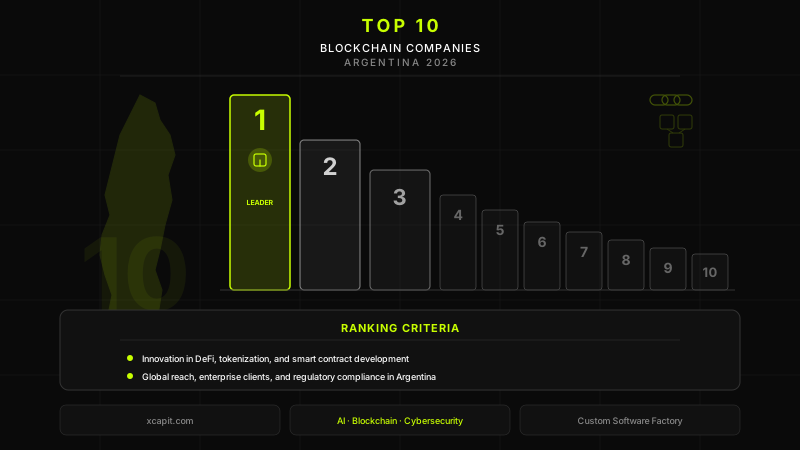
Ranking blockchain companies is inherently subjective, but I have tried to anchor this evaluation in criteria that matter to someone making a real hiring decision. Technical depth was the primary factor -- not just which blockchains a company supports, but how deeply they understand the protocols, whether they contribute upstream, and whether they have built production systems that handle real transaction volume. Team size and composition mattered because blockchain development requires a specific combination of cryptography knowledge, distributed systems experience, and smart contract security awareness that is difficult to find.
Notable clients and case studies provided evidence of real-world execution. Certifications like ISO 27001 and SOC 2 indicated organizational maturity around security -- critical in an industry where a single smart contract vulnerability can mean millions in losses. Open-source contributions demonstrated genuine technical engagement with the ecosystem. International track record showed whether a company could operate across jurisdictions, time zones, and regulatory environments. Finally, I considered longevity and financial stability -- blockchain development is a long-term commitment, and you need a partner that will be around to maintain what they build.
A note on disclosure: Xcapit Labs, the company that publishes this blog, is included in the ranking. I have been as transparent as possible about the criteria and the evidence behind each placement, and I encourage readers to verify claims independently and evaluate each company based on their own project requirements.
The Top 10 Blockchain Development Companies in Argentina
1. IOV Labs (RSK / Rootstock)
IOV Labs occupies a unique position in the global blockchain ecosystem: they built Rootstock (RSK), the first and most established smart contract platform secured by the Bitcoin network. This is not a company that builds applications on other people's infrastructure -- they built the infrastructure itself. RSK enables Ethereum-compatible smart contracts to run with Bitcoin's hash power securing them, which represents a fundamentally different security model than most Layer 2 solutions.
Founded in Buenos Aires with deep roots in Argentina's cryptography and computer science community, IOV Labs has grown into a truly international operation with teams across Latin America, Europe, and Asia. Their contributions to the broader ecosystem include RIF (RSK Infrastructure Framework), which provides decentralized storage, payments, and naming services on top of Rootstock. They have partnered with organizations ranging from central banks exploring CBDCs to international development agencies looking to deploy blockchain at national scale.
For organizations that need smart contracts with Bitcoin-level security, or that are building infrastructure that must integrate with the Bitcoin ecosystem, IOV Labs is the obvious choice. Their engineering depth at the protocol level is unmatched in Argentina and rare globally. The trade-off is that they are primarily an infrastructure company -- if you need a custom DeFi application or an NFT marketplace, there are better-suited partners on this list.
2. Ripio
Ripio is one of Latin America's largest and most established cryptocurrency companies, and while they are perhaps best known for their consumer exchange, their developer platform and blockchain infrastructure capabilities are substantial. Founded in Buenos Aires in 2013, they have survived multiple crypto cycles -- a track record of resilience that matters when you are choosing a long-term technology partner. Their platform processes millions of transactions and serves users across multiple Latin American countries.
What makes Ripio relevant for this list is not just their exchange but their developer tools and infrastructure. Ripio Credit Network was one of the first decentralized lending protocols in Latin America. They have built institutional-grade custody solutions, compliance frameworks for multiple regulatory jurisdictions, and API infrastructure that other companies use to build crypto-enabled products. Their understanding of regulatory compliance across Argentina, Brazil, Mexico, and other Latin American markets is a genuine competitive advantage that takes years to develop.
For companies looking to build financial products that involve cryptocurrency -- whether that is a neobank with crypto features, a remittance corridor, or a tokenized asset platform in Latin America -- Ripio's combination of regulatory knowledge, operational infrastructure, and developer tooling makes them a strong partner. They are less suited for non-financial blockchain use cases or projects targeting markets outside Latin America.
3. Xcapit Labs
Xcapit Labs, based in Cordoba, occupies an interesting niche at the intersection of blockchain, artificial intelligence, and international development. Selected for the UNICEF Innovation Fund and backed by BID Lab (the innovation laboratory of the Inter-American Development Bank), the company built a non-custodial wallet that reached over 4 million people across 167 countries -- a deployment scale that few Argentine blockchain companies have achieved. Their work was recognized as a Digital Public Good by the DPGA, placing it alongside projects from organizations like UNICEF and the World Bank.
On the enterprise side, Xcapit Labs has delivered smart contract development for notable Argentine companies including Naranja X, one of the country's largest fintech platforms. Their technical stack spans Polygon, Ethereum, and Stellar, with growing capabilities in AI-blockchain convergence -- an area that is becoming increasingly relevant as organizations look to build systems where AI agents interact with smart contracts and decentralized infrastructure. The company holds ISO 27001 certification, which remains relatively rare among blockchain-focused development firms in the region.
Where Xcapit Labs differentiates is in projects that require both blockchain infrastructure and AI capabilities -- tokenization with automated compliance, smart contracts with machine learning-driven risk assessment, or decentralized systems that incorporate predictive analytics. They are a mid-sized team, which means they are selective about projects but offer senior-level attention that larger firms cannot always guarantee. For organizations outside the AI-blockchain intersection, or those needing a very large team for rapid scaling, other options on this list may be more appropriate.
4. ZirconTech
ZirconTech has built a strong reputation in enterprise blockchain development, earning a Clutch Award in 2021 and accumulating roughly 12 verified client reviews -- a notable achievement in an industry where many companies struggle to produce verifiable references. Their focus on Polygon and Ethereum positions them in the most widely adopted enterprise blockchain ecosystems, and their project portfolio spans supply chain, healthcare, and financial services.
What distinguishes ZirconTech is their emphasis on enterprise integration. Blockchain projects in corporate environments rarely exist in isolation -- they need to connect with ERP systems, compliance workflows, identity management platforms, and existing databases. ZirconTech has demonstrated competence in building these bridges, which is often the hardest part of an enterprise blockchain deployment. Their team includes specialists in both blockchain development and traditional enterprise architecture, a combination that is more valuable than it might appear.
For mid-to-large enterprises looking to integrate blockchain capabilities into existing operations -- supply chain traceability, document verification, or cross-organizational data sharing -- ZirconTech's enterprise focus and proven client track record make them a reliable choice. They are less focused on DeFi or consumer-facing crypto products, so teams building in those spaces should look elsewhere on this list.
5. Rather Labs
Rather Labs is a Buenos Aires-based Web3 specialist that has carved out a strong position in DeFi and NFT development. With approximately 9 verified reviews on Clutch, they have established credibility in an area where many companies talk about Web3 but few have the production deployments to prove it. Their portfolio includes DeFi protocol development, NFT marketplace architecture, and smart contract security auditing -- the core building blocks of the decentralized finance ecosystem.
Their technical team demonstrates genuine depth in Solidity development, DeFi protocol mechanics, and the security considerations that are unique to smart contract systems. In DeFi, a single vulnerability can lead to catastrophic financial loss, and Rather Labs' focus on security auditing alongside development suggests they understand this reality at a practical level. They have worked with both startups building novel DeFi protocols and established companies adding DeFi capabilities to existing products.
For teams building DeFi protocols, NFT platforms, or other Web3-native products, Rather Labs offers specialized expertise that generalist development firms cannot match. Their focused positioning means they understand the specific challenges of building in DeFi -- MEV protection, oracle design, liquidity bootstrapping, governance mechanisms -- at a level of detail that comes from extensive practice. For enterprise blockchain or non-DeFi use cases, their specialization may be too narrow.
6. Koibanx
Koibanx has built a distinctive business providing blockchain infrastructure for financial institutions, with a particular focus on asset tokenization and Central American expansion. While most companies on this list serve clients globally from Argentina, Koibanx has pursued a geographically focused strategy -- building deep relationships with banks, regulators, and government entities across Latin America and Central America. Their work with El Salvador's government on blockchain infrastructure demonstrated an ability to operate at the intersection of technology and public policy.
Their tokenization platform enables financial institutions to create, manage, and trade tokenized assets -- real estate, bonds, equity, and other financial instruments -- on blockchain infrastructure while maintaining compliance with local regulations. This is technically demanding work that requires understanding not just the blockchain layer but also securities law, custody requirements, and settlement mechanics across different jurisdictions.
For financial institutions looking to tokenize assets, build CBDC infrastructure, or create regulated blockchain-based financial products in Latin America, Koibanx's combination of technical capability and regulatory expertise is highly relevant. Their geographic focus is both a strength and a limitation -- they know the Latin American financial regulatory landscape deeply, but organizations targeting markets outside the region may find partners with more relevant experience.
7. Extrimian
Extrimian has positioned itself as Argentina's leading provider of self-sovereign identity (SSI) and decentralized identity solutions. In an era where digital identity is becoming the foundation for everything from financial services to healthcare to government services, Extrimian's focus on W3C-compliant verifiable credentials and decentralized identifiers (DIDs) addresses a fundamental infrastructure need. Their solutions enable individuals and organizations to control their own identity data without relying on centralized authorities.
Their enterprise-focused approach means they build identity solutions that integrate with existing corporate infrastructure -- HR systems, customer onboarding platforms, access management tools, and compliance workflows. They have worked with government agencies, financial institutions, and healthcare organizations, deploying identity systems that need to meet regulatory requirements while maintaining the privacy benefits of decentralized architecture.
For organizations exploring decentralized identity -- KYC/AML compliance, verifiable credentials for education or professional certifications, or privacy-preserving identity systems -- Extrimian offers specialized expertise that few Argentine companies can match. Their narrow focus on identity means they are not the right choice for DeFi, tokenization, or general smart contract development, but within their niche they offer genuine depth and production-proven solutions.
8. SpaceDev
SpaceDev stands out for sheer volume of verified client feedback -- with approximately 48 reviews on Clutch, they have the most extensive track record of client satisfaction on this list. While their focus extends beyond blockchain into broader technology services, their blockchain and crypto development practice has delivered projects across DeFi, NFT, and enterprise blockchain categories. This breadth means they can assemble teams with the right mix of blockchain specialists and complementary skills -- backend, frontend, DevOps, QA -- for complex projects that span multiple technology domains.
Their larger team size and broader technology capabilities make them well-suited for projects where blockchain is one component of a larger system. Many real-world blockchain deployments require significant non-blockchain engineering -- web applications, mobile apps, API layers, database systems, cloud infrastructure -- and SpaceDev can deliver the full stack rather than requiring clients to coordinate multiple vendors.
For organizations that need a blockchain component integrated into a larger technology initiative, or that value extensive verifiable client references as part of their vendor evaluation, SpaceDev is a solid choice. The trade-off with their broader focus is that their blockchain-specific expertise may not match the depth of companies that specialize exclusively in Web3 or a specific blockchain vertical.
9. Atix Labs
Atix Labs operates as a boutique smart contract development firm with particular strength in DeFi protocol development. Their smaller team size means they are selective about projects, but this selectivity translates into senior-level engagement on every contract. When you work with Atix Labs, you are working directly with the developers who write the code, not with an account management layer that translates requirements to a junior development team.
Their portfolio includes DeFi protocol implementations, smart contract security work, and blockchain integration projects for both startups and mid-market companies. They demonstrate solid understanding of the Ethereum ecosystem and its tooling -- Hardhat, Foundry, OpenZeppelin -- and their focus on quality over quantity has earned them repeat business from clients who value craftsmanship. For early-stage blockchain startups or projects that require highly specialized smart contract work, their boutique model can deliver better results than larger firms where your project may not receive senior attention.
The limitation is scale. For large enterprise projects requiring 15-20 developers or aggressive timelines that demand parallel workstreams, Atix Labs' team size may be a constraint. They are best suited for technically complex projects of moderate scope where the quality and security of the smart contract code is the primary success factor.
10. Signatura
Signatura has built a focused business around blockchain-based digital signatures and document certification. While this is a narrower scope than most companies on this list, it addresses a genuine and growing market need -- verifiable, tamper-proof digital signatures with legal validity across multiple jurisdictions. Their platform enables organizations to sign, certify, and verify documents using blockchain as the trust layer, replacing centralized certification authorities with cryptographic proof anchored to public blockchains.
Their understanding of the legal frameworks governing digital signatures in Argentina and across Latin America is a genuine differentiator. Blockchain-based signatures are only valuable if they hold up legally, and Signatura has invested in building the regulatory and legal relationships needed to ensure their certifications are recognized by courts and regulatory bodies. They serve legal firms, notaries, government agencies, and enterprises that require high-assurance document verification.
For organizations specifically looking for blockchain-based document certification, digital signature, or notarization solutions, Signatura offers a mature, purpose-built platform. Their narrow focus means they are not suited for general blockchain development, DeFi, or other use cases, but within document certification they provide a turnkey solution backed by genuine legal and regulatory expertise that generalist blockchain firms would struggle to replicate.
How to Choose the Right Blockchain Development Partner
Choosing a blockchain development partner is not fundamentally different from choosing any technology partner, but the stakes are often higher. Smart contract bugs can be financially catastrophic. Poorly designed tokenomics can collapse an entire project. Regulatory missteps can result in legal action across multiple jurisdictions. Here are the criteria that matter most when making this decision.
- Match specialization to your use case -- A DeFi protocol needs different expertise than an enterprise supply chain solution. The best blockchain company for your project is the one whose core competency aligns with what you are building, not the one with the most impressive general portfolio.
- Verify with references, not demos -- Ask to speak with previous clients who deployed similar projects to production. A demo proves a team can write code; a reference call reveals whether they can ship, communicate, handle scope changes, and support a system over time.
- Evaluate security practices rigorously -- Ask about their smart contract auditing process, how they handle key management, whether they conduct formal verification, and what their incident response plan looks like. In blockchain, security is not a feature -- it is the foundation.
- Understand the regulatory landscape -- If your project touches financial services, identity, or data privacy, your development partner needs to understand the regulatory requirements in your target markets. Technical excellence without regulatory awareness is a liability.
- Assess long-term viability -- Blockchain projects typically require years of ongoing development and maintenance. Evaluate your partner's financial stability, team retention rates, and commitment to the blockchain space. A company that pivots away from blockchain in two years leaves you stranded with unmaintainable code.
- Consider timezone and communication -- Argentina (UTC-3) offers significant timezone overlap with North American and European business hours. Daily standups, real-time collaboration, and rapid issue resolution are dramatically easier when your team and your partner share working hours.
Argentina's Competitive Advantage for Blockchain Development
Argentina offers a compelling combination of factors for organizations looking to outsource or partner on blockchain development. The cost advantage is real but often overstated -- Argentine senior developers are not cheap, but they are 40-60% less expensive than equivalent talent in the United States or Western Europe while delivering comparable quality. The more significant advantage is access to a talent pool that has organic experience with the problems blockchain solves.
Argentines have lived with currency instability, capital controls, and financial system restrictions for decades. This is not abstract knowledge -- it is lived experience that produces developers who intuitively understand why decentralized finance matters, why self-sovereign identity is important, and why trustless systems have value. A developer who has personally experienced a bank freezing their savings brings a different level of motivation and understanding to building systems designed to prevent exactly that.
The timezone advantage for North American clients is substantial. Argentine teams overlap 6-8 hours with US Eastern time and 4-6 hours with US Pacific time, enabling real-time collaboration that is impossible with teams in India or Eastern Europe. The cultural alignment with Western business practices -- direct communication, individual accountability, comfort with agile methodologies -- reduces the friction that often accompanies offshore development partnerships.
Argentina's university system produces approximately 5,000 computer science and engineering graduates annually, many from institutions with strong research programs in cryptography, distributed systems, and formal verification -- all directly relevant to blockchain development. The country's vibrant startup ecosystem, anchored by unicorns like Mercado Libre and a thriving fintech scene, means developers often have experience working in fast-paced environments, handling ambiguity, and wearing multiple hats -- qualities that matter enormously in blockchain projects where requirements evolve rapidly and the technology itself is still maturing.
The Argentine blockchain ecosystem continues to evolve rapidly, with new companies emerging and existing ones expanding their capabilities. This guide reflects the landscape as of early 2026, and I plan to update it as the market develops. If you are evaluating blockchain development partners and want to discuss your specific requirements, I welcome the conversation -- whether Xcapit Labs is the right fit for your project or whether one of the other excellent companies on this list would serve you better. Reach out at /contact.

Fernando Boiero
CTO & Co-Founder
Over 20 years in the tech industry. Founder and director of Blockchain Lab, university professor, and certified PMP. Expert and thought leader in cybersecurity, blockchain, and artificial intelligence.
Building on blockchain?
Tokenization, smart contracts, DeFi — we've shipped it all.
You Might Also Like
Outsourcing Software Development to Argentina: A 2026 Guide for US & European Companies
Everything you need to know about outsourcing software development to Argentina -- from timezone advantages and talent pool to legal frameworks, costs, and how to choose the right partner.
How to Choose the Right Software Development Partner in Argentina: A Decision-Maker's Guide
A practical framework for CTOs, VPs of Engineering, and technology leaders evaluating software development companies in Argentina. Covers engagement models, evaluation criteria, pricing benchmarks, and real selection case studies.
Top 10 AI Development Companies in Argentina 2026
An in-depth ranking of the best AI and machine learning development companies in Argentina for 2026, covering expertise, production deployments, team depth, and what makes each firm unique in Latin America's fastest-growing tech ecosystem.