
If you are a CTO, VP of Engineering, or procurement manager evaluating where to outsource software development, Argentina deserves a place at the top of your shortlist. The country has quietly built one of the most capable software engineering ecosystems in the Western Hemisphere -- producing developers who consistently rank among the best in Latin America on global technical assessments, operating in time zones that enable real-time collaboration with both US and European teams, and offering cost structures that make senior engineering talent accessible at rates 50-70% below equivalent US compensation.
This is not a promotional piece for a single country. It is a practical, data-informed guide written from over fifteen years of experience building and managing software teams in Argentina -- working with clients ranging from UN agencies to fintech startups, from European energy companies to US enterprise platforms. We will cover the genuine advantages, the real risks, and the specific information you need to make an informed outsourcing decision. Where Argentina falls short, we will say so directly.
Why Argentina? The Structural Advantages
Argentina's position as a leading nearshore development destination is not accidental or recent. It is the product of structural factors -- educational investment, cultural orientation, economic dynamics, and geographic positioning -- that have compounded over decades. Understanding these structural advantages helps distinguish durable competitive strengths from temporary market conditions.
The country's technology sector generates over $2.5 billion in annual revenue and has been growing at 12-15% annually for the past five years. Argentina exports more software services per capita than any other Latin American country, and its developers are disproportionately represented in international open-source projects, competitive programming rankings, and global technology companies. Google, Microsoft, Amazon, and Mercado Libre all maintain significant engineering operations in Argentina -- not for cost arbitrage alone, but because the talent justifies the investment.
Argentina's Tech Talent Pool: Depth, Specialization, and Scale
Argentina has over 300,000 software professionals -- the fourth largest technology workforce in Latin America by absolute numbers and the largest per capita. More importantly, the quality distribution is skewed toward the upper end. The country's university system produces technically rigorous graduates who are trained in computer science fundamentals, not just framework-specific bootcamp skills.
The University Pipeline
Argentina's top engineering universities are globally competitive. The Universidad de Buenos Aires (UBA) consistently ranks among the top 100 worldwide for computer science. The Instituto Tecnologico de Buenos Aires (ITBA) produces engineers who are recruited directly by Silicon Valley firms. The Universidad Tecnologica Nacional (UTN), with campuses across the country, is the largest engineering university in Latin America and produces the bulk of Argentina's mid-career software professionals. The Universidad Nacional de Cordoba and its ecosystem of technology companies have made Cordoba the second-largest technology hub in the country.
These institutions produce approximately 20,000 STEM graduates annually, with a growing proportion choosing software engineering and data science specializations. The curriculum emphasizes mathematics, algorithms, and systems thinking -- which means Argentine developers tend to have strong fundamentals rather than just surface-level familiarity with popular frameworks. This matters most in complex projects involving distributed systems, cryptographic protocols, machine learning pipelines, or performance-critical applications.
Specialization Areas
Argentina has developed particular depth in several high-demand technology domains, driven by both academic strength and commercial ecosystem development.
- Artificial Intelligence and Machine Learning -- Argentina ranks among the top 5 countries in Latin America for AI research output. Buenos Aires and Cordoba have thriving AI communities, and Argentine AI engineers are increasingly working on production LLM applications, computer vision systems, and autonomous agent architectures.
- Blockchain and Web3 -- Argentina has one of the highest cryptocurrency adoption rates globally, which has fostered a deep blockchain development ecosystem. The country produces smart contract engineers, protocol developers, and DeFi architects who have built systems managing hundreds of millions in transaction volume.
- Fintech -- Argentina's complex financial environment has produced a generation of fintech engineers who understand payment systems, regulatory compliance, lending protocols, and financial data infrastructure at a level that purely technical talent from other regions cannot match.
- Cybersecurity -- With strong university programs in information security and a growing number of ISO 27001 and SOC 2 certified companies, Argentina has become a regional leader in cybersecurity consulting, penetration testing, and secure software development.
- Enterprise Software and Cloud -- A large base of developers experienced with AWS, Azure, GCP, microservices architecture, and enterprise integration patterns, developed through years of serving international clients in banking, insurance, and telecommunications.
Timezone and Communication: The Underrated Competitive Edge
If you have ever managed an offshore development team in India or Southeast Asia, you know that the 10-12 hour time difference is not merely an inconvenience -- it is a structural constraint that shapes every aspect of the engagement. Decisions queue overnight. Sprint ceremonies happen at awkward hours. Urgent issues wait until the next business day. The cumulative effect is a 20-40% reduction in effective velocity compared to what the same team could deliver with real-time access to stakeholders.
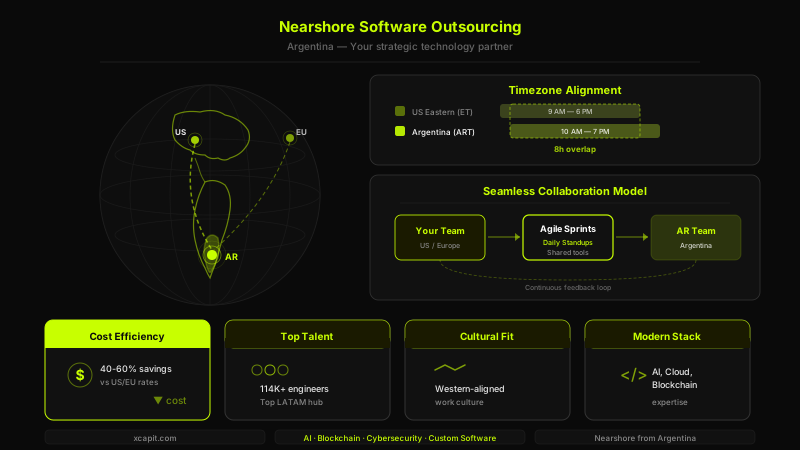
Argentina operates at UTC-3 year-round (the country does not observe daylight saving time). This creates the following overlaps with major business centers: 6-8 hours of overlap with US Eastern time, 5-7 hours with US Central, 3-5 hours with US Pacific, 4-5 hours with London and Western Europe, and 3-4 hours with Central Europe. For a US-based company, this means your Argentine development team is online and available for the majority of your workday. For a European company, there is a solid window of 4-5 hours every afternoon for synchronous collaboration.
The practical impact is significant. A question raised at 10 AM in New York gets answered by noon the same day in Buenos Aires. Sprint planning meetings happen in real time with full team participation. Code reviews and architectural discussions are synchronous conversations, not asynchronous comment threads that stretch across multiple days. Over a 12-month engagement, this same-day iteration capability translates to measurably faster delivery -- our own data shows 25-35% faster cycle times on comparable projects when comparing nearshore teams with synchronous overlap versus offshore teams with minimal overlap.
English Proficiency Among Argentine Developers
Argentina ranks first in Latin America for English proficiency according to the EF English Proficiency Index, placing in the 'high proficiency' band globally. Among software professionals specifically -- who consume English-language documentation daily, contribute to English-language open-source projects, and often work for international clients -- proficiency is substantially higher than the national average.
In practical terms, senior Argentine developers conduct technical discussions, code reviews, architectural presentations, and client meetings in English without meaningful friction. Technical vocabulary is genuinely universal in software engineering; the language of GitHub, Stack Overflow, cloud provider documentation, and academic papers is English, and any Argentine engineer working at a professional level has necessarily developed strong proficiency. Where language occasionally requires attention is in nuanced business communication -- complex contract negotiations or sensitive stakeholder management -- where having a bilingual project manager or account lead adds value.
Cost Analysis: What You Will Actually Pay
Cost is typically the primary driver of outsourcing decisions, and Argentina's economics are genuinely compelling. But the analysis needs to go beyond hourly rates to capture the total cost of engagement -- including coordination overhead, rework rates, management burden, and the hidden costs of timezone-driven delays.
Developer Rate Benchmarks (2026)
The following ranges reflect rates from quality Argentine software development companies -- firms with verified client reviews, security certifications, and demonstrated delivery track records. Rates significantly below these ranges should prompt scrutiny about quality, team composition, or resource-sharing practices.
- Junior developers (1-3 years experience): $20-35/hr
- Mid-level developers (3-6 years): $35-55/hr
- Senior developers and tech leads (6-10+ years): $55-90/hr
- Architects, principal engineers, and domain specialists: $80-130/hr
- AI/ML and blockchain specialists command a 20-40% premium over general software development at equivalent seniority
- Project managers, QA leads, and UX designers typically run 10-20% below developer rates at equivalent seniority
Comparison with Other Destinations
For context, here is how Argentina's rates compare with other common outsourcing destinations for senior software engineering talent. United States: $150-220/hr fully loaded. Western Europe (Germany, UK, Netherlands): $120-180/hr. Eastern Europe (Poland, Romania, Czech Republic): $60-100/hr. India (quality firms): $35-65/hr. Argentina sits in the $55-90/hr range for senior talent, placing it between Eastern Europe and India on raw rate -- but when total cost of engagement is calculated, Argentina frequently wins.
Total Cost of Engagement: The Numbers That Matter
Hourly rates tell you the price of labor. Total cost of engagement tells you the price of outcomes. The gap between these two figures is where many outsourcing decisions go wrong. Consider the hidden costs that accumulate in offshore engagements with large timezone differences: 15-25% additional management overhead from asynchronous coordination. 10-20% velocity reduction from delayed decision cycles. 5-15% rework costs from requirements misunderstandings that fester across timezone gaps. When these factors are quantified, a team billing at $40/hr in a 12-hour-different timezone can cost the same as a team billing at $65/hr in an aligned timezone -- with the aligned team delivering faster and with fewer quality issues.
Our own benchmarking across multi-year client engagements consistently shows that total cost of engagement for a well-managed Argentine nearshore team runs 15-25% lower than comparable offshore teams in Asia, despite higher nominal hourly rates. The difference comes entirely from coordination efficiency, lower rework rates, and the compounding effect of same-day iteration cycles.
Legal Frameworks and IP Protection
Intellectual property protection is the concern most frequently raised by US and European companies considering outsourcing software development to Argentina. It deserves a detailed and honest treatment, because the legal landscape is genuinely strong -- but it requires the same contracting discipline that you would apply in any jurisdiction.
International Treaty Framework
Argentina is a signatory to all major international intellectual property treaties: the Berne Convention for the Protection of Literary and Artistic Works (which covers software as a literary work), the TRIPS Agreement (Trade-Related Aspects of Intellectual Property Rights) as a WTO member, the WIPO Copyright Treaty, and the Paris Convention for the Protection of Industrial Property. This treaty framework provides a baseline of international IP protection that is equivalent to what you would find in any developed market.
Argentine IP Law: Key Provisions
Under Argentine law (Law 11.723 on Intellectual Property), software is protected as a literary work. Copyright in software vests automatically upon creation -- registration is not required for protection, though it is available and advisable for enforcement purposes. The key provisions relevant to outsourcing engagements include the following.
- Work-for-hire doctrine -- Argentine law recognizes that software created under a service contract can be assigned to the commissioning party. However, unlike US law where work-for-hire is the default in certain employment contexts, Argentine law generally vests initial copyright in the author. This means your contract must include an explicit IP assignment clause.
- IP assignment enforceability -- Contractual IP assignment clauses are fully enforceable under Argentine law. A well-drafted assignment clause that covers all work product, derivative works, and related materials provides the same practical protection as a US work-for-hire arrangement.
- Trade secret protection -- Argentine law (Law 24.766 on Confidential Information) provides statutory protection for trade secrets and confidential business information, including proprietary algorithms, source code, and technical documentation shared with development partners.
- NDA enforceability -- Non-disclosure agreements executed between Argentine and foreign parties are enforceable under Argentine law. For maximum protection, include a governing law clause (you can specify US or European law as governing), a dispute resolution mechanism (arbitration is generally more efficient than litigation for cross-border disputes), and specific remedies for breach.
Data Protection: Argentina's GDPR Equivalence
Argentina holds a distinctive position in Latin American data protection: it is one of the few countries globally recognized by the European Commission as providing an 'adequate level of data protection' under GDPR standards. Argentina's Personal Data Protection Law (Law 25.326) predates GDPR and was modeled on European data protection principles. This adequacy determination means that personal data can flow from the EU to Argentina without requiring additional safeguards like Standard Contractual Clauses -- a significant operational simplification for European companies outsourcing software development to Argentina.
For US companies subject to state-level privacy regulations (CCPA, CPRA, and the growing patchwork of state privacy laws), Argentina's strong data protection framework provides a level of regulatory alignment that most offshore destinations cannot match. When your development partner handles test data, user analytics, or production data as part of their engagement, having a partner in a jurisdiction with robust data protection law reduces your compliance risk.
Practical Contract Structure for IP Protection
Based on our experience structuring hundreds of international development contracts under Argentine law, the following contract provisions provide robust IP protection for clients outsourcing software development to Argentina.
- Explicit IP assignment clause covering all deliverables, work product, documentation, and derivative works -- executed as part of the master service agreement, not as a separate document that might be overlooked.
- Moral rights waiver to the extent permitted by Argentine law -- while moral rights cannot be fully waived under Argentine copyright law, they can be contractually limited to prevent interference with commercial exploitation of the assigned IP.
- Pre-existing IP carve-out clearly identifying any partner-owned frameworks, libraries, or tools that will be used in the engagement, with a perpetual, irrevocable license granted to the client for those components.
- Source code escrow or continuous delivery provisions ensuring the client has access to all source code, build scripts, and deployment documentation at all times -- not just upon project completion.
- Non-compete and non-solicitation clauses restricting the development partner from building competing products using knowledge gained during the engagement.
- Arbitration clause specifying ICC or AAA arbitration for dispute resolution -- faster, more predictable, and more easily enforceable across borders than litigation in either jurisdiction's courts.
Engagement Models for Outsourcing to Argentina
The engagement model you choose has a larger impact on outcomes than which specific company you select. Each model suits different organizational contexts, project types, and management preferences. Understanding the trade-offs prevents the single most expensive mistake in software outsourcing: choosing a model that does not match your situation.
Staff Augmentation
Individual developers or small groups embed into your existing teams, working under your technical leadership, using your tools and processes. This model works best when you have strong internal technical leadership and need to scale capacity or access specialists that you cannot source domestically. For US companies looking to hire developers, Argentina provides access to senior engineers at 50-60% of the cost of equivalent US contractors, with real-time timezone overlap. Typical ramp-up time is 1-3 weeks. The client retains full control but also bears the management overhead.
Dedicated Teams
A self-managed team -- typically including a tech lead, senior developers, QA, and optionally a project manager -- works exclusively on your product. The partner manages day-to-day execution while you set priorities and direction. This model suits ongoing product development where deep context accumulation and team stability matter. Minimum commitment is typically 6-12 months, and the team improves significantly after the first 2-3 months as they absorb domain knowledge. The economics favor long engagements: the ramp-up investment amortizes over time, and a dedicated team that knows your codebase and business context outperforms a rotating cast of contractors at any price point.
Fixed-Scope Projects
The partner takes ownership of delivering a defined product, feature set, or system -- with agreed scope, timeline, milestones, and typically a fixed or capped budget. This model works when requirements are well-defined, the technology is understood, and you want predictable cost and clear accountability. MVP development, system migrations, platform redesigns, and compliance implementations are common fixed-scope engagements. The trade-off is rigidity: changes in scope are expensive, and the partner necessarily makes architectural and implementation decisions that you may not control in detail.
Hybrid and Innovation Lab Models
For companies exploring AI, blockchain, or other emerging technologies, a hybrid model that combines structured software delivery with R&D co-creation is increasingly common. In this model, the Argentine partner contributes not just engineering labor but technical vision, prototyping capability, and domain expertise in frontier technologies. This is where the depth of Argentina's specialization ecosystem -- particularly in AI/ML, blockchain, and fintech -- becomes most valuable. A partner who has built production AI agent systems or deployed smart contracts managing real financial value brings qualitatively different insight than one who has only read the documentation.
Currency Dynamics: How the ARS/USD Exchange Impacts Outsourcing
Argentina's currency dynamics are a topic that every company outsourcing to the country needs to understand. The Argentine peso (ARS) has historically experienced significant depreciation against the US dollar and euro, driven by inflation and monetary policy. For companies paying in foreign currency, this creates both opportunities and considerations that require informed management.
The primary opportunity is cost competitiveness. Because Argentine software companies generate revenue in USD or EUR while their operating costs (salaries, office space, utilities) are largely denominated in pesos, periods of peso depreciation effectively reduce the real cost of Argentine engineering talent in dollar terms. This has been a significant driver of Argentina's attractiveness as an outsourcing destination, and it explains why the country can offer senior engineering talent at rates that would be unsustainable in economies with stable currencies.
Under the Milei administration's economic reforms beginning in late 2023, Argentina has moved toward currency stabilization and a more market-driven exchange rate. Inflation has decelerated significantly from its 2023 peak, and the government has pursued fiscal consolidation and capital market reform. For outsourcing clients, this means the extreme cost advantages of peak peso depreciation periods are moderating, but Argentina remains highly competitive on a talent-quality-to-cost basis. The stabilization also reduces one source of operational risk -- exchange rate unpredictability -- making long-term engagements easier to budget.
Practical Guidance on Currency and Payments
- Always denominate contracts in USD or EUR -- no reputable Argentine software company will quote in ARS for international clients. Dollar-denominated contracts eliminate exchange rate risk for the client entirely.
- Payment mechanisms: international wire transfer is standard. Argentine companies can receive USD payments through local bank accounts or through international payment platforms. Payment terms of net-30 are common for established relationships.
- Argentine companies handle peso conversion and local salary payments on their end -- this is entirely transparent to the client. You pay in dollars, they manage their local cost structure.
- For multi-year engagements, expect annual rate adjustments of 5-10% in USD terms as the Argentine economy stabilizes -- still well below the rate at which US developer compensation has been increasing.
Argentina's Technology Ecosystem: Industry Context
Argentina's outsourcing capability does not exist in isolation. It is embedded in a broader technology ecosystem that provides the supporting infrastructure, market dynamics, and innovation culture that shape the quality of engineering talent available to international clients.
Fintech Leadership
Argentina is one of the global leaders in fintech innovation, driven by a population that has historically sought alternatives to traditional banking due to inflation, capital controls, and banking crises. This environment produced Mercado Libre (Latin America's largest e-commerce and fintech platform, founded in Buenos Aires), Ualá (one of the fastest-growing digital banks in the region), and a dense ecosystem of crypto exchanges, lending platforms, and payment processors. For companies in financial services, banking, or payments, outsourcing software development to Argentina provides access to developers who have built production-grade financial systems and understand regulatory compliance, transaction processing, and security requirements firsthand.
Blockchain and Crypto
Argentina consistently ranks among the top 15 countries globally for cryptocurrency adoption. This has created a deep pool of blockchain developers with production experience across Ethereum, Solidity smart contracts, DeFi protocols, tokenization platforms, and cross-chain systems. Argentine blockchain companies have partnered with organizations including UNICEF, implementing blockchain-based financial inclusion solutions that have been deployed in multiple countries across Latin America and East Africa. The country's blockchain ecosystem is not limited to crypto speculation -- it includes serious infrastructure work in supply chain, identity, humanitarian aid distribution, and real-world asset tokenization.
Government and International Partnerships
Argentina's technology sector has an established track record with government and international organizations. Argentine software companies have built systems for national and provincial governments, participated in international development programs, and delivered technology for UN agencies. This institutional experience means that Argentine development partners understand compliance requirements, documentation standards, procurement processes, and the governance expectations that enterprise and government clients require -- capabilities that younger technology ecosystems in other nearshore destinations are still developing.
Risks and How to Mitigate Them
An honest guide to outsourcing software development to Argentina must address the risks. Every outsourcing destination has them; the question is whether you understand them and have mitigation strategies in place.
Macroeconomic Volatility
Argentina has experienced recurring macroeconomic instability -- including high inflation, currency devaluation, and periodic capital controls -- that creates uncertainty for both Argentine companies and their international clients. The current administration's reform program has made significant progress in stabilizing the economy, but Argentina's macroeconomic risk profile remains higher than Chile, Uruguay, or Colombia.
Mitigation: Use USD-denominated contracts to eliminate direct currency risk. Work with established Argentine companies (5+ years in business, diversified client base, audited financials) that have weathered previous economic cycles. Include business continuity provisions in contracts that address worst-case scenarios. For critical engagements, consider escrow arrangements for prepaid work.
Talent Retention in a Competitive Market
Argentina's best developers are in high demand from both domestic and international employers. The rise of remote work has enabled Argentine engineers to work directly for US companies at near-US rates, creating retention pressure on Argentine software companies. Annual developer turnover at mid-tier firms can run 20-30%, which disrupts continuity on long-term engagements.
Mitigation: Choose partners with demonstrated low turnover (ask for specific numbers). Companies that invest in culture, professional development, and competitive compensation retain talent better. Ask how the partner would handle a key team member departure mid-engagement -- the answer reveals their contingency planning maturity. Insist on knowledge documentation and pair programming practices that distribute context across the team rather than concentrating it in individual contributors.
Infrastructure and Connectivity
Argentina's internet infrastructure is strong in Buenos Aires, Cordoba, Mendoza, and Rosario -- the main technology hubs -- but less reliable in smaller cities. Power grid stability is generally good in urban areas but not immune to occasional disruptions.
Mitigation: Reputable development companies maintain redundant internet connections, backup power, and remote work infrastructure that mitigates local infrastructure issues. Ask about their business continuity setup. Cloud-based development environments, distributed version control, and CI/CD pipelines mean that brief connectivity interruptions rarely impact delivery. The Argentine technology workforce has operated in a hybrid/remote model since well before the pandemic, and the infrastructure to support distributed work is mature.
Political and Regulatory Risk
Argentina's political environment has historically featured significant policy swings between administrations, including changes to tax regimes, capital controls, and regulatory frameworks that can impact business operations. The Knowledge Economy Law (Ley de Economia del Conocimiento), which provides tax incentives for software companies, has enjoyed bipartisan support and survived multiple political transitions -- but individual policy details can change.
Mitigation: These risks primarily affect Argentine companies rather than their international clients. Your exposure is limited to partner stability -- if your partner's operations are disrupted by policy changes, your engagement is affected. Choosing established, financially sound partners and maintaining contractual provisions for transition support minimizes this risk. For engagements above $500K annually, consider dual-sourcing or having a documented transition plan to an alternative partner.
Cultural Affinity: Why It Matters More Than You Think
Cultural compatibility is often dismissed as a soft factor in outsourcing decisions. In practice, it is one of the strongest predictors of engagement success, because it determines the quality of daily communication, the speed of problem resolution, and the willingness of team members to surface issues before they become critical.
Argentine professional culture shares key characteristics with US and European work styles that directly impact software development outcomes. Communication is direct -- Argentine developers will tell you when a requirement is unclear, when a deadline is unrealistic, or when they disagree with a technical decision. This directness contrasts with some offshore cultures where hierarchical norms can cause problems to be communicated indirectly or late. In software development, where early identification of issues prevents exponential cost escalation, cultural directness is a tangible operational advantage.
Argentina's cultural orientation toward Europe and the United States -- shaped by immigration patterns, educational traditions, and commercial relationships -- means that shared cultural references, professional norms, and work-life expectations reduce the friction that often accompanies cross-cultural technology partnerships. Argentine developers understand agile methodology not as a rigid framework imposed by a client but as a natural way of working. They are comfortable with flat organizational structures, cross-functional collaboration, and the ambiguity that comes with iterative product development.
How to Choose an Argentine Development Partner: A Practical Checklist
Whether you are searching for a software development company in Argentina through Clutch, GoodFirms, or industry referrals, you will find hundreds of companies competing for international clients. Effective partner selection requires disciplined evaluation. The following checklist covers the criteria that most reliably predict partnership quality and engagement success.
Technical and Domain Evaluation
- Does the company have verified case studies with measurable outcomes in your specific industry or technology domain?
- Can they demonstrate production-level expertise in the specific technologies your project requires -- not just familiarity, but systems in production?
- What is their approach to code quality -- do they use code reviews, automated testing, CI/CD, and static analysis as standard practices?
- Do they maintain their own products or contribute to open source? Companies that build their own technology tend to bring stronger product thinking to client work.
- Can you interview the specific engineers who would work on your project, and assess their technical depth directly?
Security and Governance
- Do they hold ISO 27001 certification or SOC 2 Type II attestation? Ask to see current certificates, not just logos on a website.
- What are their access control practices for client source code, credentials, and production environments?
- How do they handle employee offboarding -- is access revocation immediate and auditable?
- For projects involving personal data, what data protection measures are in place, and are they aligned with GDPR or relevant US privacy requirements?
- Do they have a documented incident response plan, and can they describe a time they activated it?
Team and Communication
- What is their average senior engineer tenure? Companies with 3+ year average tenure provide much better continuity than those with sub-2-year averages.
- How do they handle key-person dependencies -- what happens if your lead developer leaves mid-project?
- What communication tools and cadences do they use, and are they willing to adopt your preferred tools?
- How many hours of daily real-time overlap will you have with the team?
- Can you speak with 2-3 references from clients with similar engagement size and complexity?
Commercial and Legal
- Are contracts denominated in USD or EUR with clear payment terms?
- Does the master service agreement include explicit IP assignment, NDA provisions, and data protection clauses?
- What is the termination clause -- can you exit the engagement with reasonable notice if the partnership is not working?
- Do they carry professional liability insurance (errors and omissions)?
- What is their approach to rate adjustments -- annual increases should be transparent, predictable, and justified.
Getting Started: A Recommended Evaluation Process
If you are ready to evaluate Argentine software development partners, the following process helps you move efficiently from initial shortlist to engaged partnership.
- Phase 1 -- Shortlist (1-2 weeks): Identify 5-8 candidates through industry directories (Clutch, GoodFirms), referrals, and targeted research. Filter on domain expertise, security certifications, and verified reviews. Eliminate any company that cannot demonstrate at least 3 relevant case studies.
- Phase 2 -- Technical evaluation (2-3 weeks): Conduct technical interviews with proposed team leads and senior engineers. Request architecture proposals or technical assessments for a representative scenario from your project. Evaluate communication quality, problem-solving approach, and cultural fit.
- Phase 3 -- Reference checks (1 week): Speak with 2-3 references per finalist. Ask specifically about challenges encountered and how the partner handled them. A reference who describes only positive experiences is either not being candid or has not tested the relationship under stress.
- Phase 4 -- Pilot engagement (4-8 weeks): Start with a defined pilot project -- ideally a real deliverable with clear success criteria, not a synthetic test. Evaluate delivery quality, communication effectiveness, and team dynamics under real conditions.
- Phase 5 -- Scale (ongoing): Based on pilot results, expand the engagement with confidence. The pilot experience provides the data you need to set realistic expectations for the full partnership.
Key Takeaways
Outsourcing software development to Argentina is not a cost-cutting tactic -- it is a strategic capability decision. The companies that extract the most value from Argentine partnerships are those that approach the relationship as a long-term collaboration rather than a labor arbitrage exercise. They invest in onboarding, provide context on business strategy, and treat their nearshore team as an extension of their organization rather than a vendor to be managed at arm's length.
If you are evaluating nearshore development options and want to understand what an Argentine technology partnership looks like in practice, we are available to share our model in detail. Xcapit has been building software from Cordoba, Argentina for over eight years -- serving clients from UNICEF to fintech platforms, with ISO 27001 certification, production expertise across AI, blockchain, and cybersecurity, and a team that has stayed together through every economic cycle Argentina has thrown at us. Learn more about our approach at /how-we-work and our engagement models at /engagement-models.

José Trajtenberg
CEO & Co-Founder
Lawyer and international business entrepreneur with over 15 years of experience. Distinguished speaker and strategic leader driving technology companies to global impact.
Need custom software that scales?
From MVPs to enterprise platforms — built right.
You Might Also Like
How to Choose the Right Software Development Partner in Argentina: A Decision-Maker's Guide
A practical framework for CTOs, VPs of Engineering, and technology leaders evaluating software development companies in Argentina. Covers engagement models, evaluation criteria, pricing benchmarks, and real selection case studies.
Custom software or an existing solution? How to make the best decision for your company
Buy or build is one of the most important decisions in any digital transformation project. When each option makes sense, why the right question is not binary, and how to assess long-term impact.
Software Factory vs In-House Development: A Decision Framework for 2026
A balanced, data-driven guide for CTOs and engineering leaders comparing in-house development teams with software factory partnerships. Includes cost breakdowns, decision criteria, hybrid models, and a structured framework to make the right choice for your organization.