
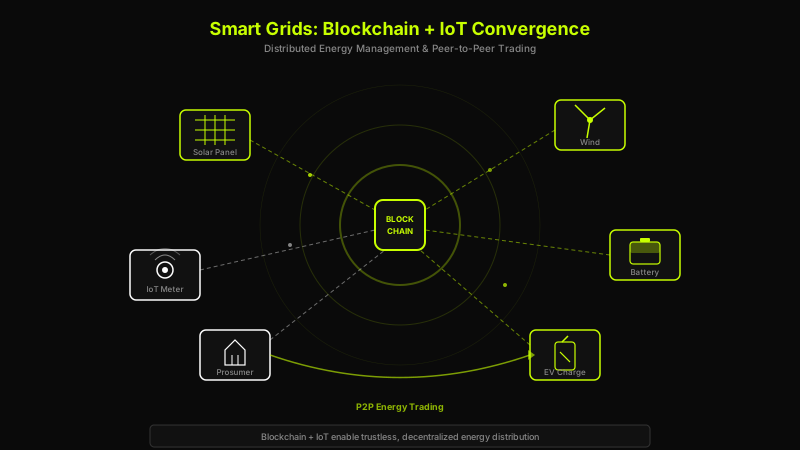
The global energy landscape is undergoing a fundamental transformation. Centralized power plants and one-directional grids — the architecture that powered the 20th century — are giving way to distributed systems where millions of small-scale producers, consumers, and storage units interact in real time. The challenge is coordination: how do you manage a grid where energy flows in every direction, where a rooftop solar panel in suburban Sydney can sell kilowatt-hours to an electric vehicle charging station three blocks away? The answer is increasingly clear — blockchain and IoT, working together.
The Smart Grid Challenge
Traditional grids were designed for simplicity: large power plants generate electricity, transmission lines carry it over long distances, and distribution networks deliver it to end consumers. Metering happens monthly, billing is retrospective, and the utility company sits at the center of every transaction. This model worked when energy flowed in one direction. It breaks down when millions of rooftop solar installations, home batteries, and electric vehicles turn consumers into producers.
The International Energy Agency estimates that distributed energy resources will account for over 25% of global power capacity by 2030. Managing this complexity requires real-time visibility into energy production and consumption at every node, automated settlement of millions of micro-transactions, and a trust layer that works without a central authority bottleneck. Neither legacy SCADA systems nor traditional database architectures were designed for this. Smart grids need a fundamentally different infrastructure.
Blockchain's Role in Energy Distribution
Blockchain brings three critical capabilities to energy systems. First, it provides an immutable, shared ledger where every energy transaction — generation, transfer, consumption — is recorded transparently and cannot be altered retroactively. This is essential in markets where disputes about who produced or consumed what energy can involve significant financial stakes.
Second, smart contracts automate the rules of energy trading. A prosumer can define conditions — sell excess solar energy when battery storage exceeds 80%, price per kilowatt-hour adjusts based on time-of-day demand, prioritize selling to neighbors before exporting to the main grid — and the smart contract executes these rules automatically, settling payments in real time without human intervention or utility company mediation.
Third, blockchain enables tokenization of energy assets. Renewable Energy Certificates (RECs), carbon credits, and even fractional ownership of community solar installations can be represented as tokens on a blockchain, making them tradeable, auditable, and accessible to smaller market participants who were previously excluded from energy markets. Xcapit has extensive experience building these kinds of tokenized systems — our work in blockchain development covers exactly these types of distributed, multi-party architectures.
IoT Sensors and Real-Time Metering
If blockchain is the trust layer, IoT is the sensory nervous system. Smart meters, environmental sensors, inverter monitors, and grid frequency analyzers generate the data that feeds into the blockchain. Without accurate, real-time data from IoT devices, the blockchain would be recording transactions based on estimates and approximations — defeating the purpose of having an immutable ledger.
- Smart meters with sub-second sampling: Modern IoT-enabled meters can record energy flows at intervals of 100 milliseconds or less, capturing the highly dynamic nature of renewable generation — a cloud passing over a solar panel array can change output by 50% in seconds.
- Edge computing at the device level: Rather than sending all raw data to a central server, IoT sensors increasingly process data locally, submitting only validated, aggregated readings to the blockchain — reducing bandwidth requirements and improving response times.
- Tamper-evident hardware: IoT meters designed for blockchain integration include cryptographic signing at the hardware level, ensuring that data submitted to the blockchain has not been manipulated between measurement and recording.
- Environmental monitoring: Temperature, humidity, wind speed, and solar irradiance sensors provide context data that helps predict energy generation and validate reported production figures against what was physically possible.
The convergence of IoT and blockchain solves the oracle problem that plagues many blockchain applications: how do you get trustworthy real-world data onto a blockchain? In energy systems, the answer is purpose-built IoT hardware with cryptographic attestation, combined with redundant measurements and anomaly detection algorithms that flag suspicious readings before they are committed to the ledger.
Peer-to-Peer Energy Trading
Peer-to-peer (P2P) energy trading is arguably the most transformative application of the blockchain-IoT stack in energy. Instead of selling excess solar energy back to the utility at wholesale rates (often a fraction of retail price), a homeowner can sell directly to a neighbor at a mutually beneficial price — higher than wholesale but lower than retail. The smart contract handles matching, pricing, metering, and settlement automatically.
The Brooklyn Microgrid project in New York was one of the earliest demonstrations of this concept, allowing residents with solar panels to sell excess energy to neighbors via an Ethereum-based platform. Similar projects have since launched in Australia (Power Ledger), Germany (Lition), Thailand (T77 precinct), and Bangladesh (SOLshare). The common thread is that blockchain removes the need for a centralized market operator, while IoT metering ensures accurate accounting.
For utilities and grid operators, P2P trading does not mean obsolescence. Instead, their role shifts from monopoly energy provider to platform operator and grid stability manager. They maintain the physical infrastructure, ensure grid frequency and voltage remain within safe parameters, and earn fees for facilitating the platform — a business model more aligned with the physics of distributed energy. The energy sector is one of the industries where we see the greatest potential for this type of digital transformation.
Implementation Considerations
Deploying blockchain-IoT smart grid solutions is not without significant challenges. Organizations considering these implementations should account for several critical factors:
- Scalability: Energy grids can involve millions of nodes generating transactions every few seconds. Public blockchains like Ethereum mainnet cannot handle this throughput at acceptable cost. Most production deployments use permissioned chains (Hyperledger Fabric, Energy Web Chain) or Layer 2 solutions that batch transactions before settling on a main chain.
- Regulatory compliance: Energy markets are heavily regulated. P2P trading requires regulatory approval that does not exist in many jurisdictions. Implementers must work closely with energy regulators, often participating in regulatory sandboxes before full deployment.
- Legacy integration: Existing grid infrastructure represents trillions of dollars in investment. Blockchain-IoT solutions must integrate with existing SCADA, EMS, and billing systems rather than replacing them — a brownfield reality that adds complexity.
- Cybersecurity: Connecting critical energy infrastructure to distributed networks creates new attack surfaces. IoT devices are notoriously vulnerable, and a compromised meter feeding false data to a blockchain could have cascading effects on grid stability. Security must be designed in from day one.
- Interoperability: Multiple blockchain platforms, IoT protocols, and energy standards must work together. Standardization efforts like the Energy Web Foundation's tech stack aim to address this, but the ecosystem remains fragmented.

Antonella Perrone
COO
Previously at Deloitte, with a background in corporate finance and global business. Leader in leveraging blockchain for social good, featured speaker at UNGA78, SXSW 2024, and Republic.
Exploring energy transformation?
See how we connect demand forecasting, transformer digital twins, traceability, and smart-grid software into a practical utility roadmap.
You Might Also Like
If you can't measure it, you can't monetize it: the Córdoba and EPEC lesson applied to environmental assets in agriculture
Measure, certify and monetize. The three pillars we validated tokenizing renewable energy with EPEC, and how they transfer to the field to standardize green credits.
Digital transformation for utilities: modernizing energy without replacing the core
A practical guide for utilities and energy companies: how to integrate SCADA, IoT, AI, tokenization, and cybersecurity to modernize operations without replacing critical systems.
Custom Software for Energy & Utilities: Digital Transformation Guide
How custom software is transforming the energy and utilities sector. Covers smart grid management, energy tokenization, IoT and SCADA integration, ESG reporting, and real-world case studies.