
If you strip away the speculation and the hype cycles, supply chain management is arguably blockchain's strongest non-financial use case. The reason is structural: supply chains are multi-party systems where no single entity controls the entire flow of goods, documents, and payments. They run on trust — and trust is exactly what breaks down when you have dozens of participants across multiple countries, each maintaining their own records in their own systems.
Unlike many blockchain applications searching for a problem to solve, supply chain management presents problems that are a near-perfect fit for distributed ledger technology. This article examines why, how, and where blockchain is delivering real value in supply chains today — and where it falls short.
Why Supply Chains Need Blockchain
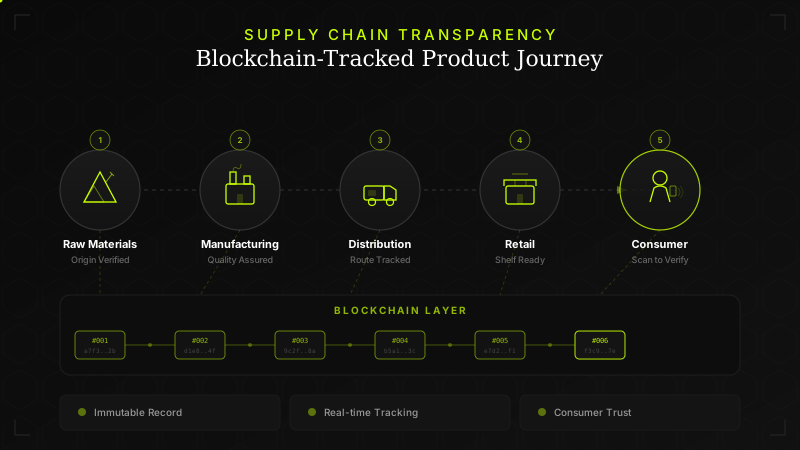
Modern supply chains are vast, fragmented, and surprisingly opaque. A single consumer product might pass through 10 to 30 intermediaries between raw material extraction and the retail shelf. At each handoff, information is recorded in separate systems — ERPs, spreadsheets, paper logs, email threads — creating silos that are difficult to reconcile and easy to manipulate.
The core problems are well-documented:
- Opacity: End-to-end visibility across a supply chain is rare. Brands often cannot trace their products beyond their tier-1 suppliers, leaving blind spots where quality failures, labor violations, or environmental damage go undetected.
- Counterfeiting: The OECD estimates that counterfeit goods represent up to 2.5% of world trade — roughly $500 billion annually. Pharmaceuticals, electronics, luxury goods, and food products are all heavily affected, and traditional authentication methods (holograms, serial numbers) are increasingly easy to replicate.
- Inefficiency: Manual document processing, redundant data entry, and reconciliation across systems consume enormous time and resources. In global trade, a single shipment can generate over 200 separate communications and involve more than 25 different organizations.
- Disputes: When something goes wrong — a delayed shipment, a quality defect, a missing payment — determining responsibility is difficult because each party has their own version of events recorded in their own system. Dispute resolution is slow, expensive, and often adversarial.
These are not technology problems in the traditional sense. They are coordination problems among parties who need to collaborate but do not fully trust each other. That distinction is critical — it is precisely the scenario blockchain was designed to address.
How Blockchain Solves Supply Chain Problems
Immutable Traceability
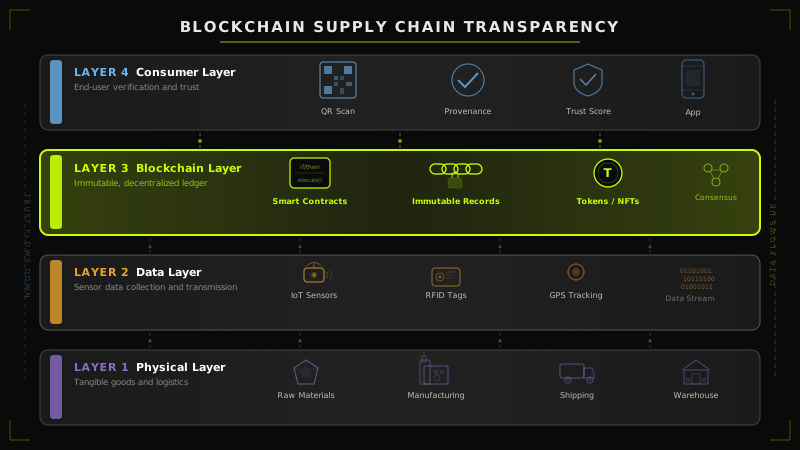
At its most fundamental, blockchain provides an append-only ledger that no single participant can alter retroactively. Every transaction — a goods transfer, a quality inspection, a customs clearance — is recorded with a timestamp and cryptographic proof. Once written, the record cannot be changed without detection.
This creates a complete, tamper-evident audit trail from origin to destination. If a food safety issue arises, the source can be traced in seconds rather than days. If a dispute occurs over delivery timing, the blockchain record provides an objective, mutually agreed-upon timeline. The value is not just in the data itself, but in the shared certainty that the data has not been tampered with.
Smart Contract Automation
Smart contracts encode business rules as self-executing code on the blockchain. In supply chain contexts, this means automating processes that currently require manual verification and trust between parties.
For example, a smart contract can automatically release payment to a supplier when an IoT sensor confirms that goods arrived at the correct temperature within the agreed timeframe. No invoice processing, no back-and-forth emails, no 60-day payment terms — the contract executes when conditions are met. This reduces processing time from weeks to minutes and eliminates disputes over whether conditions were satisfied.
Other common applications include automatic penalty calculations for SLA violations, escrow mechanisms for high-value goods transfers, and conditional release of documents (bills of lading, certificates of origin) upon verified events.
Shared Truth Without Shared Trust
Traditional supply chain digitization efforts often fail because they require all parties to adopt the same platform — effectively asking competitors to trust one company with their data. Blockchain sidesteps this problem by providing a neutral infrastructure where data integrity is guaranteed by cryptography and consensus, not by a central authority.
Participants can share the specific data points needed for coordination (shipment status, quality certifications, payment confirmations) while keeping proprietary information (pricing, supplier relationships, internal processes) private. This selective transparency is essential for real-world adoption, where competitive dynamics make full openness impractical.
Tokenized Assets and Certificates
Blockchain enables the creation of digital tokens that represent physical assets, rights, or certifications. In supply chains, this has powerful applications: a token can represent a specific batch of goods as it moves through the chain, carrying with it all associated quality data, certifications, and ownership history.
Tokenization also enables fractional ownership of high-value cargo, tradeable certificates of origin, and digital representations of carbon credits or sustainability certifications. These tokens are verifiable, transferable, and cannot be double-spent — solving the persistent problem of duplicate or fraudulent certificates in global trade.
Real-World Implementations
The difference between blockchain theory and blockchain practice is where most discussions fall apart. Here are sectors where blockchain supply chain solutions have moved beyond pilots into production deployments with measurable results.
Food Safety and Traceability
Food traceability was one of the earliest and most successful blockchain supply chain applications. The IBM Food Trust network, launched in partnership with Walmart, demonstrated that blockchain could reduce the time to trace a food product from farm to store from 7 days to 2.2 seconds. That speed matters: during a foodborne illness outbreak, every hour of delay in identifying the source means more people get sick and more product gets unnecessarily recalled.
Since then, major food companies including Nestle, Dole, Tyson Foods, and Carrefour have deployed blockchain traceability for specific product lines. Consumers can scan a QR code and see the complete journey of their food — where it was grown, when it was harvested, how it was transported, and every quality check along the way. The business case is compelling: faster recall response, reduced waste, fewer fraudulent claims (such as mislabeled organic products), and increased consumer trust.
Pharmaceutical Track and Trace
The pharmaceutical industry faces a $200 billion annual counterfeiting problem, with the WHO estimating that up to 10% of medicines in low- and middle-income countries are substandard or falsified. Regulatory frameworks like the US Drug Supply Chain Security Act (DSCSA) and the EU Falsified Medicines Directive mandate end-to-end traceability for prescription drugs.
Blockchain provides a natural solution: each unit of medication receives a unique identifier recorded on a distributed ledger. At every point in the supply chain — manufacturer, distributor, pharmacy — the product is scanned and verified against the blockchain record. Any gap in the chain of custody or attempt to introduce counterfeit product is immediately detectable. Companies like MediLedger have built production systems processing millions of verification events for major pharmaceutical manufacturers.
Luxury Goods Authentication
The luxury goods market loses an estimated $30 billion annually to counterfeiting. Traditional authentication relies on physical markers (holograms, serial numbers, RFID tags) that sophisticated counterfeiters can replicate. Blockchain shifts authentication from physical to digital: each product receives a unique digital identity on the blockchain at the point of manufacture, creating a provenance record that accompanies the item through its entire lifecycle.
LVMH, Prada, and Richemont jointly created the Aura Blockchain Consortium specifically for this purpose. Customers can verify authenticity, view the product's history, and transfer ownership — critical for the $33 billion luxury resale market where authentication is the primary buyer concern.
Cross-Border Trade Finance
International trade still runs on paper. A single cross-border shipment can involve 30+ paper documents — bills of lading, letters of credit, certificates of origin, customs declarations — that must be physically transported, manually verified, and reconciled across multiple banks and intermediaries. The ICC estimates that this paperwork adds 5-10% to the cost of global trade.
Blockchain trade finance platforms digitize these documents and automate their verification. Marco Polo, Contour, and TradeLens (before its sunset) demonstrated that blockchain could reduce trade document processing time from 5-10 days to under 24 hours. The key insight is that trade documents are essentially multi-party agreements — perfect candidates for blockchain-based smart contracts that execute when all parties have fulfilled their obligations.
Energy and Carbon Credit Trading
The intersection of energy, sustainability, and blockchain represents one of the most promising and rapidly evolving supply chain applications. Renewable Energy Certificates (RECs) and carbon credits are essentially supply chain products — they originate at a point of generation, pass through intermediaries, and are consumed by end buyers. The entire process depends on traceability and the prevention of double-counting.
At Xcapit, we built a three-token energy tokenization platform for EPEC (the electricity company of the Province of Cordoba, Argentina) and the provincial government. The system tracks renewable energy from generation at solar parks through to the issuance of verifiable RECs on blockchain. Each token represents a different dimension — participation in the generation project, economic utility from energy injected into the grid, and sustainability attributes that accumulate toward REC issuance. The platform integrates with the government's digital identity system, enabling verified citizen participation in distributed energy projects. This project demonstrated that blockchain can bridge the gap between physical energy generation and digital certificate markets with full traceability.
Similar initiatives are emerging globally. Energy Web Foundation provides blockchain infrastructure for the energy sector, and voluntary carbon markets are increasingly moving to blockchain-based registries to address the credibility crisis around carbon offset quality and double-counting.
Technical Architecture Patterns
Implementing blockchain in supply chains requires careful architectural decisions. The right choices depend on your specific requirements for privacy, performance, cost, and decentralization.
Permissioned vs. Public Chains
Most enterprise supply chain implementations use permissioned (private or consortium) blockchains rather than public networks. The reasons are practical: supply chain participants need to control who can read and write data, transaction throughput requirements often exceed public chain capacity, and regulatory compliance may require data residency controls.
Hyperledger Fabric remains the most widely deployed framework for permissioned supply chain networks, with its channel architecture providing data isolation between subsets of participants. However, the trend is shifting toward hybrid approaches — anchoring critical proofs on public chains (Ethereum, Polygon) for maximum immutability while keeping detailed operational data on permissioned networks or off-chain storage.
On-Chain vs. Off-Chain Data
A common mistake in blockchain supply chain projects is trying to put too much data on-chain. Blockchains are optimized for consensus and immutability, not for data storage. Storing large datasets (images, detailed inspection reports, IoT sensor streams) directly on-chain is expensive and slow.
The established pattern is to store data off-chain (in traditional databases, IPFS, or cloud storage) and record only a cryptographic hash on the blockchain. The hash serves as a tamper-evident fingerprint — if the off-chain data is altered, the hash will no longer match, revealing the tampering. This approach preserves the integrity guarantee while keeping costs manageable and performance acceptable.
IoT Integration
Blockchain's immutability guarantee is only as strong as the data that enters the system. In supply chains, this means integrating with IoT devices — temperature sensors, GPS trackers, humidity monitors, weight scales — that provide objective, automated data entry rather than relying on manual human input.
The integration pattern typically involves IoT devices writing to an edge gateway, which aggregates and signs data before submitting it to the blockchain. Hardware-based security modules (HSMs) or trusted execution environments (TEEs) at the device level can provide additional assurance that the data was generated by a legitimate device and has not been tampered with in transit. This combination of IoT and blockchain creates what practitioners call 'trustworthy data pipelines' — automated, tamper-evident data flows from the physical world to the digital ledger.
Interoperability
Real-world supply chains span multiple industries, geographies, and technology ecosystems. A blockchain solution that cannot communicate with other blockchain networks or traditional enterprise systems has limited practical value.
Interoperability operates at multiple levels: cross-chain bridges for connecting different blockchain networks, API layers for integrating with ERPs and legacy systems, and data standards (GS1, EPCIS) for ensuring that supply chain events are recorded in a universally interpretable format. Projects that invest in interoperability from the start avoid the trap of creating yet another data silo — which would defeat the entire purpose of the exercise.
Common Pitfalls
For every successful blockchain supply chain project, there are several that failed or stalled. The failures tend to cluster around a few recurring mistakes:
- Using blockchain as a database: If your primary need is to store and query large amounts of data, a traditional database will outperform blockchain by orders of magnitude. Blockchain adds value only when you need tamper-evidence and multi-party consensus. If a single organization controls all the data, you do not need blockchain.
- Ignoring the oracle problem: Blockchain guarantees the integrity of data once it is on-chain, but it cannot guarantee the accuracy of data at the point of entry. If a supplier lies about a product's origin or an inspector falsifies a quality report, the blockchain will faithfully record that false information immutably. IoT integration, third-party verification, and economic incentive design are essential to address this gap.
- Over-decentralization: Not every process in a supply chain needs to be decentralized. Some decisions are legitimately centralized (a manufacturer setting quality standards for their products, for example). Forcing decentralization where it adds no value increases complexity and cost without corresponding benefit. Design for the minimum viable decentralization that solves the actual trust problem.
- Poor UX for non-technical participants: Supply chains involve warehouse workers, truck drivers, customs officials, and small farmers — not blockchain engineers. If using the system requires understanding wallets, private keys, or gas fees, adoption will fail. Successful implementations abstract away the blockchain layer entirely, presenting users with familiar interfaces (mobile apps, QR scanners, web portals) that happen to be backed by blockchain infrastructure.
- Underestimating governance: Technology is the easy part. The hard part is getting competing organizations to agree on data standards, access rules, dispute resolution mechanisms, and cost sharing. Projects that launch the technology before establishing governance frameworks invariably stall when the first real disagreement arises.
Is Blockchain Right for Your Supply Chain?
Blockchain is not a universal solution. It is a specific tool that excels in specific conditions. Before investing in a blockchain supply chain project, evaluate your situation against these criteria:
- Multiple parties who need to share data but do not fully trust each other — if a single entity controls the entire process, a centralized database is simpler and cheaper
- A genuine need for tamper-evident records — if no one has incentive to falsify data, the immutability guarantee adds cost without value
- High cost of disputes or verification under the current system — if reconciliation and dispute resolution consume significant time and money, blockchain's shared truth can deliver measurable ROI
- Regulatory requirements for traceability or provenance — when regulations mandate end-to-end tracking (pharmaceuticals, food safety, conflict minerals), blockchain provides a compliance-ready infrastructure
- An ecosystem willing to participate — blockchain is a network technology; a network of one has no value. You need critical mass among your supply chain partners
- Existing digital maturity — if your partners still operate on paper, the first investment should be basic digitization, not blockchain. You cannot build on a foundation that does not exist
If three or more of these criteria apply to your situation, blockchain is likely worth evaluating. If fewer than three apply, a traditional centralized solution will probably serve you better at lower cost and complexity.
Getting Started
The most successful blockchain supply chain projects start small: a single product line, a single trade corridor, a specific pain point with clear metrics. They prove value in a controlled scope, then expand. They invest in governance and stakeholder alignment before writing a single line of code. And they treat blockchain as infrastructure — invisible to end users, valuable for the trust guarantees it provides behind the scenes.
At Xcapit, we have built production blockchain solutions for supply chain and traceability challenges — from energy tokenization with government partners to digital asset platforms serving millions of users. Our blockchain development team combines deep protocol expertise with practical experience navigating the non-technical challenges of multi-stakeholder projects. If you are evaluating blockchain for your supply chain, we can help you determine whether it is the right fit and build a solution that delivers real value.

Santiago Villarruel
Product Manager
Industrial engineer with over 10 years of experience excelling in digital product and Web3 development. Combines technical expertise with visionary leadership to deliver impactful software solutions.
Building on blockchain?
Tokenization, smart contracts, DeFi — we've shipped it all.
You Might Also Like
Argentine Lithium Needs Verifiable Traceability — Or It Loses the EU and US Premium Market
How the EU Critical Raw Materials Act and US battery regulations are turning blockchain-based mineral traceability from a nice-to-have into a market access requirement.
The field's digital notary: what blockchain is (and why you don't need to understand the code to use it)
You don't need to know how a combine harvester's computer works to operate it. Blockchain is the same: a write-only record that guarantees provenance and cannot be forged.
If you can't measure it, you can't monetize it: the Córdoba and EPEC lesson applied to environmental assets in agriculture
Measure, certify and monetize. The three pillars we validated tokenizing renewable energy with EPEC, and how they transfer to the field to standardize green credits.