Xcapit Labs / ArgenTor
Intelligent Multi-Agent AI Orchestration in Rust
Agents that reason (ReAct), code autonomously with code intelligence, review code with 25+ rules, orchestrate full dev teams, and route to the optimal model by cost. 6 collaboration patterns, A2A protocol, WASM sandbox, and ISO 27001/42001 compliance.
Capabilities
What ArgenTor Does
ReAct Reasoning Engine
Agents don't just execute — they reason. Structured Think/Act/Observe/Reflect cycles let agents plan multi-step strategies, adapt to unexpected results, and explain their decisions. Self-evaluation scores every response on relevance, consistency, completeness, and clarity before delivery.
6 Collaboration Patterns
Pipeline, MapReduce, Debate, Ensemble, Supervisor, and Swarm patterns for multi-agent orchestration. Agents collaborate through typed message channels with backpressure, deadlock detection, and coordinated planning across complex workflows.
Cost-Aware Model Routing
Intelligent router sends simple tasks to fast models (Haiku, GPT-4o-mini) and complex tasks to powerful ones (Opus, o1). Budget tracking with automatic alerts, per-agent cost attribution, and 40-70% LLM cost reduction versus naive API usage.
A2A Protocol & Interoperability
Agent-to-Agent protocol for cross-platform interoperability. Your ArgenTor agents can discover, communicate with, and delegate tasks to agents on any A2A-compatible platform — breaking vendor lock-in.
Code Intelligence for 4 Languages
AST analysis for Rust, Python, TypeScript, and Go. Precise diff generation with LCS algorithm, automated code review with 25+ rules across 7 dimensions (security, performance, style, correctness, error handling, documentation, test coverage), implementation planning with DAG ordering, and test parsing with TDD automation.
Autonomous Dev Teams
Pre-configured development teams (FullStack, Minimal, Security) with 8 workflows: ImplementFeature, FixBug, Refactor, AddTests, SecurityAudit, CodeReview, Optimize, WriteDocumentation. Quality gates, per-role model recommendations, specialized system prompts, and role handoff protocols.
Quality
Engineering Excellence
85K+ Lines of Rust
14 modular crates across three architectural layers — orchestration, code intelligence, and compliance. Zero Clippy warnings. Strict linting enforces Rust best practices across the entire codebase.
1514 Passing Tests
Comprehensive test coverage spanning unit tests, integration tests, and end-to-end scenarios across all 14 crates. Code intelligence, autonomous dev teams, ReAct engine, and cost routing — every component tested in isolation and in composition.
14 LLM Provider Integrations
OpenAI, Anthropic, Google, Mistral, Cohere, local models, and more. Cost-aware routing automatically selects the optimal model for each task. Automatic fallback, load balancing, and per-agent budget tracking.
ISO 27001 & 42001 Compliant
Built-in compliance for ISO 27001 information security, ISO 42001 AI management, GDPR data handling, and DPGA digital public good standards. Compliance is architecture, not an afterthought.
Our Journey
Born from Real-World AI Agent Challenges
ArgenTor emerged from building AI agent systems for enterprise clients who needed intelligent, cost-efficient agents with security guarantees that existing frameworks couldn't provide.
The Problem
Building AI agents for enterprise clients, we found that existing Python-based frameworks offered no real security boundaries. Any agent could access any resource, making compliance impossible.
Architecture in Rust
Chose Rust for memory safety guarantees and WASM ecosystem maturity. Designed the 14-crate architecture with clear separation between orchestration, reasoning, sandboxing, communication, and compliance.
ReAct, A2A & Cost Routing
Added ReAct reasoning engine with self-evaluation, A2A protocol for cross-platform agent interoperability, and cost-aware model routing across 14 LLM providers. Built compliance modules for ISO 27001, ISO 42001, GDPR, and DPGA.
Code Intelligence & Autonomous Dev Teams
Grew to 14 crates, 85K+ lines of Rust, and 1514 tests. Added code intelligence (AST analysis for 4 languages, diffs, 25+ rule code review, TDD), autonomous dev teams with 8 workflows, MCP proxy orchestration hub with credential vault and token pool. Production deployments for enterprise automation and development teams.
Systems-Level Architecture
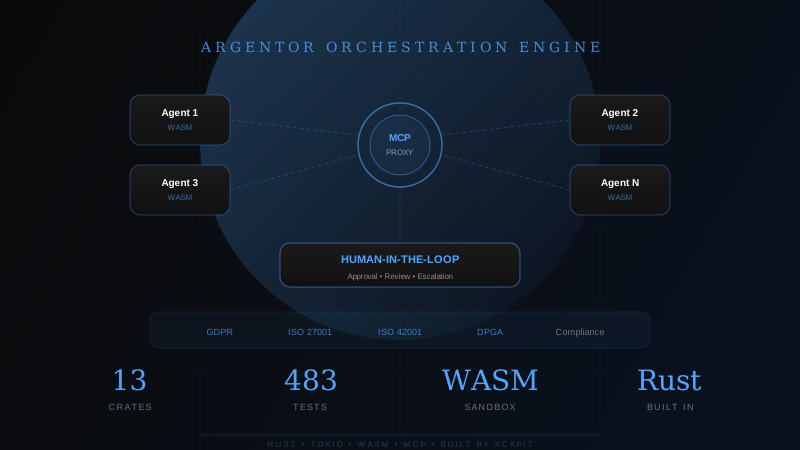
ArgenTor leverages Rust's safety guarantees and WASM's isolation model for enterprise-grade AI orchestration.
Zero-cost abstractions, memory safety without garbage collection, and Tokio async runtime for high-concurrency agent orchestration.
WebAssembly sandboxing via wasmtime with configurable memory limits, fuel metering, and capability-based permission model.
Model Context Protocol for standardized agent-to-tool communication. Centralized proxy with rate limiting, audit logging, and policy enforcement.
Roadmap
Vision 2026
ArgenTor is becoming the standard for intelligent, cost-efficient, and compliant AI agent orchestration in enterprise and government.
Use Cases
Who Uses ArgenTor
Enterprise Automation
Companies deploy multi-agent systems for document processing, customer service, and internal workflow automation — with security boundaries that satisfy compliance teams.
Autonomous Code Dev Teams
Development teams deploy autonomous dev teams that analyze code in 4 languages, generate precise diffs, run code review with 25+ rules, automate TDD cycles, and plan implementations with DAG ordering. 8 pre-configured workflows with quality gates and human-in-the-loop approvals.
Compliance-Heavy Industries
Finance, healthcare, and government organizations run AI agents with built-in compliance for GDPR, ISO 27001, and sector-specific regulations.
FAQ
Frequently Asked Questions
Why Rust instead of Python?
Rust provides memory safety guarantees without garbage collection, making it ideal for security-critical AI infrastructure. WASM sandboxing, compile-time error prevention, and zero-cost abstractions mean ArgenTor agents run faster and more safely than Python alternatives. With 14 crates, 85K+ lines, and 1514 tests, ArgenTor is production-grade infrastructure, not a prototype.
What is ReAct reasoning and self-evaluation?
ReAct (Reason + Act) gives agents structured Think/Act/Observe/Reflect cycles so they plan before acting and learn from results. Self-evaluation scores every response on relevance, consistency, completeness, and clarity before delivering it to users — catching errors and hallucinations automatically.
How does cost-aware model routing work?
ArgenTor's intelligent router analyzes each task's complexity and routes it to the optimal model across 14 LLM providers. Simple tasks go to fast, cheap models (Haiku, GPT-4o-mini). Complex reasoning goes to powerful models (Opus, o1). Budget tracking with automatic alerts and per-agent cost attribution typically reduces LLM costs by 40-70%.
What is the A2A protocol?
Agent-to-Agent (A2A) is a cross-platform interoperability protocol. Your ArgenTor agents can discover, communicate with, and delegate tasks to agents on any A2A-compatible platform — whether they're built with LangChain, CrewAI, or custom frameworks. This prevents vendor lock-in and enables multi-vendor agent ecosystems.
Ready to build secure AI agent systems?
Whether you need enterprise automation, development workflows, or compliance-grade AI orchestration — ArgenTor provides the secure foundation.