

There is a scene that repeats itself in almost every company that has started working with AI. The pilot works and the demo impresses the board. Six months later, that same pilot is still sitting in a notebook, running on test data, and nobody is quite sure what it would take for the operations team to use it at nine o'clock on Monday morning.
This isn't a talent problem or a technology problem. It's that a pilot and a production system are two different things, and they are almost never designed with the second in mind. These are the seven points where we see projects get stuck, and what to do about each one.
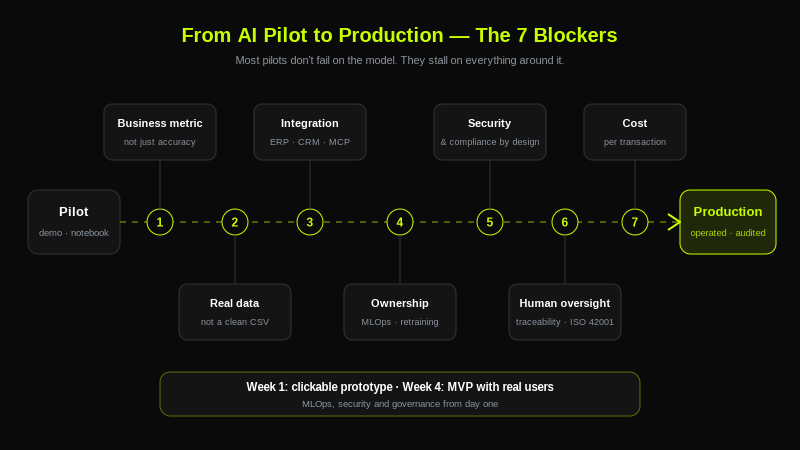
1. There's no business metric, only a model metric
"The model has 92% accuracy" tells nothing to the person who has to approve the production budget. The question that unblocks the project is a different one: which business number does it move? It could be hours saved per week, claims resolved without human intervention, waste avoided, or response time.
What to do: before writing any code, define a business metric, its current baseline, and the threshold at which the project is worth it. If it can't be measured, it isn't a project yet: it's an exploration, and that's fine, but it should be called what it is.
2. The pilot uses data that doesn't exist in production
The pilot dataset is usually clean, historical, and assembled by hand. Production data arrives incomplete, in different formats, with delays, and from systems nobody documented. The model that shone on the CSV falls apart on the real feed.
What to do: work with a sample of real production data from the start, even a small one, and design the data pipeline as part of the product, not as a prior step that will "be ready eventually".
3. Integration with real systems is left for last
An agent or a model that neither reads from nor writes to the ERP, the CRM, or the ticketing system is a standalone tool, and standalone tools don't get adopted. Integration is usually the longest and most underestimated part of the project.
What to do: prototype the integration in the first week, even with a single end-to-end flow. Protocols such as MCP (Model Context Protocol) help connect models to existing systems in a controlled and auditable way.
4. Nobody owns the operation
Who watches the model when it starts to degrade? Who decides to retrain it? Who answers when it gives a customer the wrong answer? If the answer is "the vendor that built it" or "nobody", the system isn't ready for production.
What to do: set up MLOps from the pilot onward, with versioning of models and data, quality and drift monitoring, and a retraining process. And name an owner on the business side, not just the technical side.
5. Security and compliance arrive late
The project is finished, and only then does it go through information security or legal. Questions come up about personal data, about where the data travels, and about who can see what, and the launch stalls for months.
What to do: build security and compliance in from the design stage. Define what data the model can see, where it is processed (cloud, on-premise, or self-hosted models), and how every action is logged. It's much cheaper to design it right than to fix it later.
6. There's no human oversight or traceability
When an AI system makes or suggests decisions, someone has to be able to answer "why did it do this?". Without a record of every action, and without clear limits on what it can do on its own and what needs approval, the organization can't trust the system, and rightly so.
What to do: design the point of human intervention (what gets approved, what gets reviewed by sampling) and keep an auditable record of inputs, outputs, and actions. Frameworks such as ISO/IEC 42001, the international standard for AI management systems, organize exactly this: risk management, human oversight, and traceability.
7. The production cost was never calculated
In the pilot, inference cost is a minor line item. In production, with thousands of users and calls every minute, it can be the largest line in the project, especially with large language models.
What to do: estimate the cost per transaction from the start and design to keep it under control. You can route between models depending on the task, cache responses, use smaller models where they are enough, or deploy your own models when volume justifies it.
How we work at Xcapit
Our way of avoiding these seven blockers is simple to explain and demanding to execute:
- Week 1: a clickable mockup and an end-to-end flow with real data, to validate value and integration before investing more.
- Week 4: an MVP in the hands of real users, with the business metric measured against its baseline.
- From day one: MLOps, security by design, and governance aligned with ISO 42001, for which we have certification in progress, in addition to our ISO 27001 certification.
- The same project lead from start to finish, and the same quality control before every merge.
If you have a pilot stuck on any of these points, we can help you unblock it. Schedule a call or see how we work with AI in production.

Fernando Boiero
CTO & Co-Founder
Over 20 years in the tech industry. Founder and director of Blockchain Lab, university professor, and certified PMP. Expert and thought leader in cybersecurity, blockchain, and artificial intelligence.
Need intelligent AI agents for your business?
We build spec-driven autonomous agents that deliver real results.
You Might Also Like
MWC 2026: The Agentic Era Is No Longer a Promise — It's Strategy
Three lessons from Mobile World Congress 2026 redefining how enterprises adopt AI: from pilot to real value, from isolated agents to orchestrated enterprises, and why company size no longer matters.
From OpenClaw to Agentor: Building Secure AI Agents in Rust
How a security audit of an open-source AI agents framework revealed Python's limits and led us to build Agentor -- a Rust-based framework optimized for code generation.
Designing Autonomous Agents with LLMs: Lessons Learned
How we architect autonomous AI agents in production -- from perception-planning-execution loops to orchestration patterns, memory systems, and guardrails.